

2026 Top 100 Prospects
Pre-Season MLB Top 100 Prospects

This article was previously published on TJStats.ca
In this article I will highlight my MLB Top 100 Prospects prior to the start of the 2026 MLB Season. Each player will have a report and a graphic associated with them that includes information such as biographical data, MiLB statistics, and, most importantly, my scouting grades. These grades are on the traditional 20-80 Grade Scouting Scale and were determined through both statistical and video analysis.
As I learned through this process, the task of writing and compiling a Top Prospects list is not easy. The plethora of research required is time-consuming, and that does not consider the complexity of scouting. I have consumed countless amounts of baseball content in my life, and I would like to thank everyone that inspired and provided me the knowledge to undertake this project.
Let’s cover some important parts of my scouting process:
I defined an MLB Prospect as any player signed to a MLB Team:
that has no more than 130 AB or 50.0 IP
that has no more 45 total days on an active Major League roster
I used the 20-80 Scale for my scouting grades with Present Value (PV) and Future Value (FV) in the format of PV/FV
I have separated “Contact” and “Swing Decisions” into their own tool to more accurately highlight a batter’s strengths and weaknesses
“Game Power” refers to a batter’s game power — a term to describe their ability to translate their contact into damage
Some other notes:
The backend of any Top 100 Prospect list is extremely fluid, and mine is no exception. You could argue that close to 150 Prospects deserve the title of a Top 100 Prospect, and I would agree
As always, I encourage constructive criticism! I would be happy to discuss any prospect on this list or any others that you have questions about
I am human. Please inform me if I made a mistake!
Now, with that out of the way, we can get to the list. Enjoy!
Click here for an interactive version of my Top 100 Prospects List
2026 MLB Top Prospects
1) Konnor Griffin - SS - PIT
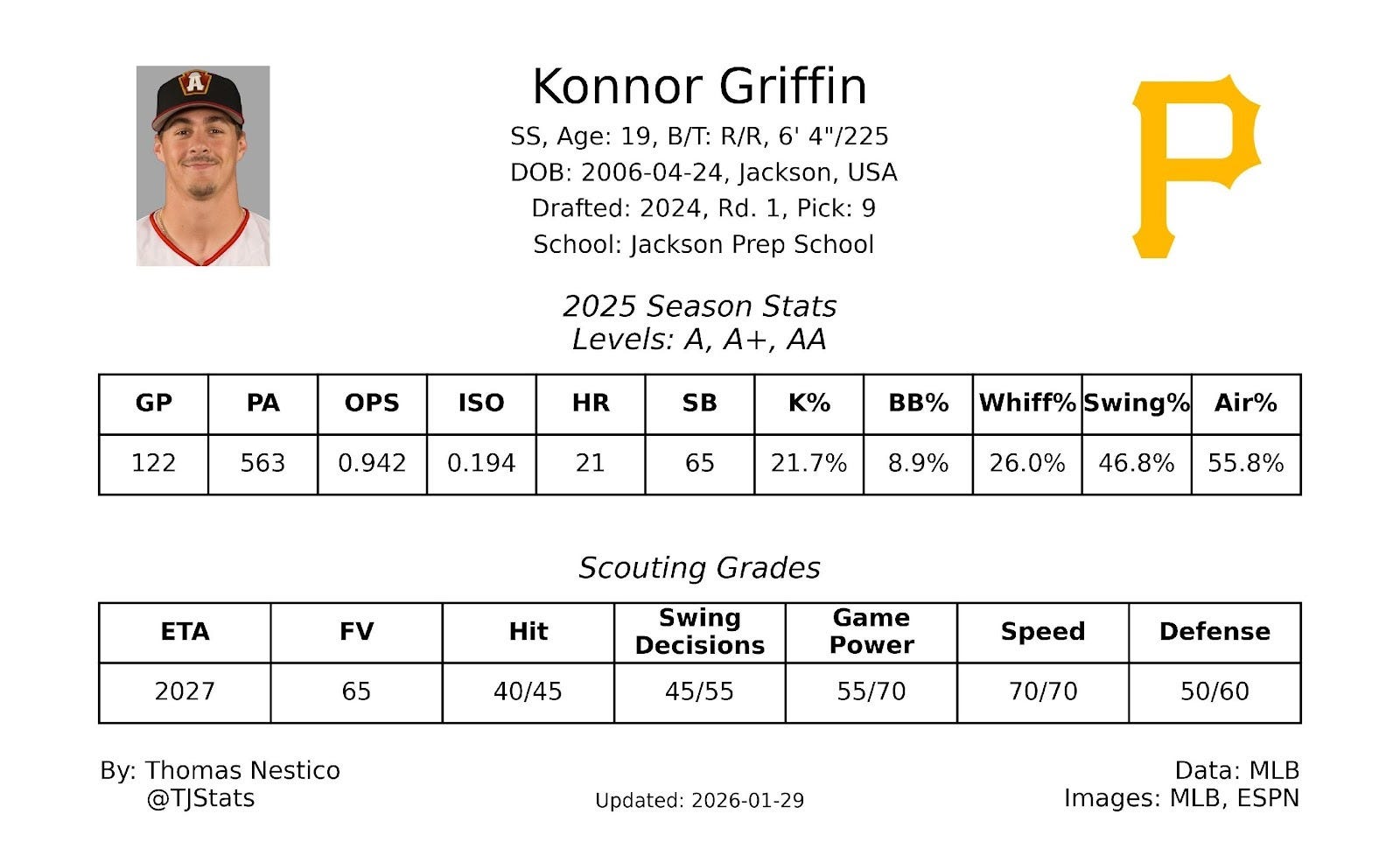
Konnor Griffin could not have drawn up a better pro debut. The #1 prep selection from the 2024 draft recorded a .942 OPS and stormed his way to AA while flashing his elite power and speed tools with 21 HR and 65 SB. His 107.9 90th% EV stood head and shoulder above his peers and there is still some room to fill out his 6’4” frame. The biggest knock against Griffin at draft was his longer swing action that posed potential contact and spray issues. Fortunately, he cleaned up his approach and opted for a more closed stance and compact swing which has greatly simplified his mechanics. He had no issues maintaining solid contact rates following each promotion and he was extremely stubborn at two strikes. The hit tool isn’t flawless though; Griffin struggled against breaking balls both in terms of whiffs and chase. His defensive capabilities raise his already exciting profile to extreme heights. He looked comfortable at both SS and CF and projects to be a dynamic defender up the middle. Griffin has entrenched himself as one of the best prospects in baseball this season and looks to be on the fast track to join Pittsburgh as soon as next season.
2) Kevin McGonigle - SS - DET
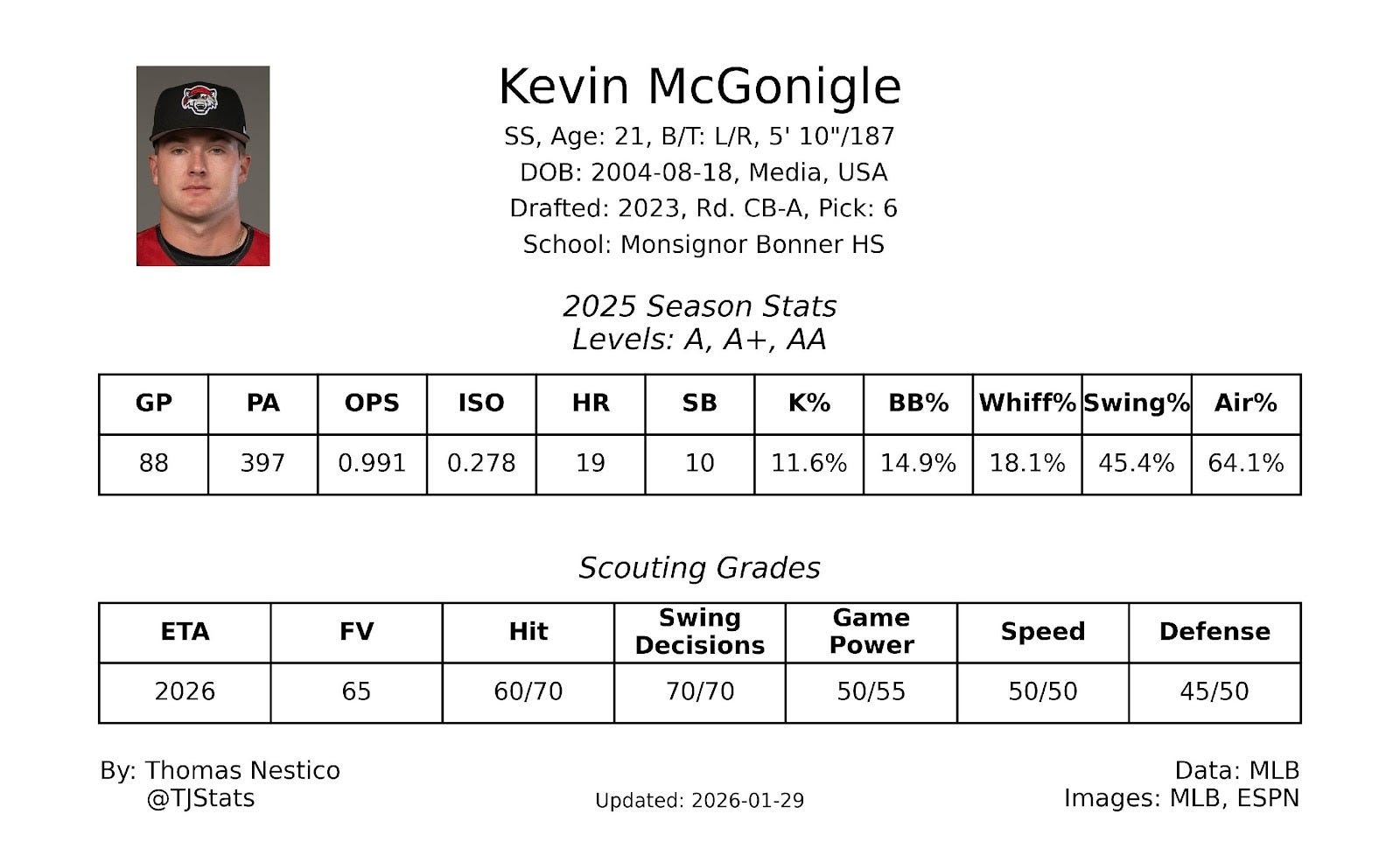
After suffering an ankle injury in the first game of the season that wiped out all of his April, Kevin McGonigle returned with a vengeance and continued to build off his exceptional pro debut. He is the best pure hitter in MiLB thanks to his incredible eye and ability to consistently impact all pitch types. He worked his way to AA and posted an exceptional .991 OPS in 88 Games while knocking in 19 HR while walking more than he struck out. He has a swing perfectly catered for loft and his smaller stature and compact levers allow him to get ahead of the ball and deposit it to the pull side. He has posted a 105.1 MPH 90th% EV and 46.7% HardHit rate while maintaining a stellar 81.9% contact rate, all marks well above average for a 21-year-old in AA. He won’t be slouch on the base paths and he projects to be a solid defender, even if his future is more likely at 2B rather than SS. Overall, McGonigle’s blend of bat control, pitch recognition, and developing power makes him one of the best prospects in MLB.
3) Carter Jensen - C - KC
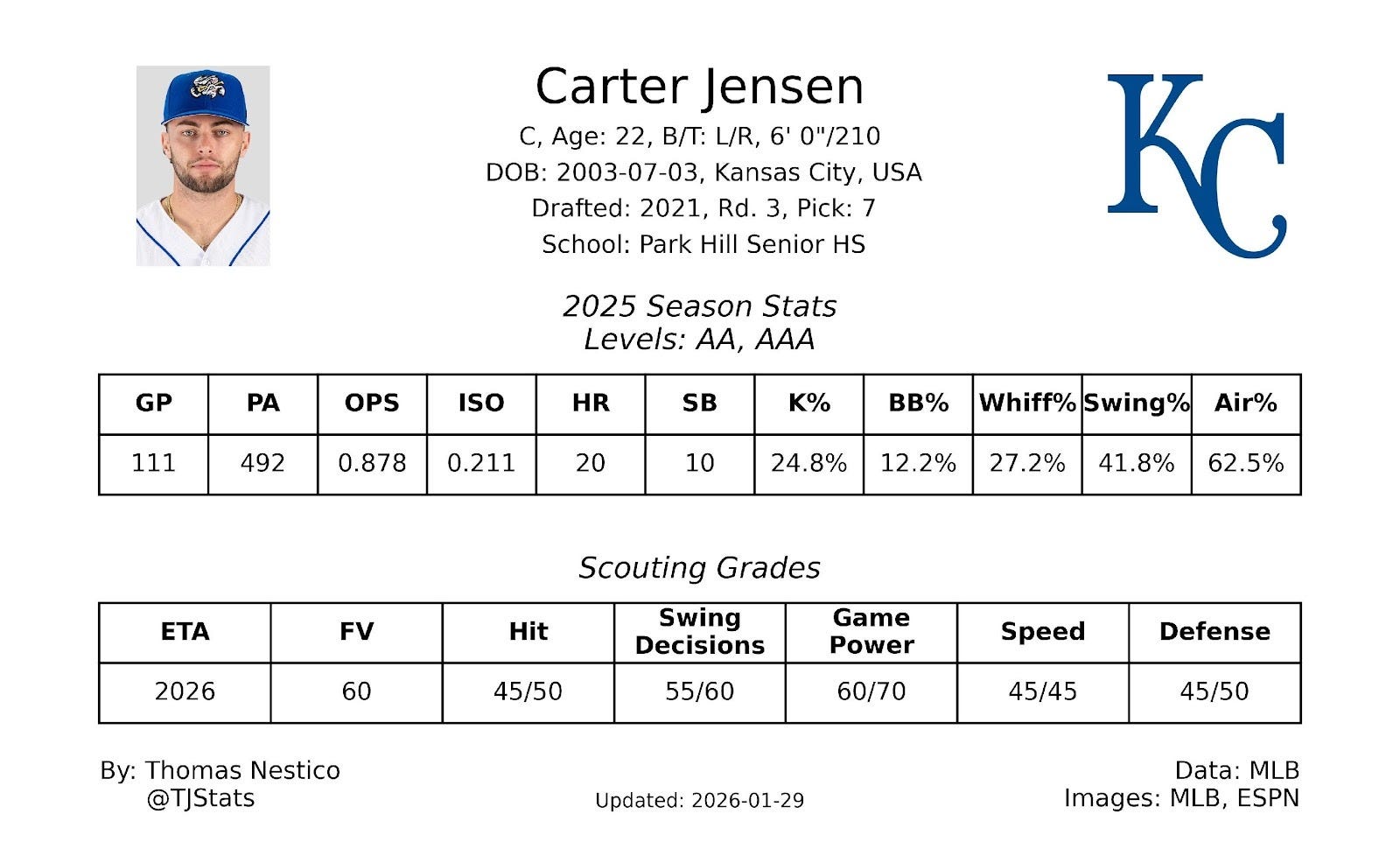
Carter Jensen looked to be having a repeat of his 2024 season after he had a good, but not great, stint in AA. His contact rates improved, however there was no indication that his power was manifesting how the Royals hoped. That all changed following his promotion to AAA where he started to sell out for power and the home runs came in bunches. He posted an incredible 1.051 OPS in 43 AAA games supported by a 61.8% HardHit rate and 107.3 MPH 90th% EV. Although his strikeouts spiked, he consistently barrelled up the ball while laying off outside pitches. He quickly became one of the premier slugging prospects in baseball all while showing flashes of improvements behind the dish, particularly with his framing. Jensen didn’t miss a beat in his cup of coffee in September and looks lined up to be the Royals long-term catcher entering 2026.
4) JJ Wetherholt - SS - STL
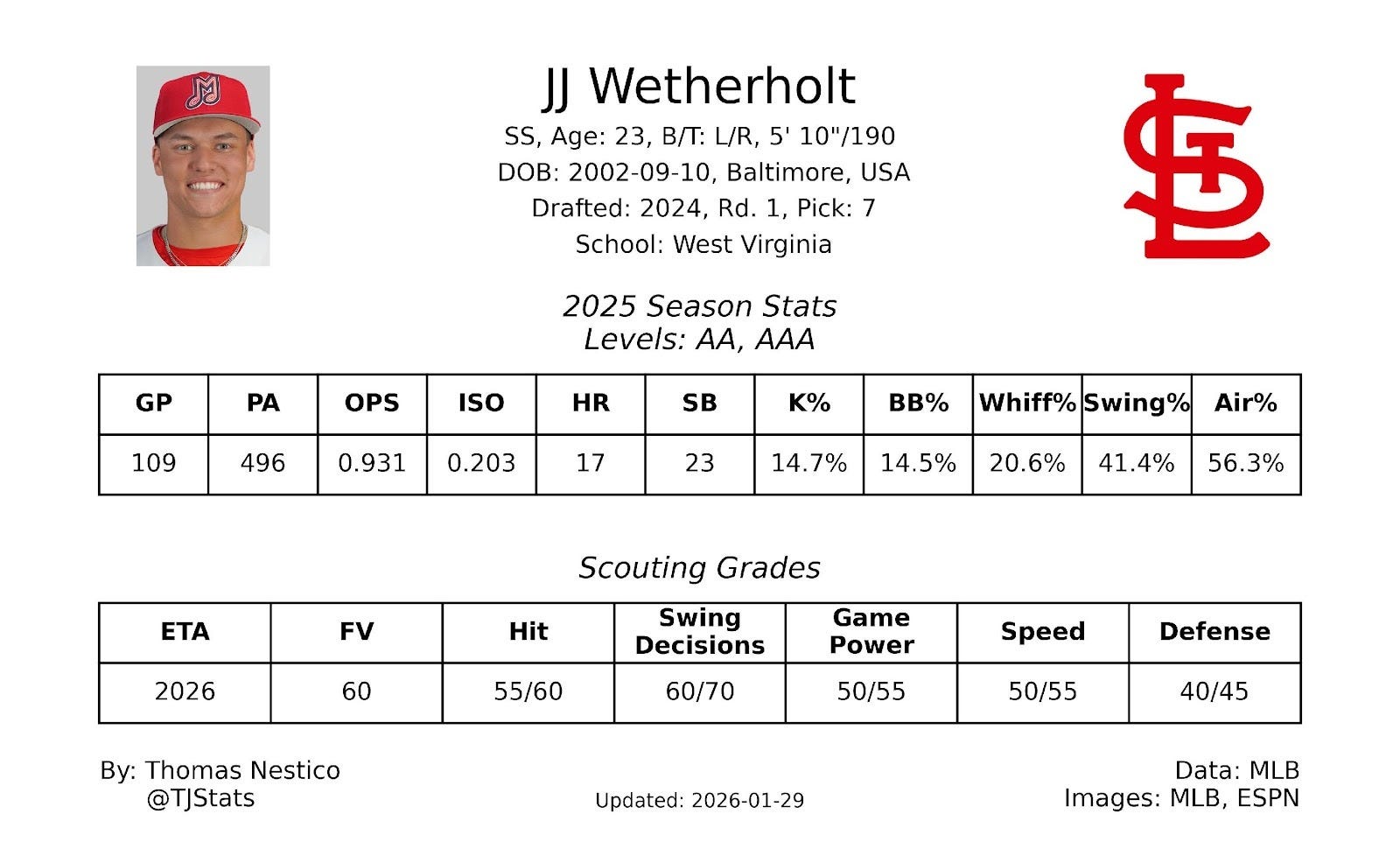
An undersized shortstop, JJ Wetherholt packs a punch from the left side thanks to his ability to land the barrel of the bat on the ball frequently. He has an incredibly stingy approach backed up by an excellent 17% O-Swing rate while not be overly passive against pitches in the zone. This approach has led him to walk more than he struck out as he worked his way to AAA just a year after his draft. He has solid bat control and his eye for laying off secondaries is sharp. Off speed pitches and high and inside fastballs give him the most trouble, par for the course for LHH. His offensive upside is well established, however there are concerns that his poor range will force him off of SS. He has the arm to stick at 3B with 2B being a fallback option if his lack of mobility continues to be a problem. All in all, Wetherholt is going to be a thorn in the side of many pitchers with the power to keep them honest.
5) Jesús Made - SS - MIL
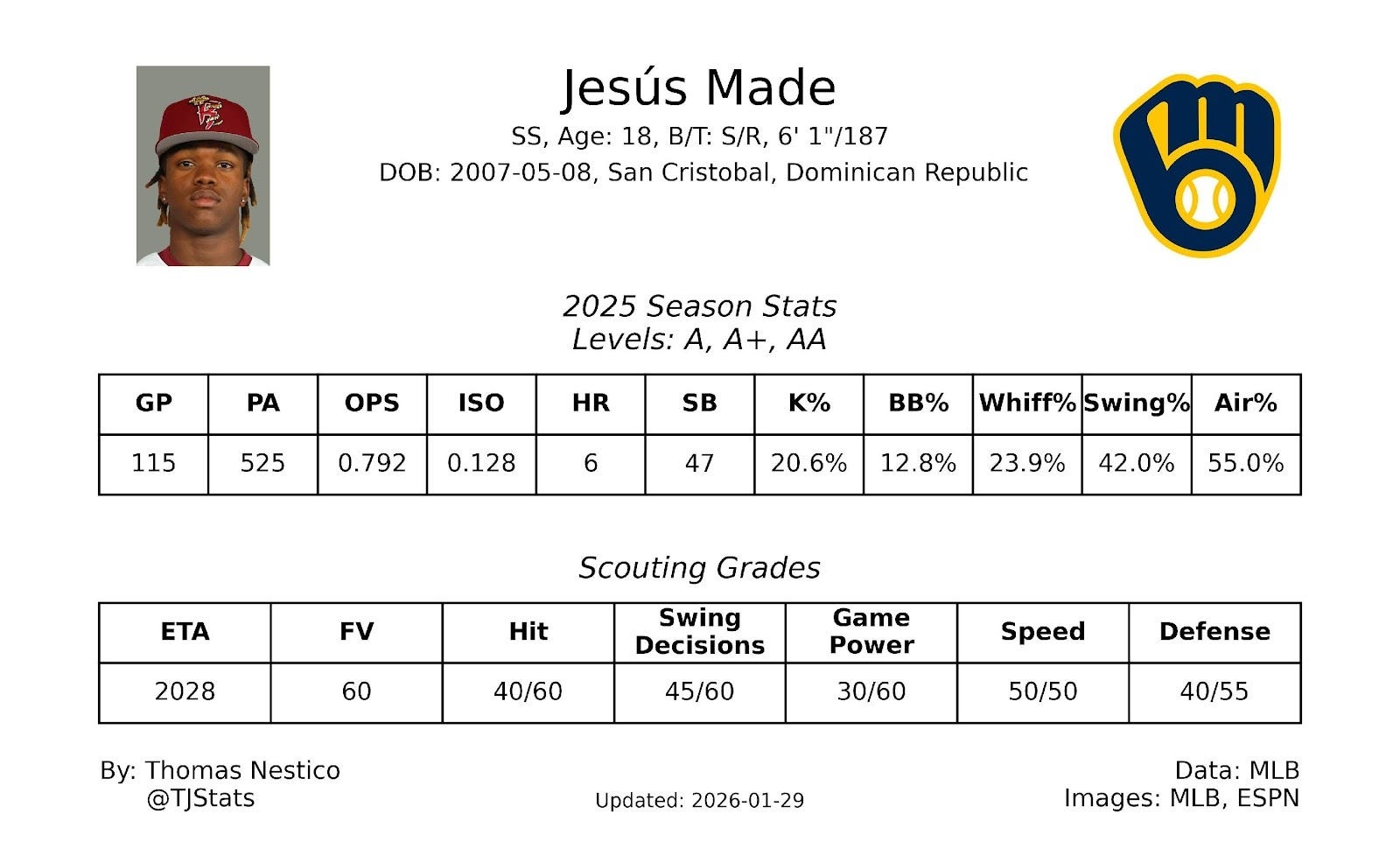
Jesus Made was the talk of the town in the DSL last season, posting a 167 wRC+ at 17 years old. The Brewers decided that he was ready for full season ball just a year later and thrusted him into Lo-A where he continued to excel, ultimately finishing in AA. The biggest thing that stands out about Made is how quick his hands move from both sides of the plate. His swing looks explosive and when he connects squarely (which is often) the outcome is typically stunning. Although it was just 6 HR this season, he impressed scouts and analysts alike with his demeanor, hit tool, and approach. Against competition multiple years his senior Made utilized his raw strength to drive baseballs all over the field. His ability to punish any type of pitch at such a young age in jaw-dropping. Standing at 6’1”, he doesn’t have too much room to fill out his frame, but the power he has exhibited indicates he can reach a plus-plus projection in that category. The biggest hurdle for Made is his less-than-ideal swing plane that has led to plenty of ground balls and an exorbitant number of pop-ups. On the defensive side of things, he projects to be a strong defender on the left side of the infield with the arm strength if a move to 3B is required. He is also an above average runner, racking up 47 SB this season. Overall, Made has all the tools to be the #1 prospect in baseball. As he continues to develop, he will need to add loft to his swing to tap into his tantalizing power.
6) Nolan McLean - P - NYM
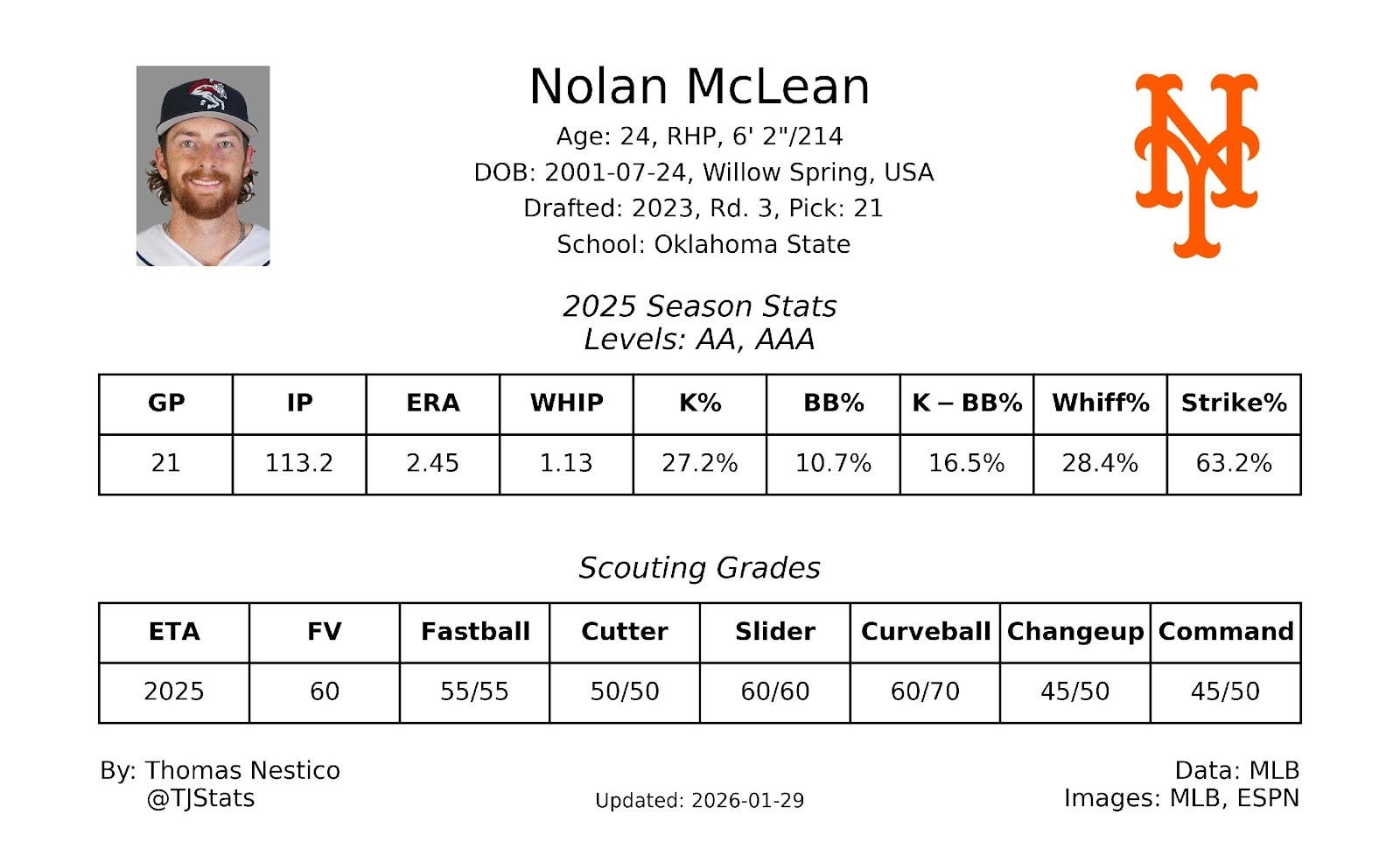
Nolan McLean’s development has been rather unprecedented. He was drafted as a two-way player out of Oklahoma State and did not start pitching full-time until mid-2024. Not even a year later he finds himself in MLB and excelling. His ability to spin the ball is otherworldly as he can eclipse 3000 RPM on his breaking balls and generate a ton of movement at higher velocities. McLean’s signature pitches are his sweeper and curveball that can each reach up to 20” of glove-side movement. His curve is one of the few potential 80 grade offerings in MLB. McLean wields a pair of fastballs, a sinker and a four-seamer, that each sit in the mid 90s. His sinker is his primary offering against RHH where its immense arm-side movement and slight deviation from his arm slot plays well on the inner third. He swaps his sinker for a four-Seamer against LHH where its extremely flat approach fools batters high in the zone. McLean also tosses a gyro cutter/slider that lives in the high 80s. It’s slight cutting action makes it effective damage mitigating offering against RHH. He rounds out his incredibly deep arsenal with a mid 80s changeup that generates above average depth with negative iVB. He is exhibiting improved command this season and doing a formidable job at getting ahead of batters early. McLean’s development and combination of stuff, athleticism, command, and versatility, all in an abridged timeframe, makes him one of the most exciting pitching prospects in MLB. There were concerns that he was more suited for a bullpen role, but he quelled most of those worries with his performance thus far.
7) Max Clark - OF - DET
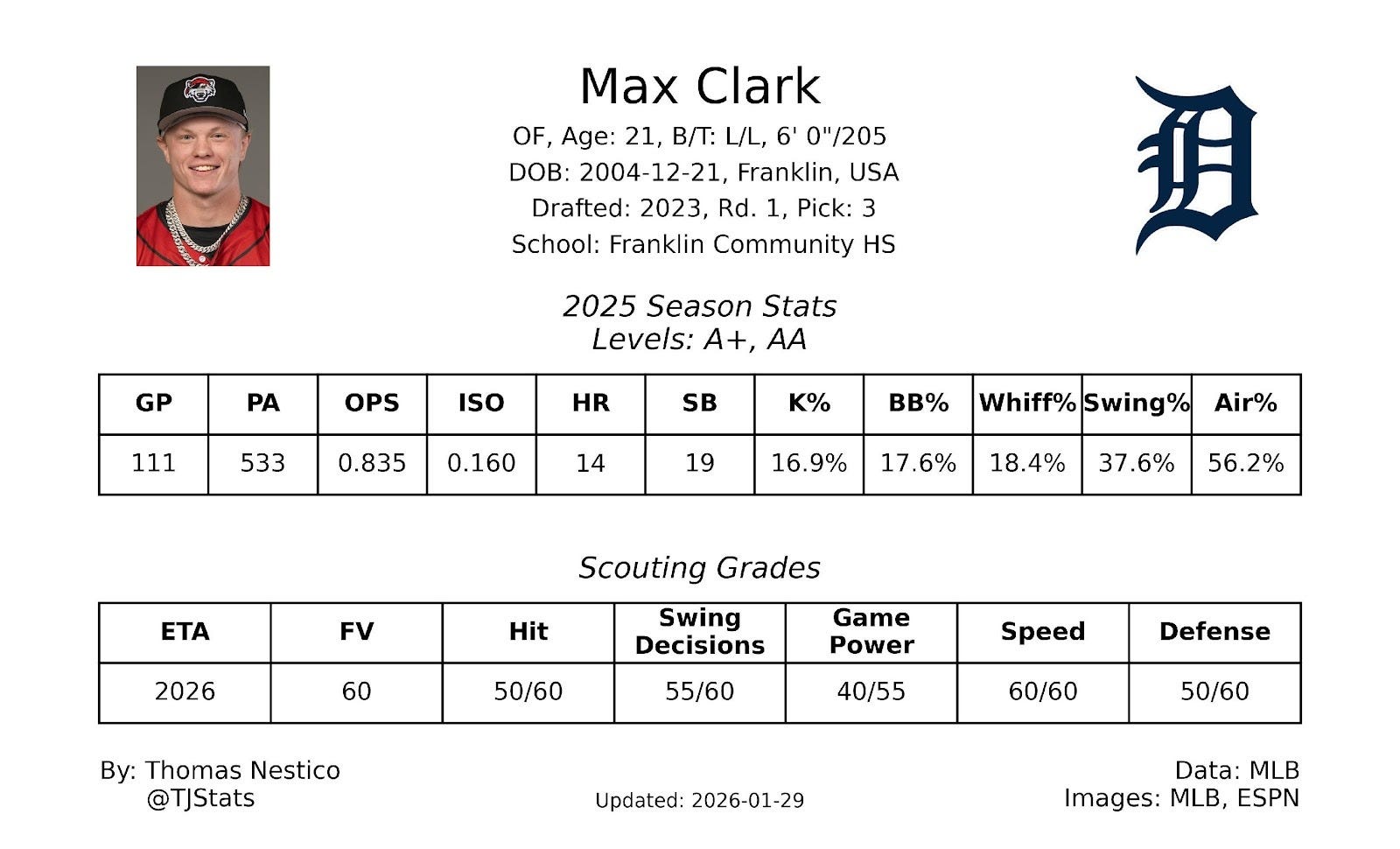
Max Clark is an uber-athletic CF who took massive strides in both the hit tool and plate discipline department this season to become one of the most complete prospects in baseball. He slashed his strikeout rate a few points and greatly improved his walk rate with an extremely patient approach. He was a nuisance for pitchers as he refused to chase with two strikes and continuously connected with whatever was thrown to him. The power has not manifested as hoped, but he looks to project as an average slugger with his flatter swing capping his ability to barrel up the ball. Early reports from Clark’s offseason bat speed training are encouraging and could lift his power ceiling further. His approach bodes well for getting on base at a higher clip; however, he falls victim to being too passive. Overall, Clark is an extremely well-rounded prospect who has considerably raised his floor since his draft.
8) Colt Emerson - SS - SEA
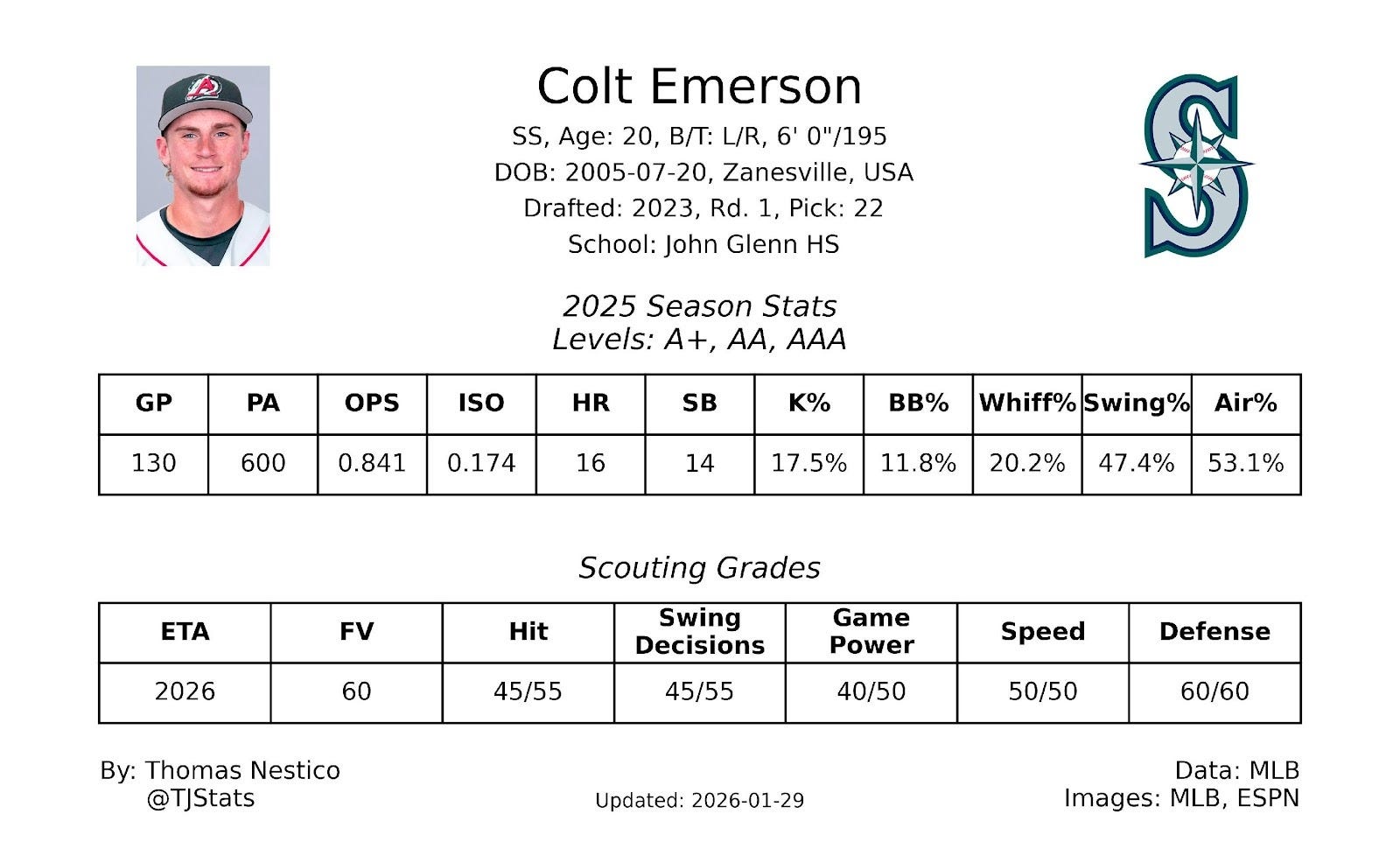
Colt Emerson continued his rapid trajectory to prospect stardom as he posted a .841 OPS and ended the season on fire, earning a promotion to AAA just months after his 20th birthday. He possesses a well-rounded approach at the dish with an encouraging blend of patience and aggressiveness, which is further boosted up by his plus contact rates. Emerson’s slugging upside hinges on his plus bat speed translating to more in-game power. Currently, he hits far too many groundballs and sprays his batted balls to the opposite field more than any other direction. On the defensive end you could argue that Emerson is the best SS defender in the minors. He has incredible range and supports his excellent glove with an above average arm. Overall, Emerson looks to be the Mariners long-term solution at SS with untapped power potential raising his ceiling to lofty heights.
9) Aidan Miller - SS - PHI
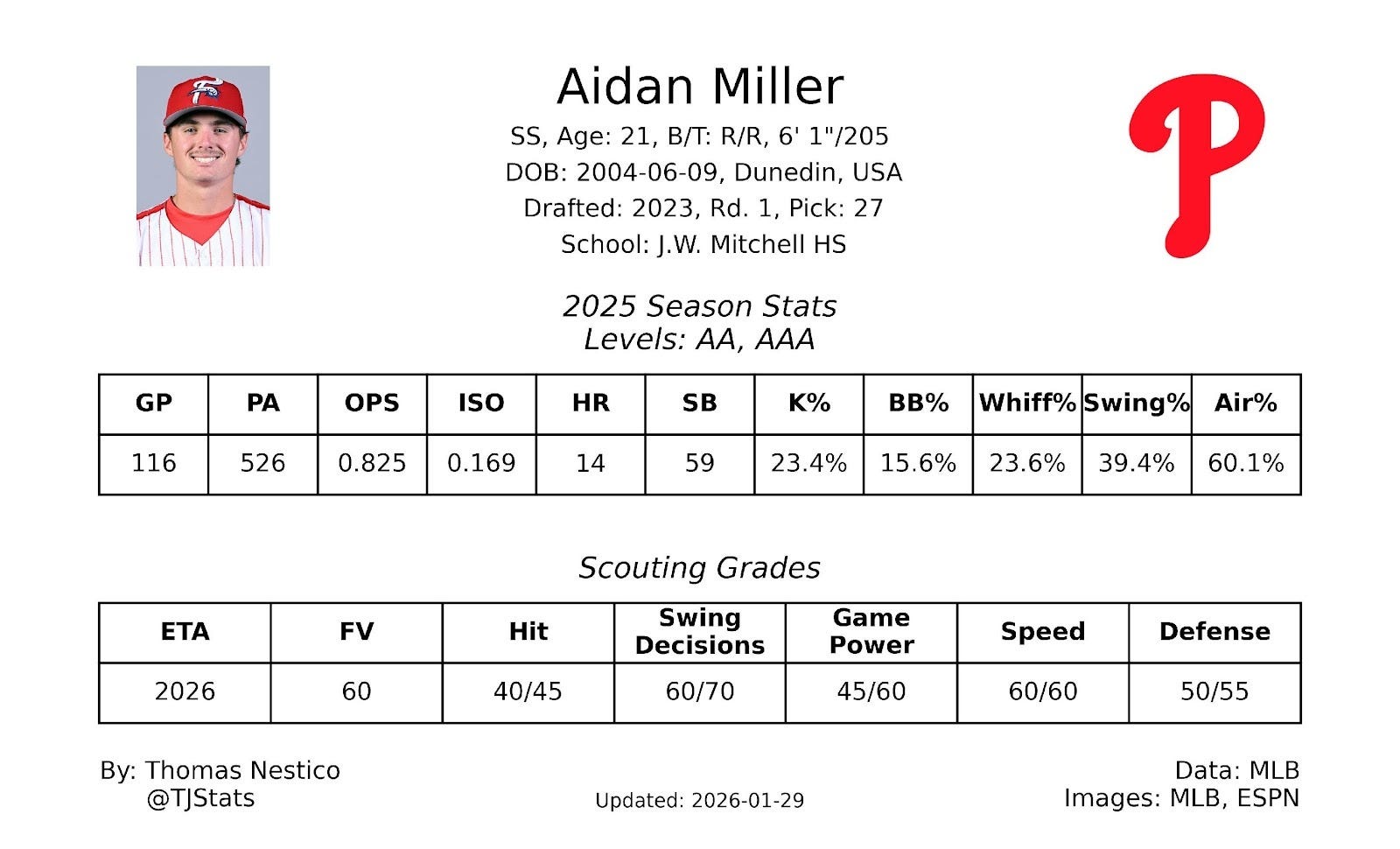
Aidan Miller fluctuated up and down my rankings throughout the season a lot. After a slow 1st half and discouraging contact rates he slipped, but he quickly rebounded with a strong 2nd half while exhibiting his excellent tools. His ability to turn on fastballs and launch them into orbit with his elite bat speed and fluid swing demonizes even the best MiLB pitchers. His slugging potential is supplemented by his incredible eye and patient approach. He forces pitchers to keep it in the zone, and he has good enough bat-to-ball skills to take advantage. The one flaw that continues to haunt Miller is his swing-and-miss against secondaries. He can identify both breaking balls and off-speed well but struggles to connect with them frequently. He projects to be a SS long-term, but with below average production. Miller has some of the loudest tools in the minors and his dominant stretch to end the 2025 season exhibited he has the talent to be a star.
10) Trey Yesavage - P - TOR
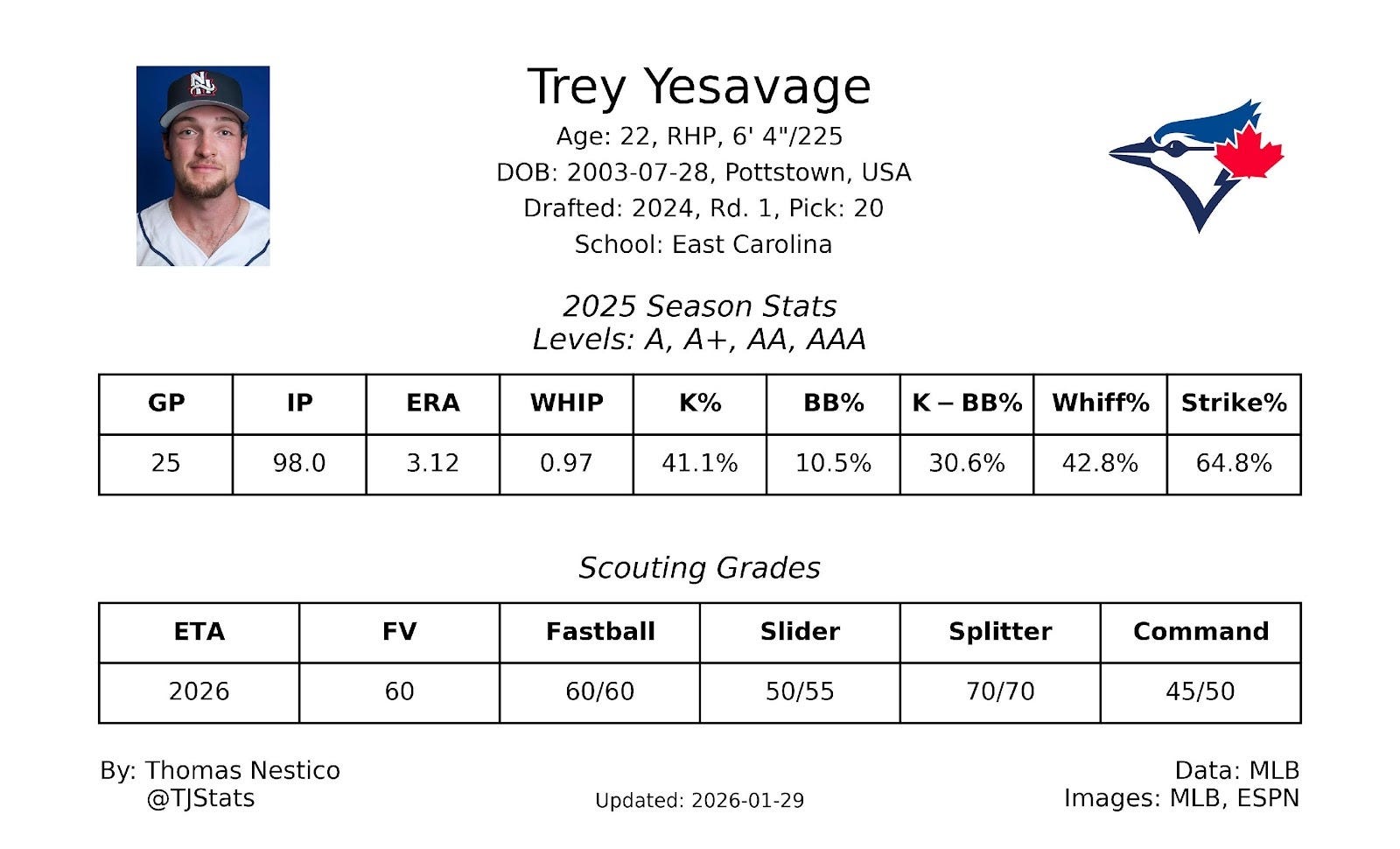
Yesavage was drafted 20th overall in the 2024 Draft by the Toronto Blue Jays. He was one of the more complete pitchers in the draft, boasting a deep pitch mix, refined command, and a strong fastball and splitter combo. Yesavage has one of the highest release points of any pitcher in baseball, reaching close to 7’. This release allows him to get a ton of carry on his fastball and creates a troubling view for batters. His slider has very tight movement, leaning more to the arm-side, unlike a typical slider. It sits in the mid-80s and is his go-to secondary against RHH. His mix to lefties changes to include a plus-plus splitter, which gets massive vertical separation from his fastball. Yesavage moved quickly through the Blue Jays system and has already flashed frontline upside.
11) Samuel Basallo - C - BAL
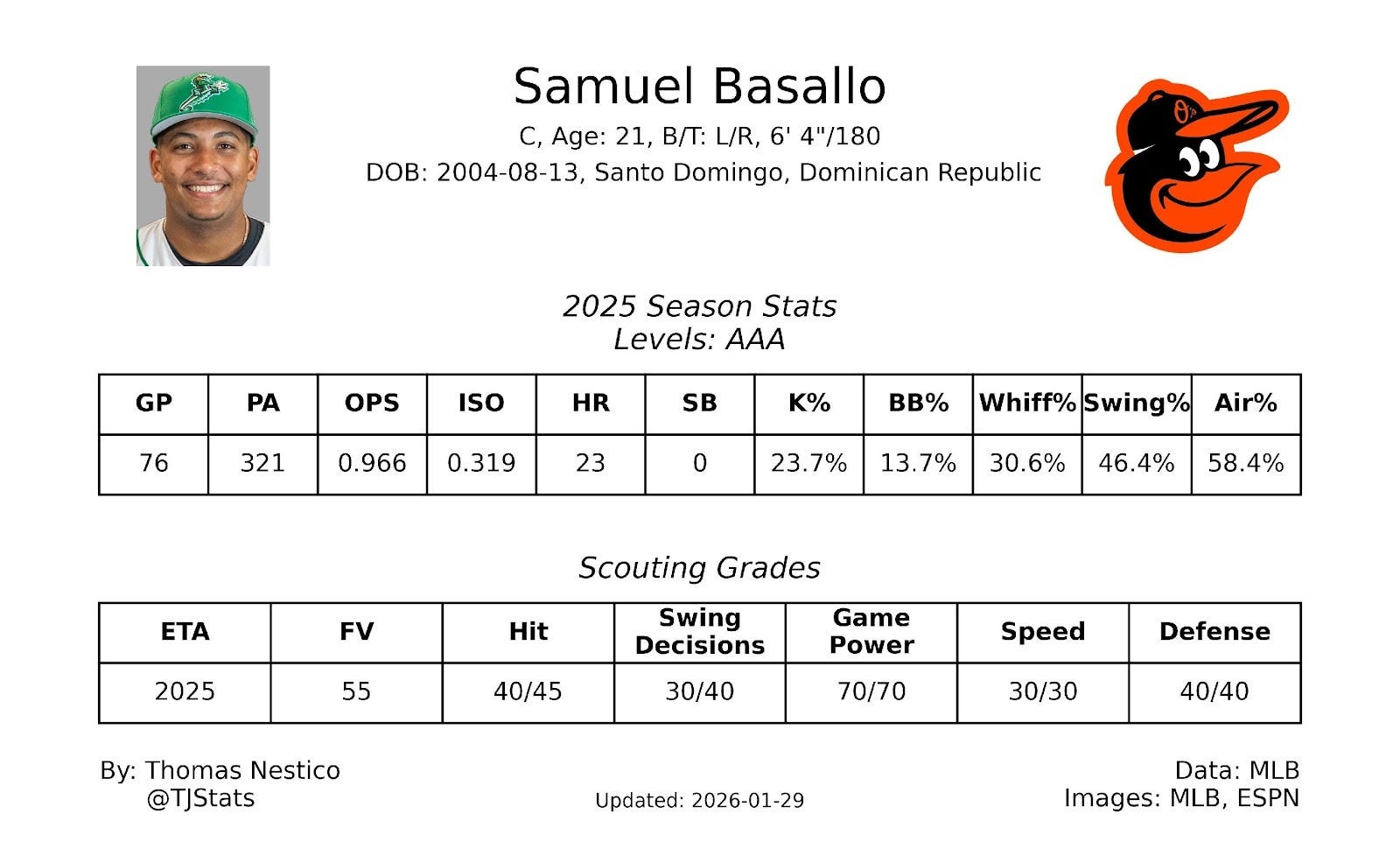
Samuel Basallo wields the most explosive bat amongst all prospects, clocking in elite bat speeds and exit velocities north of 116 MPH. His power upside given his age is bewildering and he supplements it with enough bat-to-ball skills to punish pitches in any location. This both a feature and a bug of Basallo’s approach as he will swing at pitches far outside the strike zone too often. Not only that, but he also tends to be more passive in-zone compared to his other chase-happy peers. However, when Basallo connects it is always astonishing. He can seemingly barrel up pitches that have no business even being swung at and his swing is perfectly designed to launch baseballs into orbit. He will likely need to trim the chase rate down to ensure he can remain a frightening force for opposing pitchers. Although he has remained a catcher throughout his pro career, he lacks the refined blocking and framing skills to stick behind the plate long-term. Without a significant improvement in either skill (or the departure of Adley Rutschman), he will likely be Baltimore’s long-time 1B/DH.
12) Leo De Vries - SS - ATH
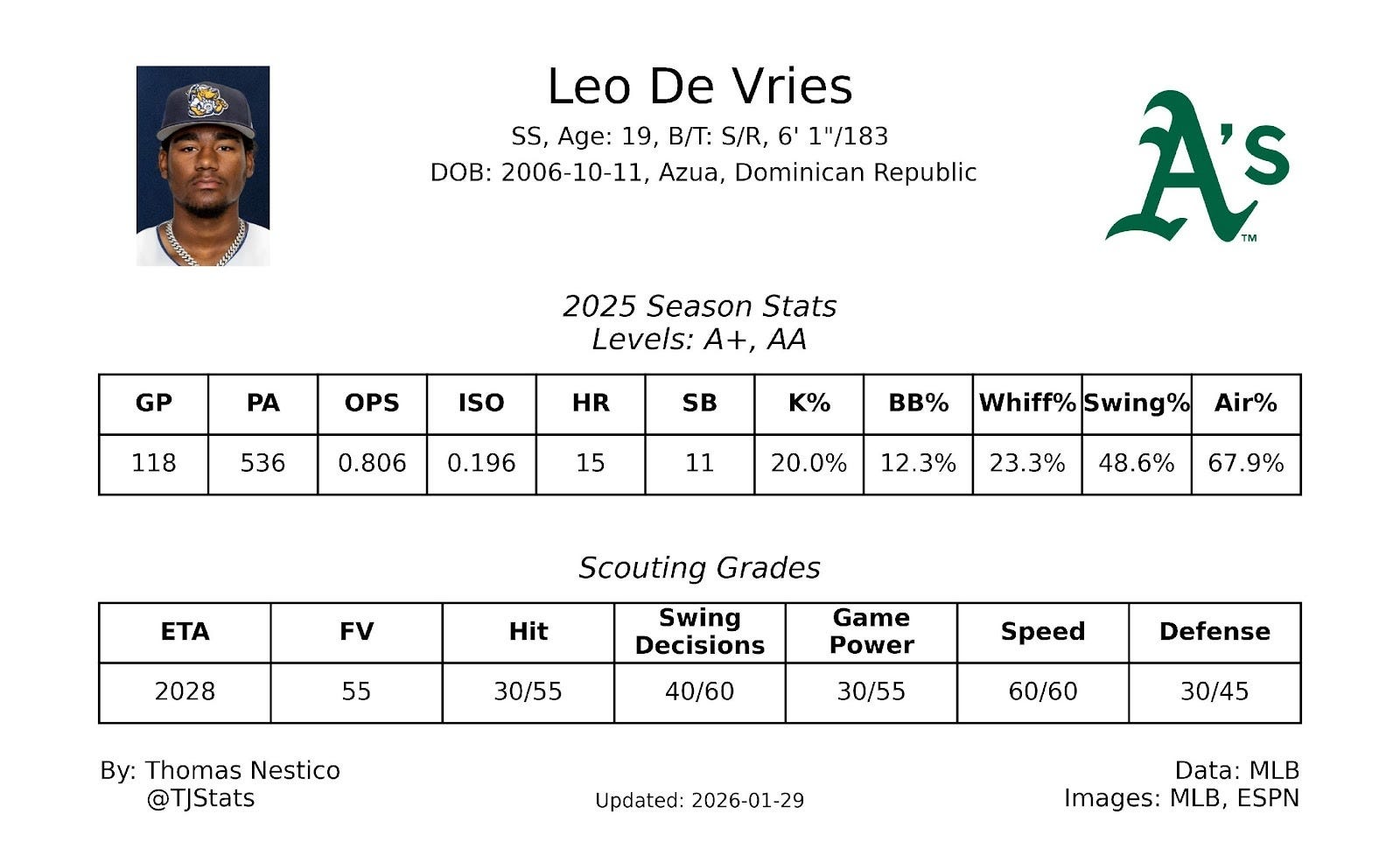
Leodalis De Vries entered the 2025 season as the youngest player in Hi-A with the Padres and ended it as the youngest player in AA with the Athletics. His trade from the Padres was a shock to the baseball world as he was considered a consensus Top 10 Prospect in baseball and was ranked as highly as top 5. After a strong showing in Hi-A where LDV continued to showcase his advanced approach and budding power, he wrapped up the season in Midland where he ended on a rampage with all 5 of his home runs coming in his final 8 games. On the season he posted a .806 OPS while cutting down his strikeout rate from 2024 and being more aggressive in the zone. His raw power did not progress as expected with his exit velocities remaining consistent with his first pro season. While this puts a damper on his power projection, he continued to keep the ball in the air where he used his shorter levers to get ahead of the ball and deposit it to the pull side. His leap to the upper minors was exciting to witness, but it did not come without growing pains. The power he flashed from both side of the plates waned as he struggled to hit LHP, ending the season with a .659 OPS as a RHH. He continued to be a force against RHP, launching 12 of 15 HR as a lefty. Defensively, he has the arm to stick on the left side of the infield with his range being the deciding factor to whether he stick at SS or 3B. Overall, LDV is a tooled-up switch-hitter with immense potential and seemingly unprecedented success given his age. He has #1 Prospect in baseball upside.
13) Carson Benge - OF - NYM
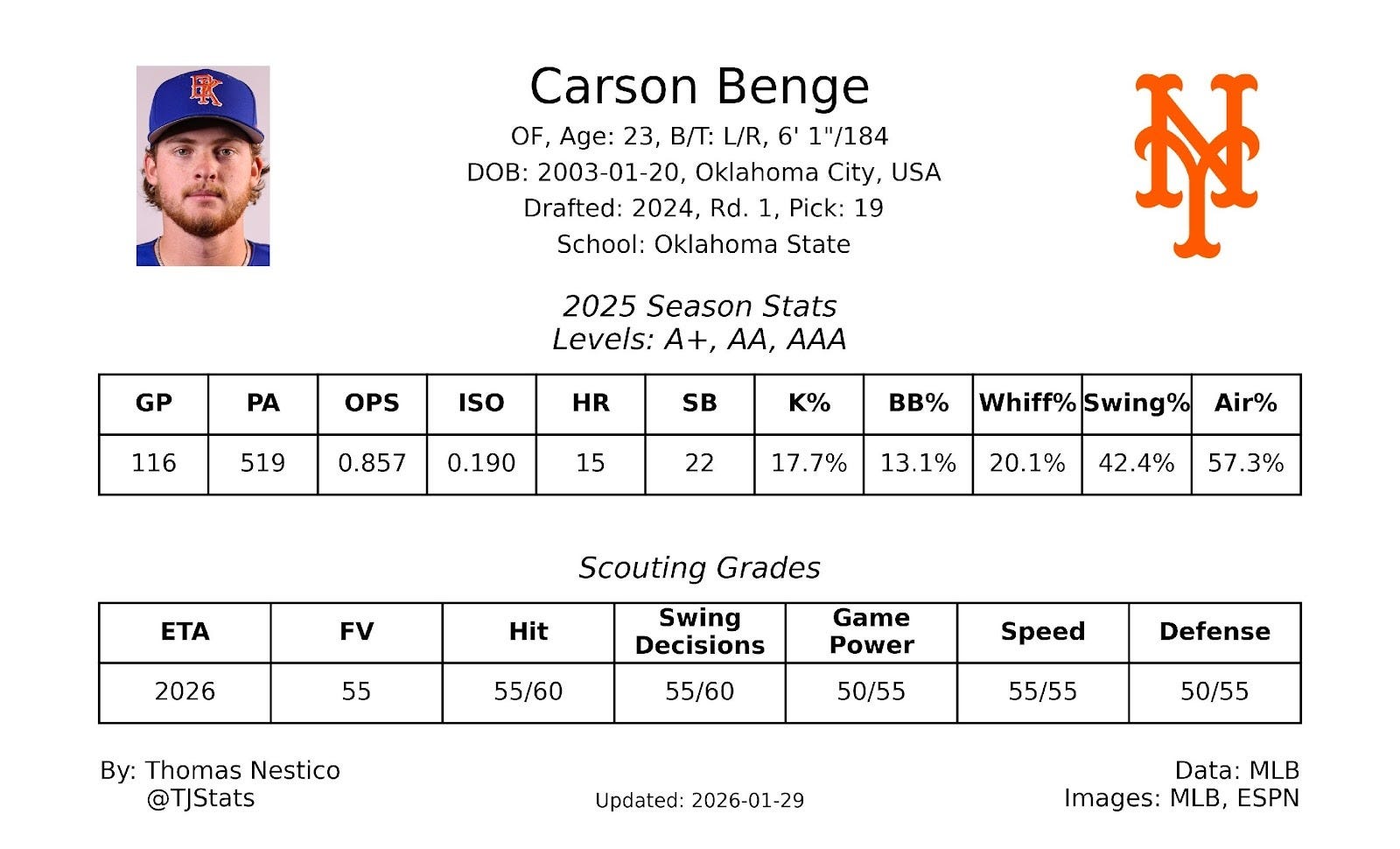
Carson Benge solidified himself as one of the most complete prospects in baseball with an excellent pro debut season where he posted a .857 OPS across 116 games. His profile is balanced with above average tools across the board while manning the outfield. A solid 20.1% Whiff rate paired with a strong 21.9% O-Swing rate helped him maintain a 17.7% strikeout rate while walking at an elite rate. His underlying power metrics indicate he has above-average to plus raw strength, however his flatter bat path and spray tendencies may limit his slugging potential. His above average speed, good route running, and cannon of an arm greatly helps his outlook as a CF. Benge is one of the safer bets to be a MLB regular and looks poised to join the Mets early in the 2026 season.
14) Bubba Chandler - P - PIT
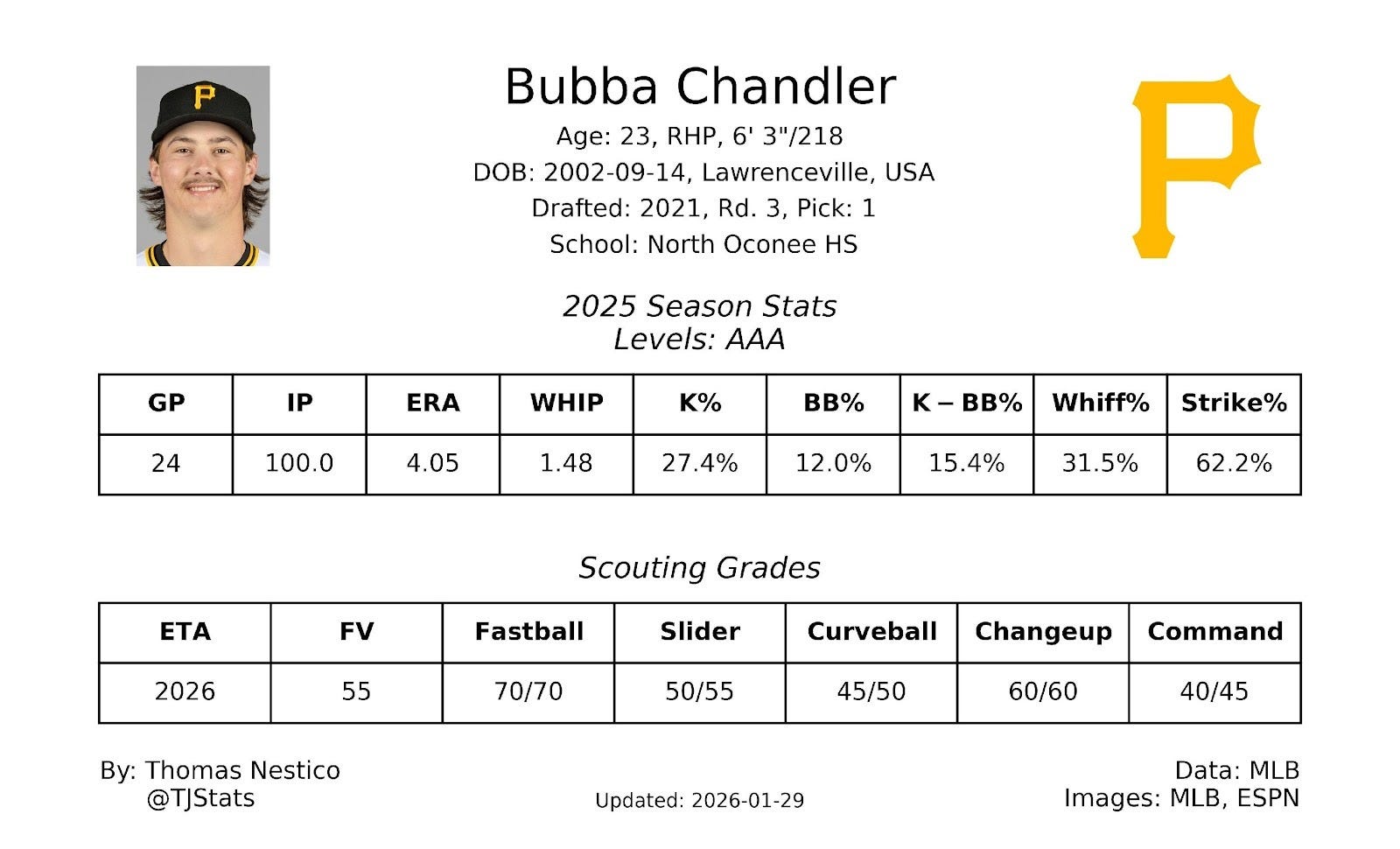
Chandler has a prototypical pitcher’s body backed by an electric fastball and increased confidence in his changeup. Chandler was raising red flags earlier in 2024 despite the strong results, as he was up to 70% Fastball usage with his changeup essentially nowhere to be seen. Chandler started diversifying his arsenal and was rewarded with a promotion to AAA, where he continued to dominate. From an initial glance, Chandler seems to be cut from the same cloth as fellow Pirate Jared Jones. Both wield a similar 4-Pitch mix highlighted by a 4-Seam Fastball, which sits at 97 MPH and gets above-average vertical movement from a lower release. While Chandler’s slider may not be a whiff-inducing machine, his changeup is helps him stand out. The changeup sits 89-91 MPH with over 10” of vertical separation from his fastball, and thanks to its running action, can get some nasty whiffs when located well. His delivery is on the aggressive side, which may limit him from making strides in the command department, but his athleticism should allow him to make the necessary adjustments to limit walks. Chandler projects to be a top of the rotation arm and should be a staple in Pittsburgh’s rotation in 2026.
15) Payton Tolle - P - BOS
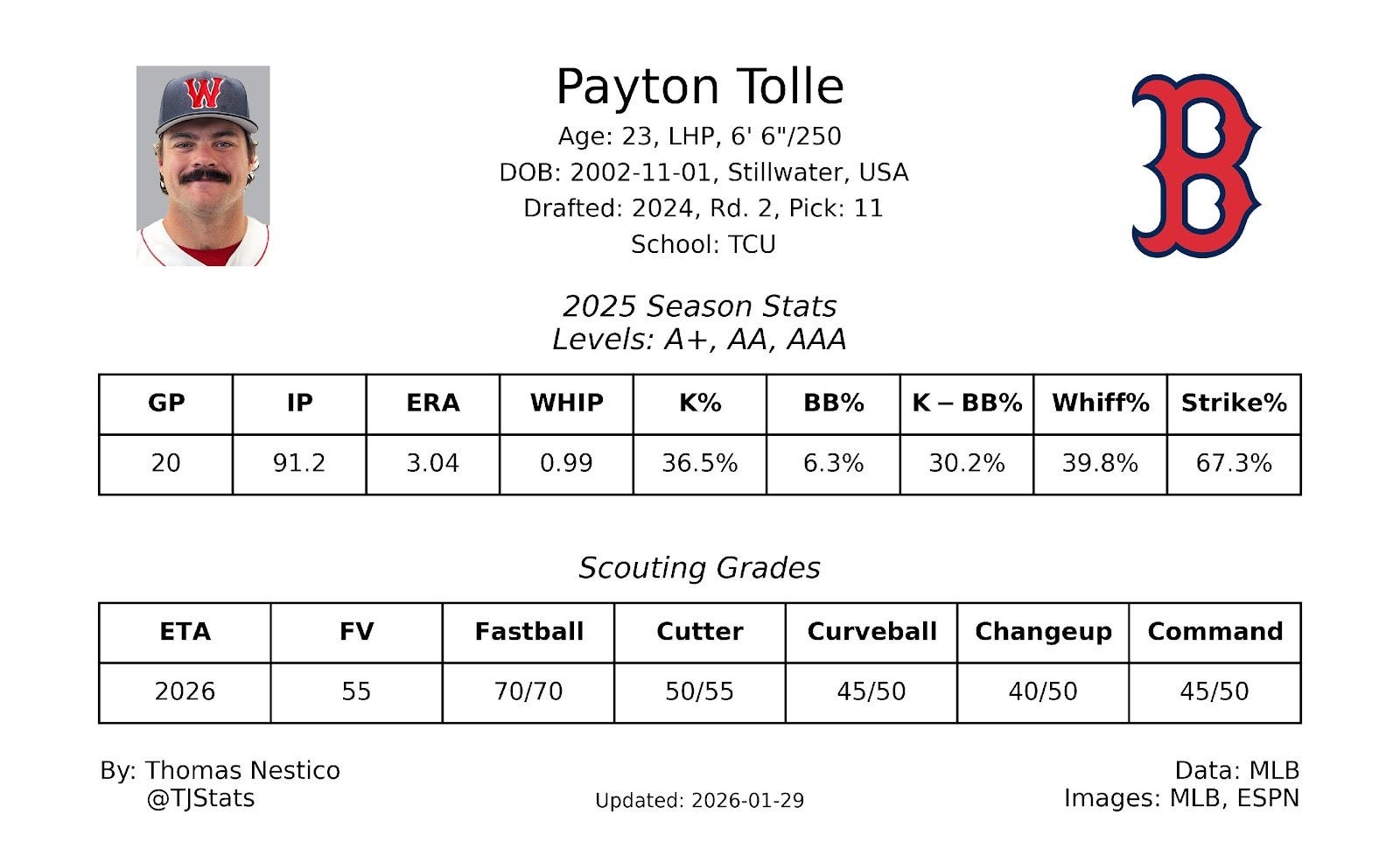
Payton Tolle was selected 50th overall in the 2024 MLB Draft after an impressive showing at TCU where he flashed a solid 3-pitch mix supported by elite extension. Tolle does an excellent job utilizing his large 6’5” frame to get down the mound which generates nearly 7.5’ of extension. This large stride pairs well with his low 3/4 release to create a distinct look with a deceptively low release point. Tolle’s fastball has garnered the most benefit from his release as its mid 90s velocity looks like upper 90s heat. Additionally, its ~16” iVB from his 5.7 ft release point leads to a flatter approach on his fastball as it whizzes through the zone. It ran a nearly 50% Whiff rate this season and Tolle does a strong job at locating it in the zone and getting ahead of batters early. Tolle’s main breaking ball is an upper 80s cutter with tight glove-side action to make it an effective offering against both handedness. He also tosses a low 80s curveball with 2-plane action. He rounds out his arsenal with an unpolished changeup that sits 88-90 MPH. It has returned underwhelming results thus far, but he has exhibited a good feel for the offering despite its low usage. Tolle’s extreme extension and unique look from his lefty slot makes him an intriguing pitching prospect. He has the frame to eat up a lot of innings and is already considered one of the best pitching prospects in baseball.
16) Sal Stewart - 3B - CIN
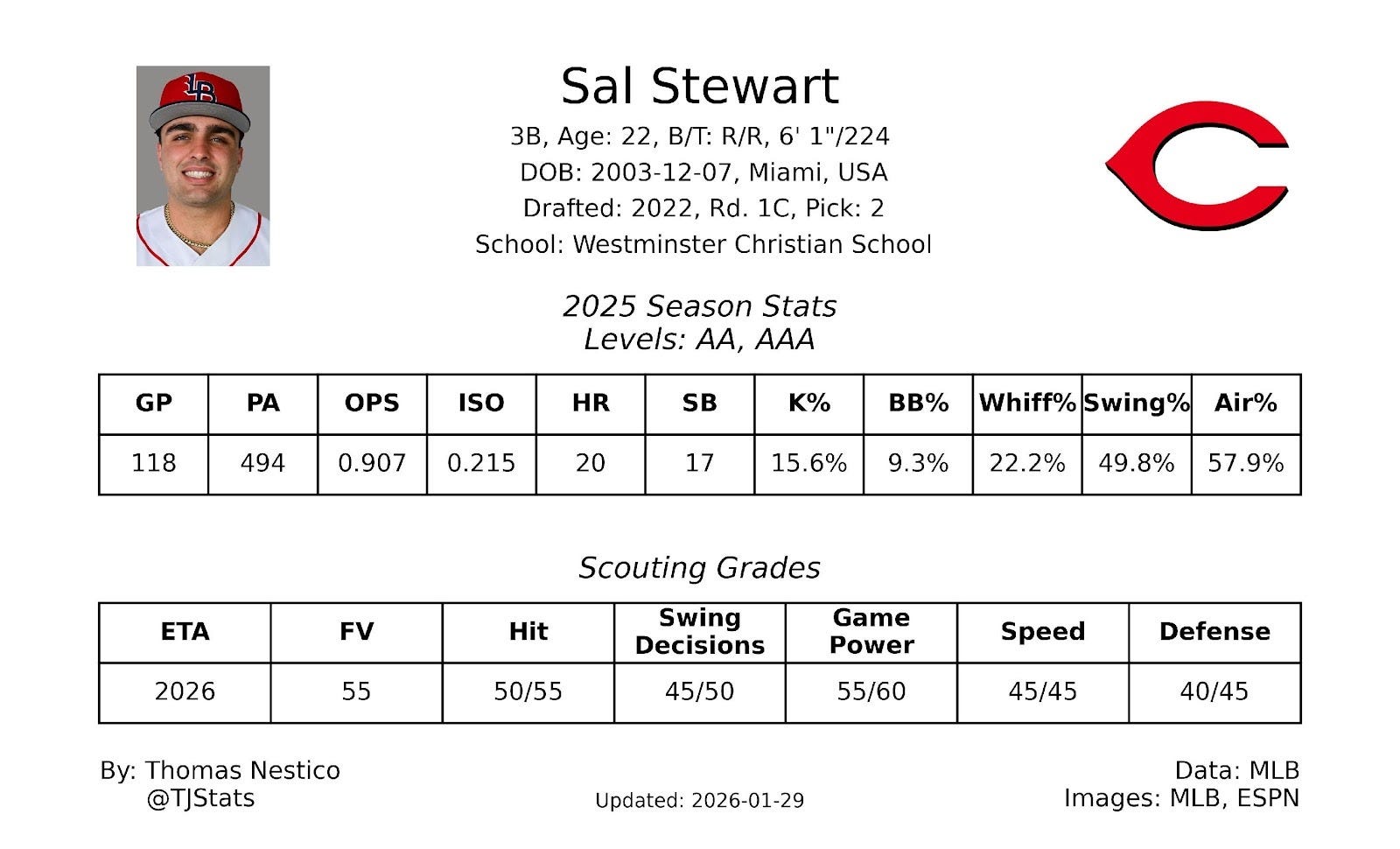
Sal Stewart continued his domination of MiLB this season with a 152 wRC+ and 20 home runs over 118 games. His batted ball quality grades out near to the top of his peers as a 107 MPH 90th% EV and superb line drive rate led to a ton of extra base hits. His solid bat-to-ball skills allow him to battle deep into counts and utilize his innate power to deal damage. His profile is not without its flaws though. Stewart lacks both the patience and aggressiveness to fully utilize his powerful bat. He grades out a poor runner despite double digit steal numbers and projects to be a 1B long-term given his below average arm strength. Stewart’s bat carries his prospect stock and given his early results in MLB, he should have no issues returning positive results.
17) Walker Jenkins - OF - MIN
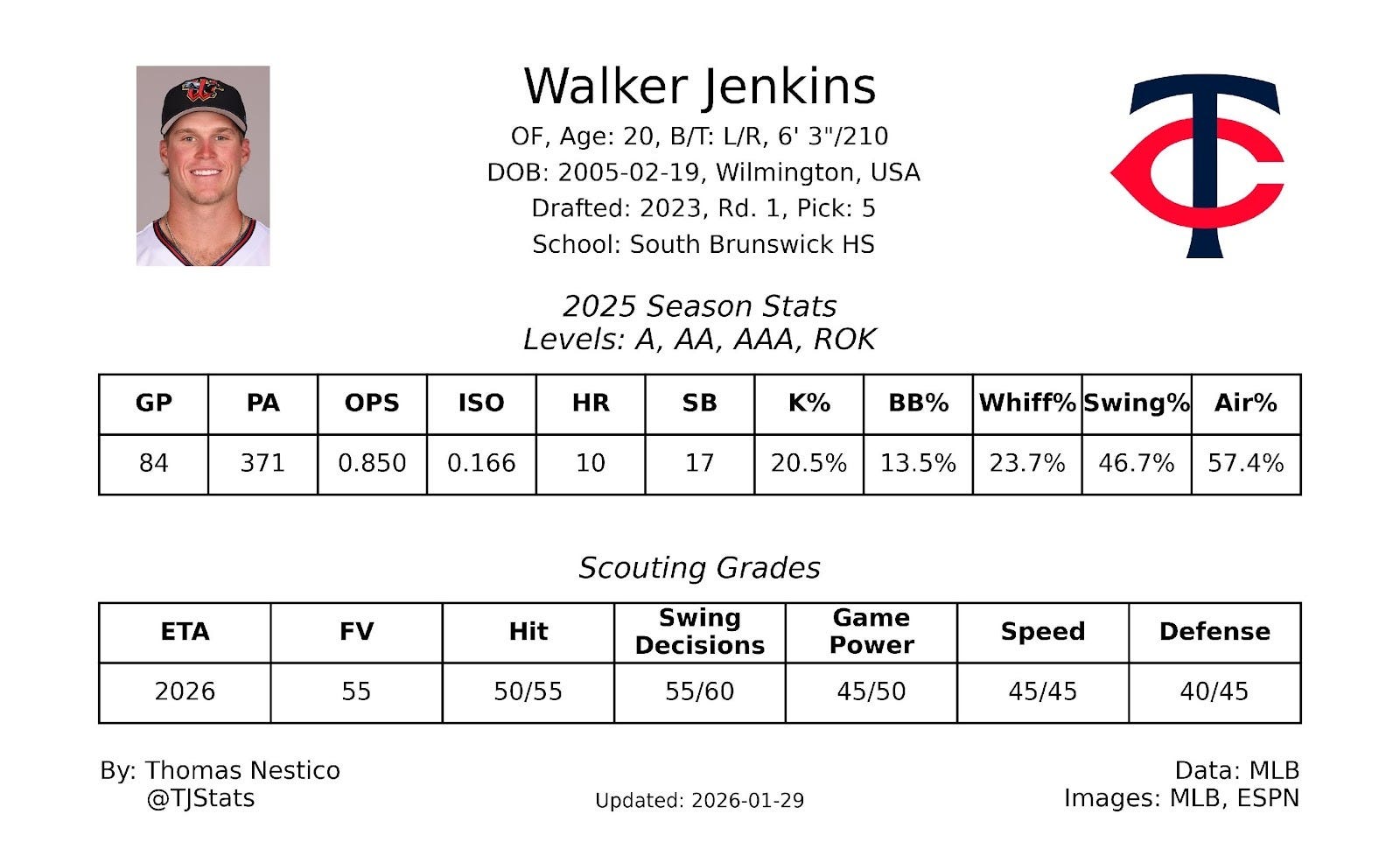
Walker Jenkins has done nothing but hit when he steps on the field. With his healthiest season yet, Jenkins posted a .850 OPS across 84 games while flashing an uptick in power. The increase in power seemed to be at the expense of his plate discipline and contact rates. His O-Swing% and Z-Swing% remained well above average, but his contact rates took a massive tumble with his Whiff Rate dropping from 16.8% to 23.7%, with an even larger drop in his Z-Contact%. The increased exit velocities are encouraging to see, but they still paint Jenkins as an average power bat. He is a solid runner, and his plus arm strength should help him be an average defender in a corner outfield spot. Jenkins has had his development stalled due to injuries and it finally seems that he is on the brink of his MLB debut.
18) Edward Florentino - OF - PIT
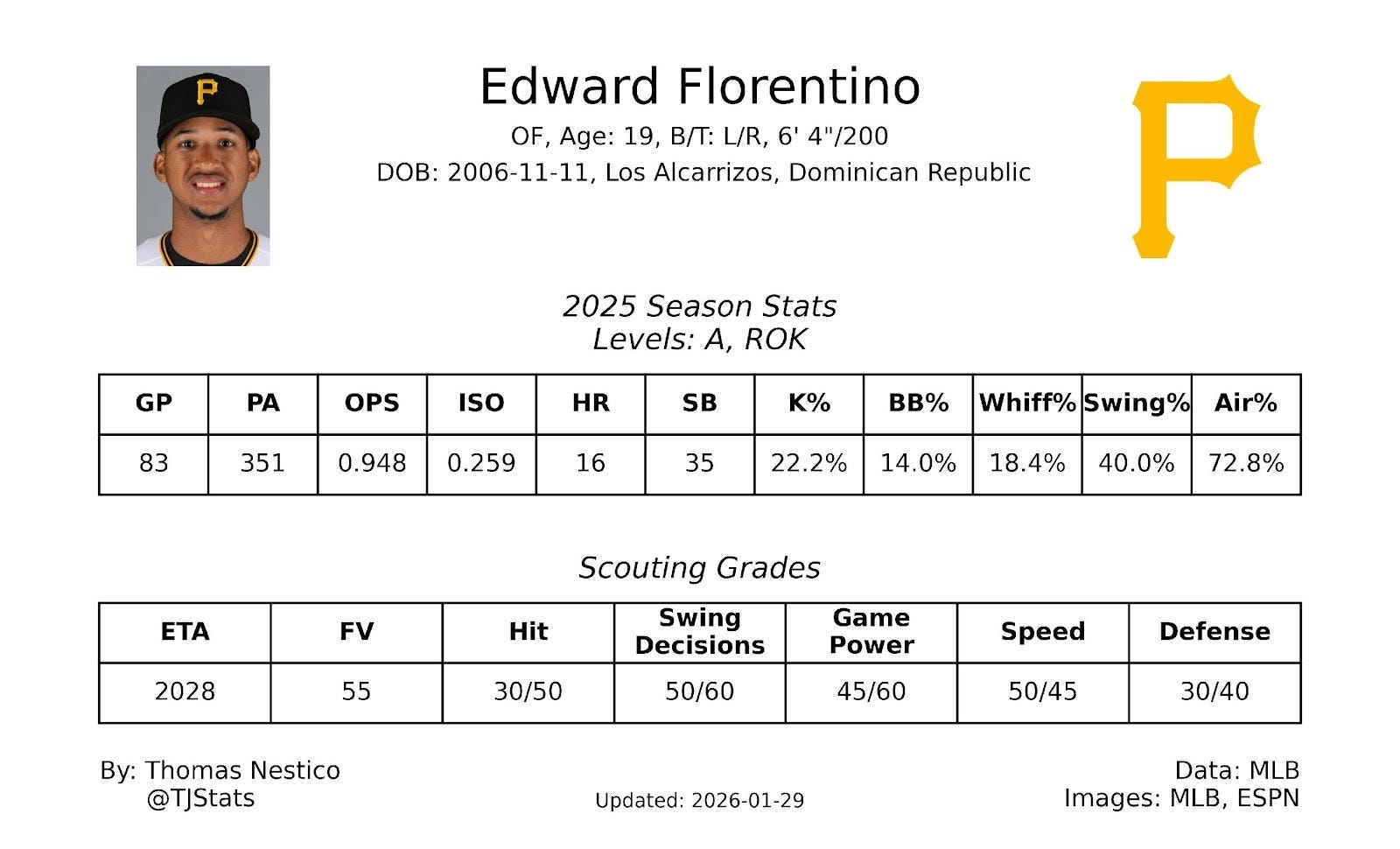
Edward Florentino was the Pirates’ top prospect in the 2024 DSL and carried that momentum into an impressive FCL stint, posting a 193 wRC+ across 29 games. Now in full-season ball at just 18, he remains an overwhelming presence at the plate both in stature and production. Standing 6’4” with room to grow, he wields a steep upper-cut swing geared for pulled fly balls. His raw power consistently translates into results, as shown by his 16 home runs in his first taste stateside. While swings like his can raise swing-and-miss concerns, he has maintained excellent contact rates, particularly in-zone. His ability to recognize and lay off pitches out of the zone, especially secondary offerings, is encouraging and positions him for a rapid ascent through the minors. However, his lack of in-zone aggressiveness makes him susceptible to called strikes. This patient approach should buoy his walk rate, though he will likely see strikeout rates rise against more advanced pitching. Limited speed may force him off center field and struggles against LHP further cap his future value. He profiles as a bat-first slugger with budding power and a swing that oozes home run potential; he just needs to keep doing what he is doing.
19) Rainiel Rodriguez - C - STL
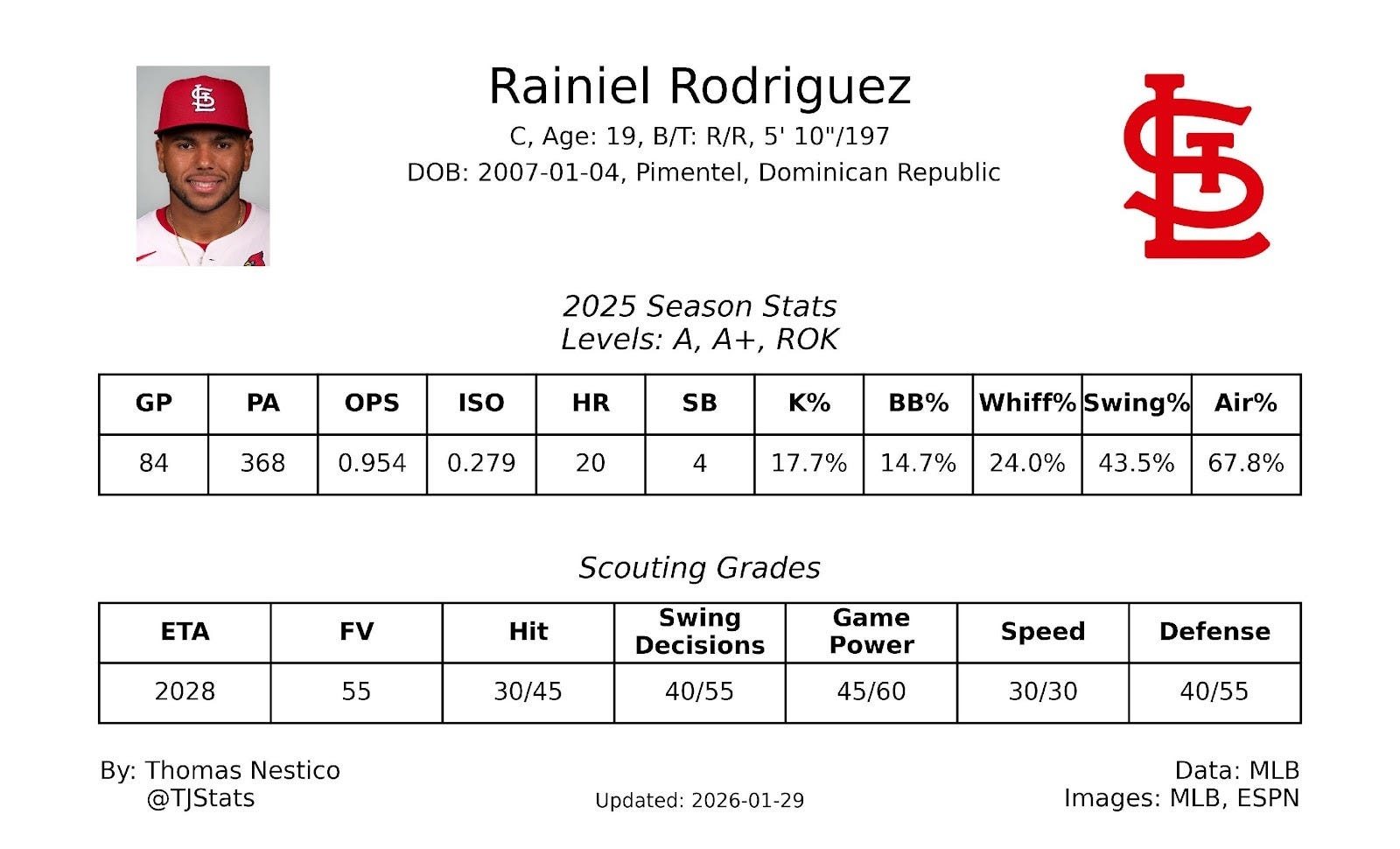
Rainiel Rodriguez needed no introduction stateside after dominating the DSL, where he hit 10 home runs at just 17. He carried that momentum into a 20-game stint in the FCL, posting a 237 wRC+ while walking more than he struck out before the Cardinals promoted him to Lo-A. Using his short levers and quick hands, he consistently turns on pitches and drives them to the pull side. This combined with his tendency to lift the ball has produced 20 home runs this season. He can punish pitches of all types and has posted exceptional barrel rates and exit velocities for his age. Contact and walk rates have dipped since his promotion, but both remain near league average with a sub-20% strikeout rate. He shows advanced feel for laying off outside breaking balls, though he has struggled with whiffs, particularly in-zone. Defensively, he is a strong blocker and has produced positive results with his arm despite below-average strength. Framing remains his biggest defensive hurdle and could force a move off catcher. Overall, Rodriguez is an exciting prospect who has the talent and demeanor to be an impact slugger with the defensive profile to be a proficient MLB regular.
20) Sebastian Walcott - SS - TEX
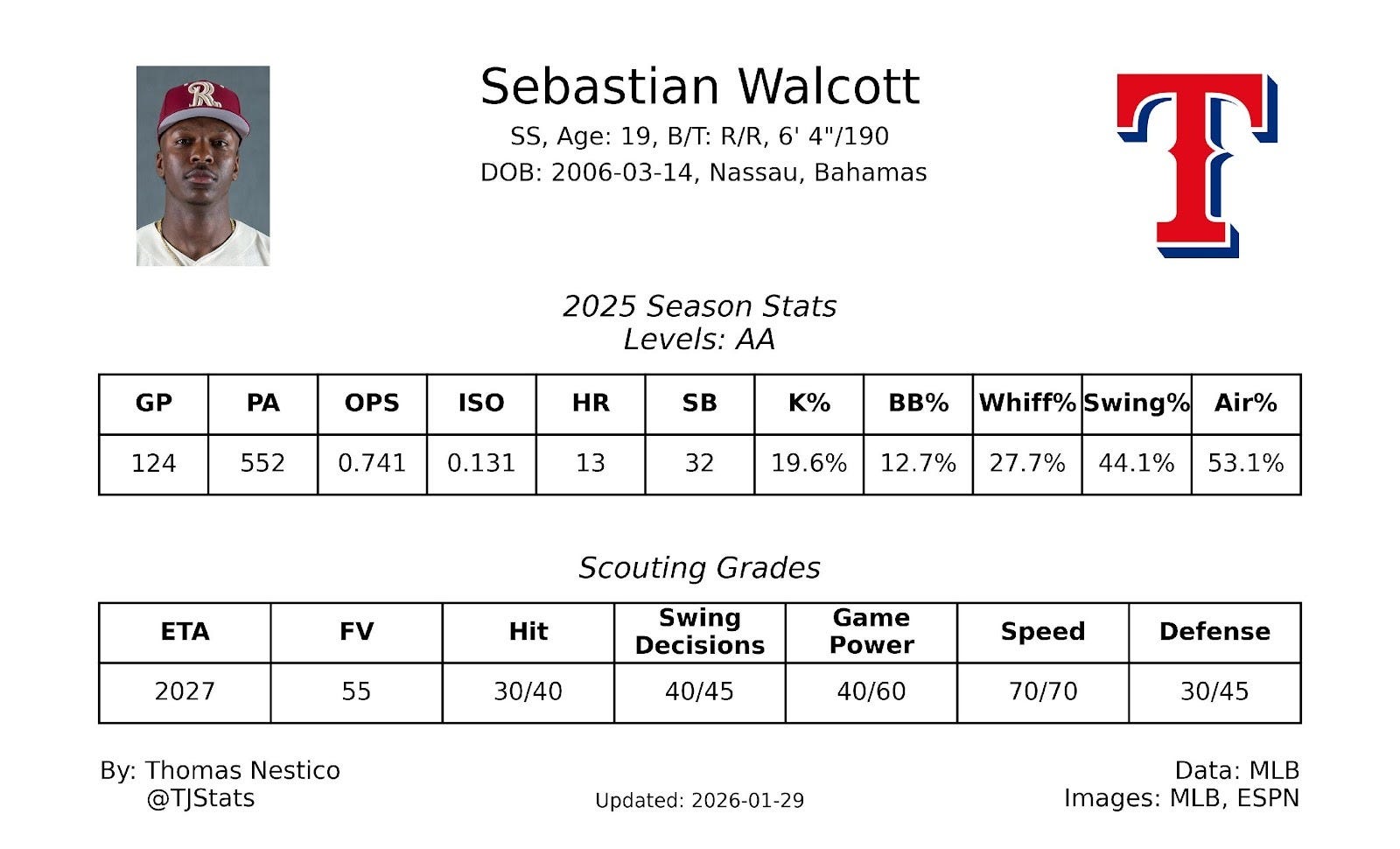
Sebastian Walcott took the prospect world by storm as an 18-year-old when he completely skipped Lo-A and smacked 11 HR in his first full season of pro ball. His combination of athleticism, size, and power makes him one of the most exciting young SS in baseball and the Rangers have no issues thrusting him into tougher competition. On top of all that, he has excelled while cleaning up his worrisome strikeout rates and refining his approach. There is no doubt that Walcott wields plus-plus raw power, however there is a fatal flaw with his swing that may prevent him to translate it into game action: it is incredibly flat. With a 46.0% ground ball rate and a 35.4% infield fly ball rate, Walcott fails to consistently barrel up the ball and let his improved contact rates return bountiful results. He has all the tools to be one of the most dynamic players in baseball, but until he revamps his swing, his upside is capped.
21) Alfredo Duno - C - CIN
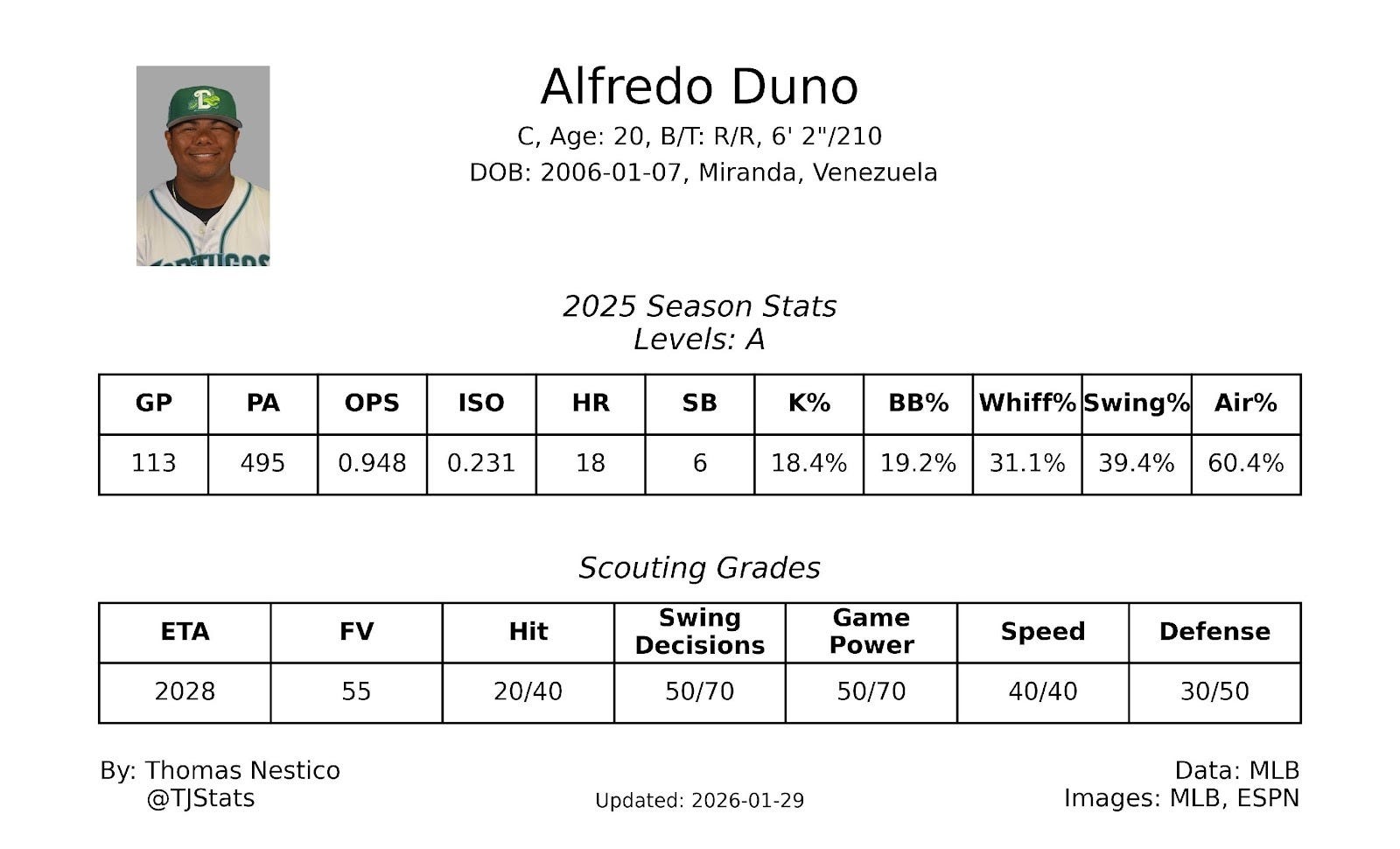
Alfredo Duno wrapped up one of the most impressive Lo-A seasons of the year with a 2nd half made of dreams where he posted a 1.127 OPS with a ludicrous 21.4% walk rate and 12.7% strikeout rate. His carrying traits are his incredible eye that helped him walk more than he struck out and his blistering bat speed that propelled him 18 home runs. His ability to consistently barrel the ball makes him an extremely dangerous hitter and lines him up for plus-plus power outlook. Although his 18.4% strikeout rate may indicate that he has no issues with swing and miss, his contact rates tell a different story as he sat near the bottom of the FSL with a 73.4% Z-Contact rate. Behind the plate he is an above average thrower and blocker which bodes well for his future as a catcher, although his framing requires a lot of work. All in all, Duno has the tools to be a dynamic slugging backstop, but his hit tool may limit him to a three-true outcome batter.
22) Josue Briceño - C - DET
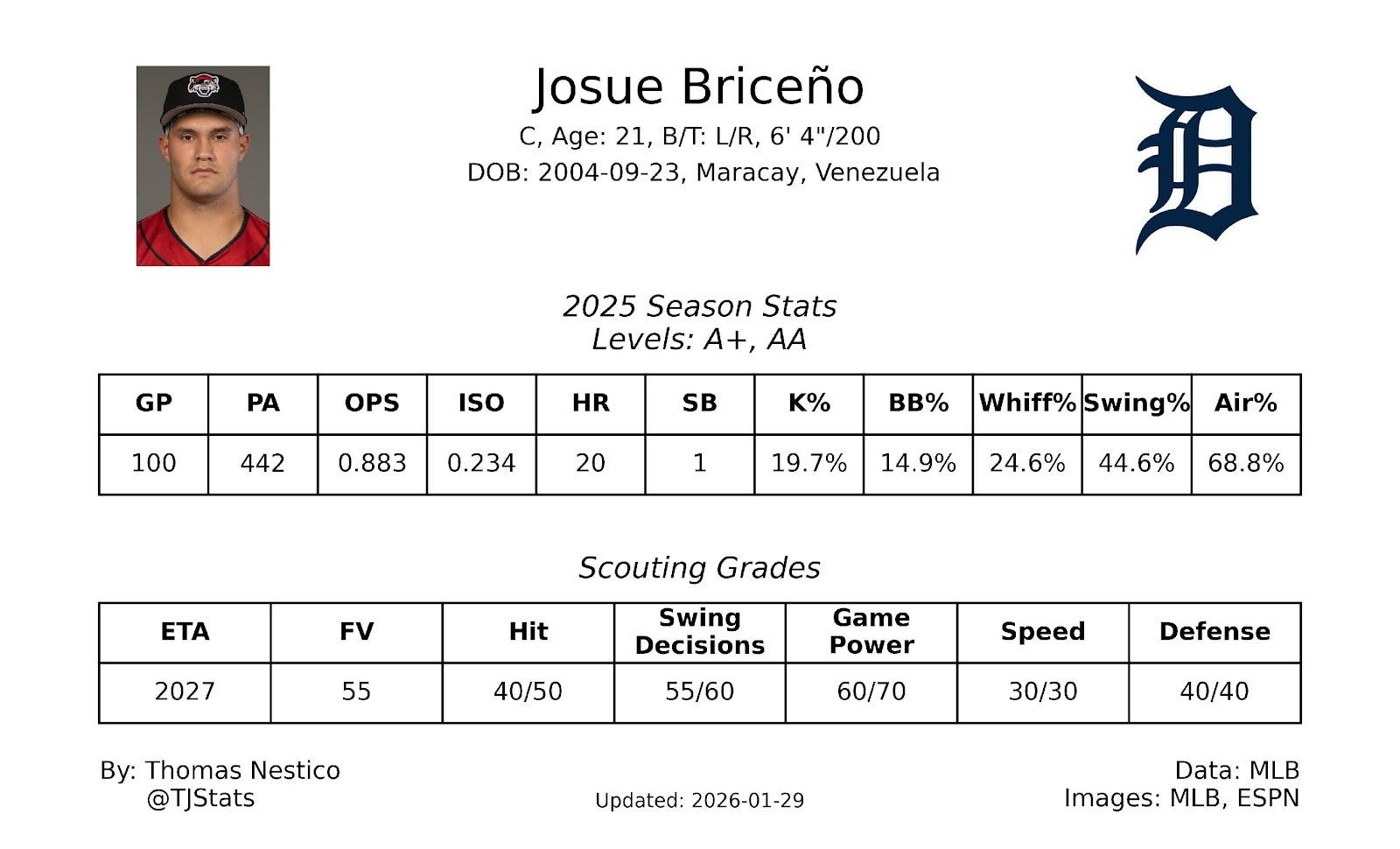
Josue Briceno let his bat do the talking this season as he posted a stellar .883 OPS across Hi-A and AA. This success comes after an outstanding showing in the AFL during 2024 where he looked more athletic and agile without sacrificing power. He brings everything you want out of a batter: explosive bat speed, outstanding barrel control, and an advanced eye; all without the strikeout rates that typical plague even the best of sluggers. His production dipped following his promotion to Erie (AA), however he righted the ship in the final weeks which were reminiscent of his dominant showing with West Michigan (Hi-A). On the defensive end, Briceno suited up behind the plate in nearly half his outings where he displayed average catching skills with the lone exception being below average framing. Overall, Briceno is one of the most well-rounded slugging prospects in baseball and continued to prove that he can hold his own at catcher, even if it looks more that likely that the Tigers view him as a secondary backstop for the time-being.
23) Connelly Early - P - BOS
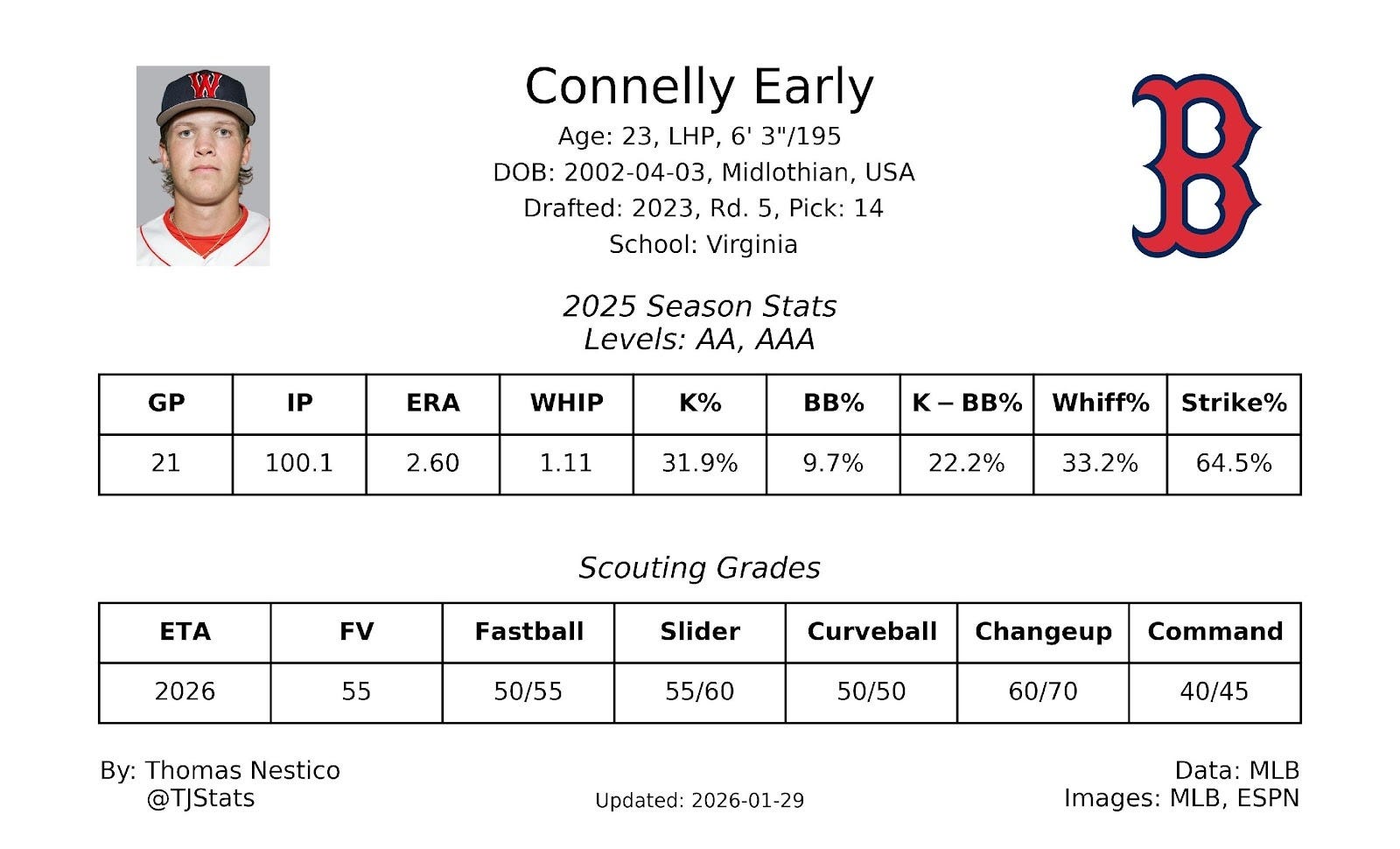
A deceptive lefty, Connelly Early has built on a strong 2024 campaign with an even better 2025, missing more bats as he advanced through the upper minors. He operates from a low slot with quick arm speed and above-average extension, all supported by a deep arsenal. He throws a pair of fastballs, an elevated four-seamer and a sinker, which sit in the lower 90s and touch 95 MPH. He mixes in his four-seamer in all counts, typically locating it high in the zone against LHH and on the inner-third versus RHH. He uses the sinker almost exclusively against LHH early in counts, keeping it in the zone to steal strikes. Early’s slider is his primary breaking ball, deployed early in counts against both RHH and LHH. Its cutting action limits damage, further aided by his ability to consistently locate it in the zone. His changeup is his most effective offering, showing significant vertical separation from his fastball and consistently kept down in the zone. It has produced excellent results this season against RHH thanks to its ability to induce both whiffs and weak contact. He rounds out his arsenal with a low-80s curve and sweeper, used as put-away pitches against RHH and LHH, respectively. Early’s outlook as a starter improved this season thanks to better strike-throwing and increased endurance. There remains some relief risk tied to his higher-effort delivery, but his command improvements and workload this year suggest he will continue to receive extended looks as a potential rotation piece.
24) Robby Snelling - P - MIA
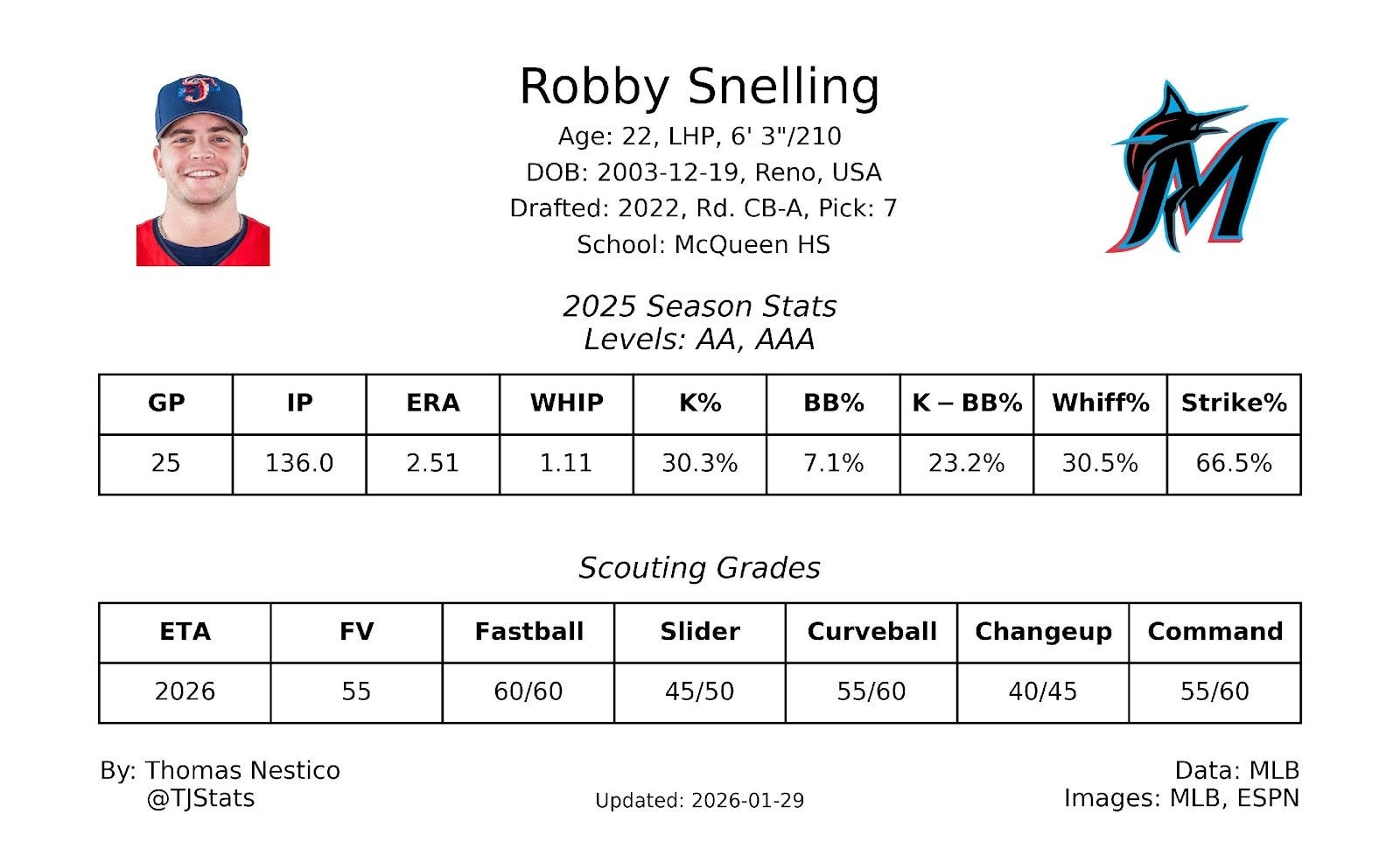
Snelling was a key piece in the trade that sent Tanner Scott to San Diego at the trade deadline last season. His upside is very apparent when you consider his projectable frame and strong fastball, which he supports with stronger secondaries than year’s prior. His fastball sits 94-96 MPH and, with its above-average ride from his 5.7’ release, has been effective at generating swings and misses. His curveball sits in the low 80s with two-plane movement. He commands it well which helps his generate called strikes early in counts and put away batters with swings and misses. His changeup sits 87-89 MPH, and he has exhibited a solid feel for the pitch, and its effectiveness is elevated due to its separation from his fastball. He rounds out his arsenal with a new mid-80s gyro slider. Snelling should be able to handle a large workload thanks to his body type and more refined arsenal, which makes his future as a starter more concrete.
25) Thomas White - P - MIA
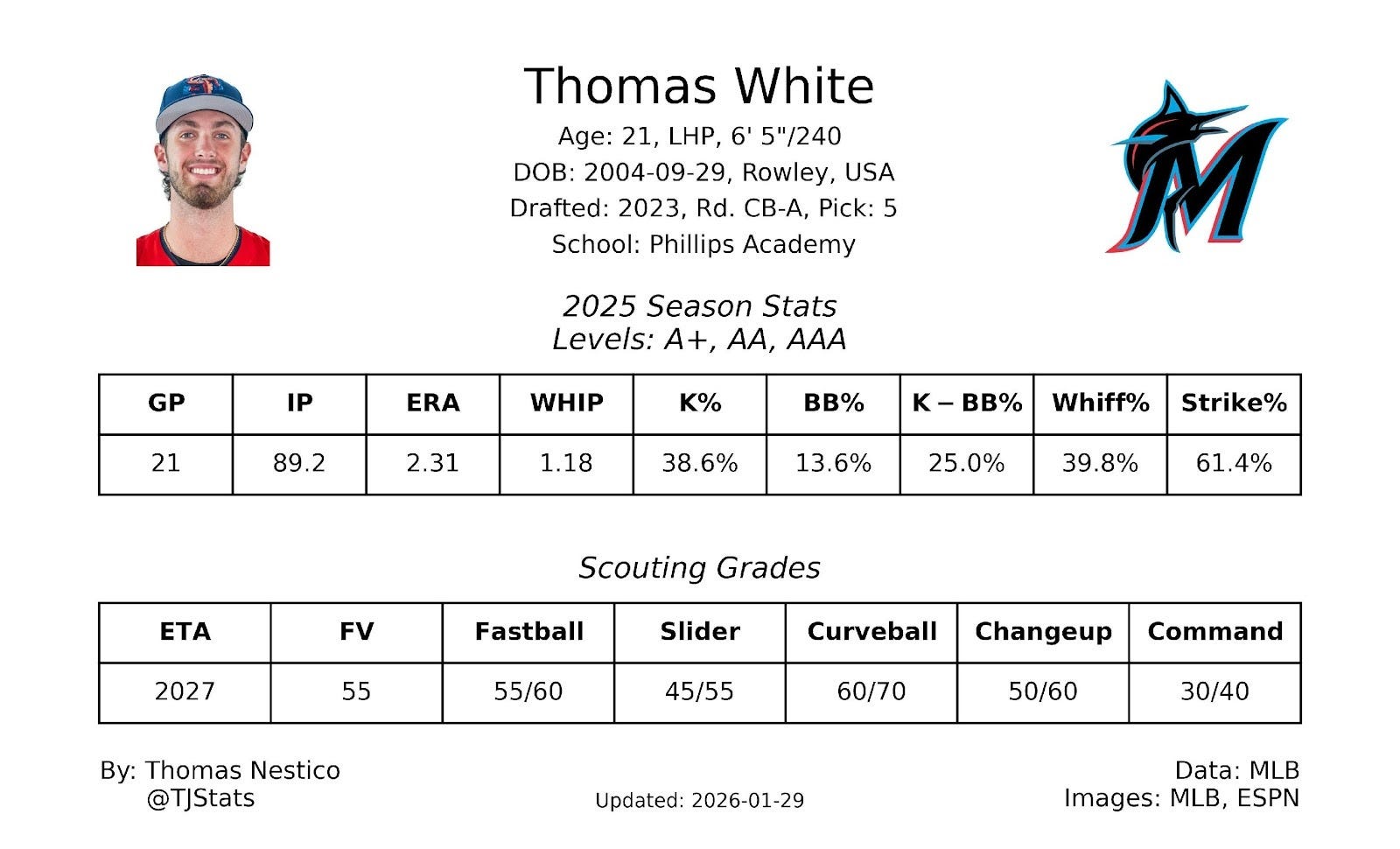
Thomas White wields a solid 5-pitch mix highlighted by a mid-90s fastball and a big, sweeping curveball. His fastball is a plus pitch thanks to the ride he can generate on the offering. He can hit up to 99 MPH and averages 17” iVB. His slurve is his main breaking ball with over a foot of glove-side movement and a fair bit of drop. It is effective at generating whiffs, and he isn’t afraid to throw against opposite-handed hitters. Last winter, he added a gyro slider and sinker to his arsenal which both grade out as average offerings. He rounds out his arsenal with an average-to-plus changeup, which sits at 85-87 MPH. His longer arm action tends to get in the way of his consistency, which may limit his command as he develops and struggles with throwing strikes have worsened in the upper minors. White’s electric stuff and wipeout strikeout numbers illustrate his immense upside, with only his ability to locate the ball restricting his ceiling.
26) Gage Jump - P - ATH
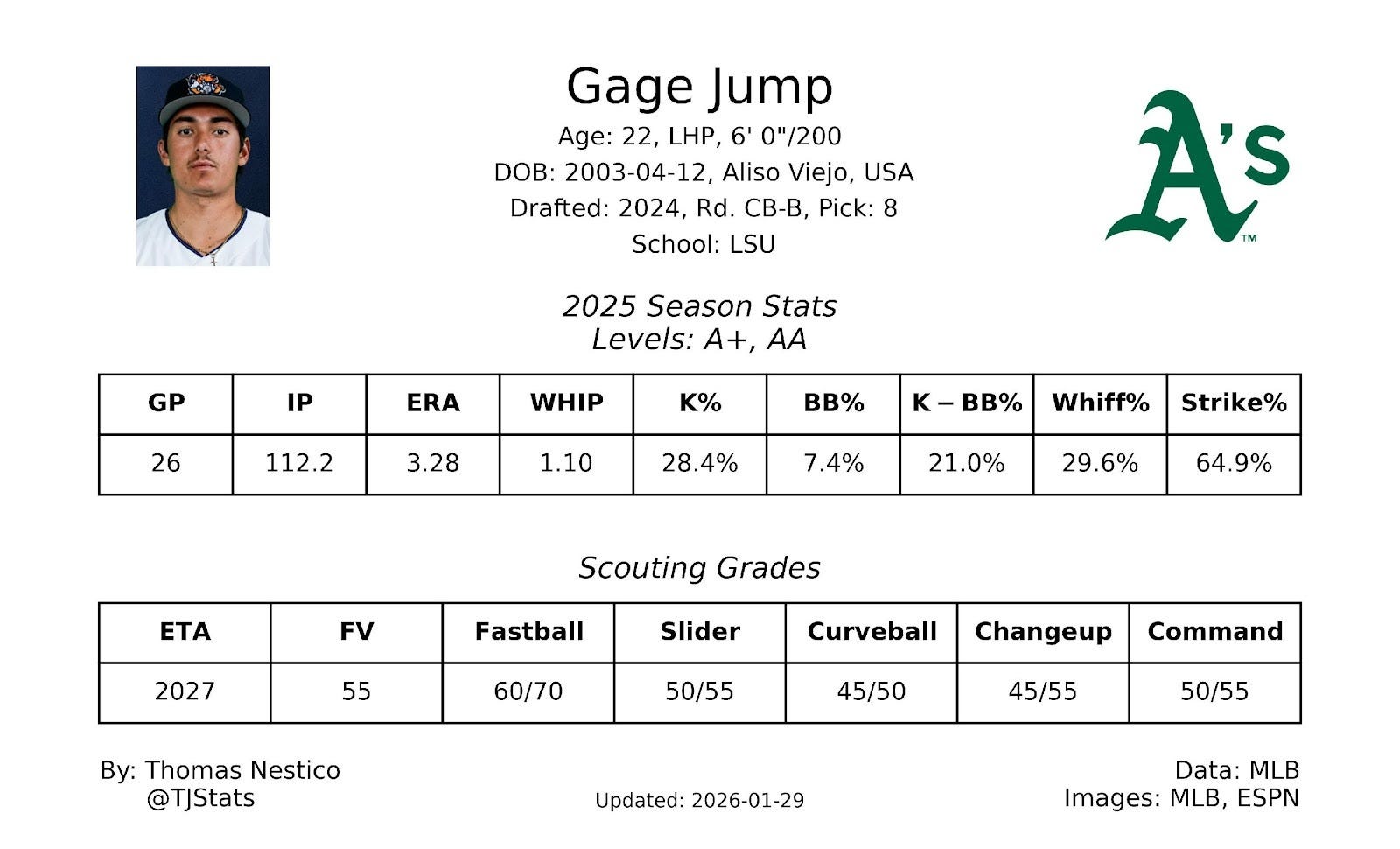
Gage Jump was selected 73rd overall in the 2024 Draft. He missed the 2023 after undergoing Tommy John Surgery but returned strong in his final year in college. This season he is making a name for himself as one of the best pitching prospects in baseball with an electric combination of stuff and command. Jump releases from a 3/4 slot and he utilizes his smaller stature to get low and create a deceptive approach on his offerings. His fastball is one of the most dominant offerings in MiLB thanks to its mid 90s velocity and high rising action. He has an excellent feel for the pitch and it misses bats in the zone at an exceptional rate. He pairs his fastball with a mid-80s changeup that exhibits nearly a foot of vertical separation. Jump wields a trio of breaking balls: a slider, a sweeper, and a curveball. His slider exhibits slight glove-side action at 85 MPH and mixes it in against both LHH and RHH. His sweeper is exclusively used against LHH where its 81-83 MPH velocity and ~12” of sweep works well as a put away offering low and away. His curveball sits in the high 70s with two-plane action. Jump’s biggest drawback is his violent delivery, although his strike throwing has greatly improved this season. He has some relief risk, but the arsenal paints the picture of a future mid-rotation arm if he can remain consistent. If everything clicks, his ceiling is sky high!
27) Ryan Sloan - P - SEA
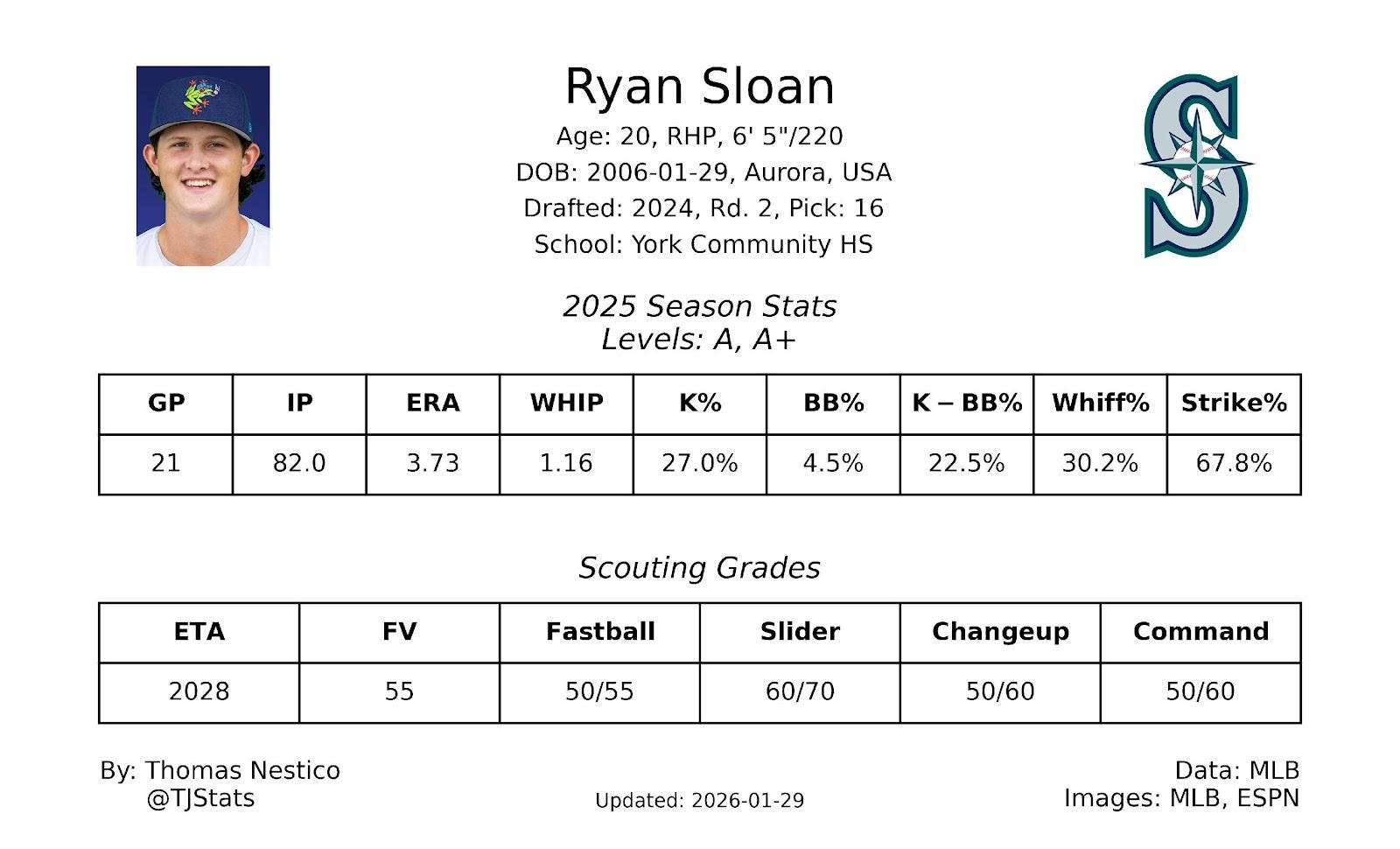
Ryan Sloan was selected in the 2nd round by the Mariners in the 2024 draft and has quickly impressed scouts with his combination of size, stuff, and command at just 19 years old. His fastball sits in the mid 90s with ~13” iVB from a 5.4’ vertical release. His slider is a nasty offering, reaching upwards of 20” of sweep while sitting in the mid 80s. It is easily a plus pitch and has the potential to be an elite weapon. His changeup may be the best in the Mariners system thanks to its late fading action. Sloan has the ideal frame for a pitcher which pairs well with his smooth and repeatable delivery. He has a massive up arrow on him and room with plenty of room to fill out. His upside is a frontend starter, and all signs point to him rapidly approaching top pitching prospect status.
28) Kade Anderson - P - SEA
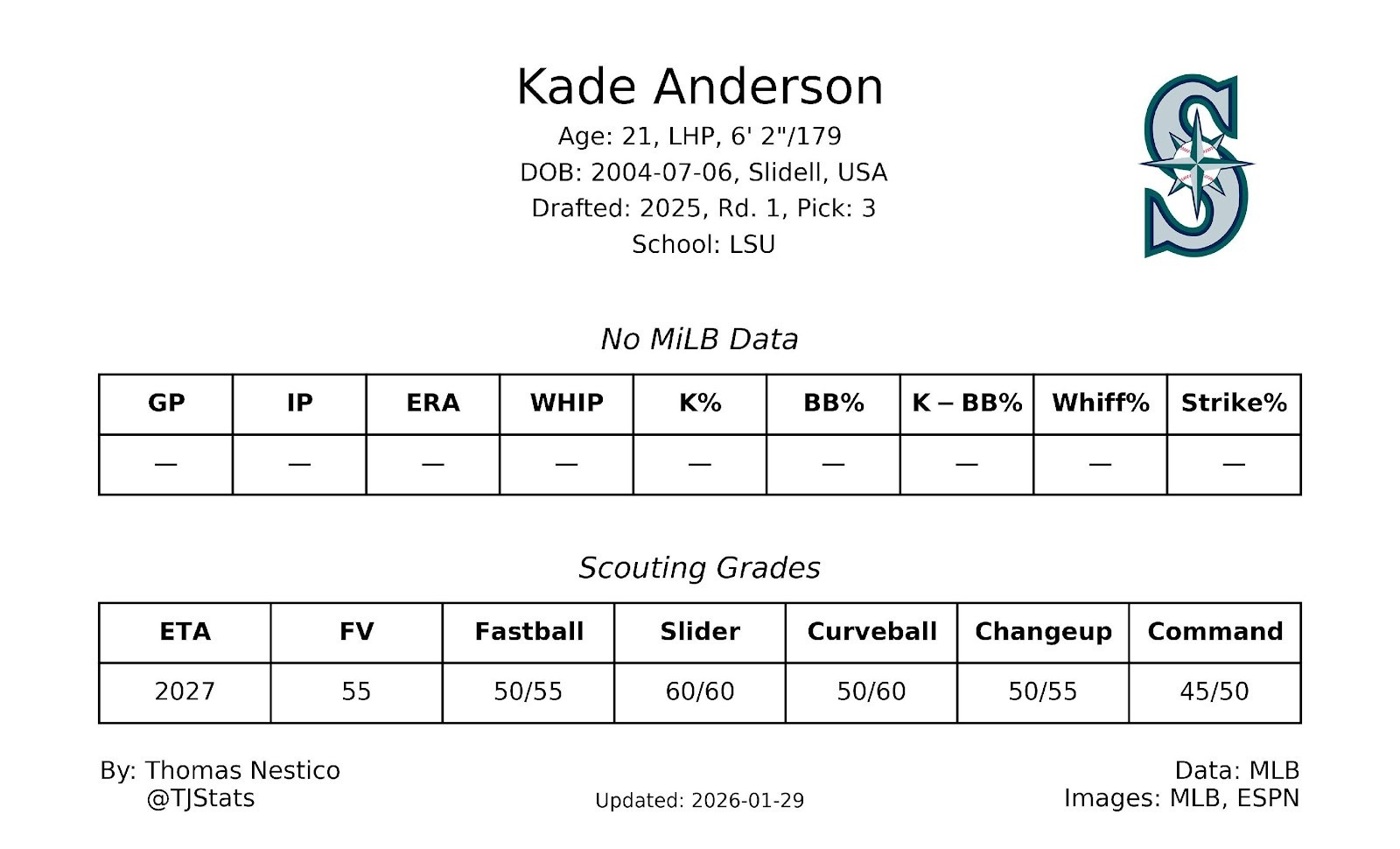
Kade Anderson fell into the Mariners lap at 3rd overall in this year’s draft. He was considered the most polished pitcher available and his eye-popping strikeout numbers at LSU back that up. He has an ideal frame for a starter, standing at 6’2” with a leaner look compared to his peers. He wields a quartet of pitches all of which grade out as above average offerings. His fastball stands out in his arsenal, sitting at 92-94 MPH with plenty of life from lefty slot and returning excellent 34% whiff rate on the year. His remaining secondaries all posted outstanding results with his breaking balls carrying most of the load. His 84-86 MPH slider averages nearly a half of foot of glove-side movement with slight depth to slip under bats while his curveball has much more exaggerated two-plane action at a much slower velocity band. He rounds out his arsenal with a lower spin changeup that sits in the lower 80s with moderate movement deviation from his fastball. Despite the excellent Zone% and Strike% in college, Anderson can be described as a “control over command” pitcher. His stuff simply overpowered college hitters and allowed him to get away with more mistakes that he likely should have. Overall, Anderson wields an extremely dynamic arsenal and is in the perfect organization to maximize his potential.
29) Caleb Bonemer - SS - CWS
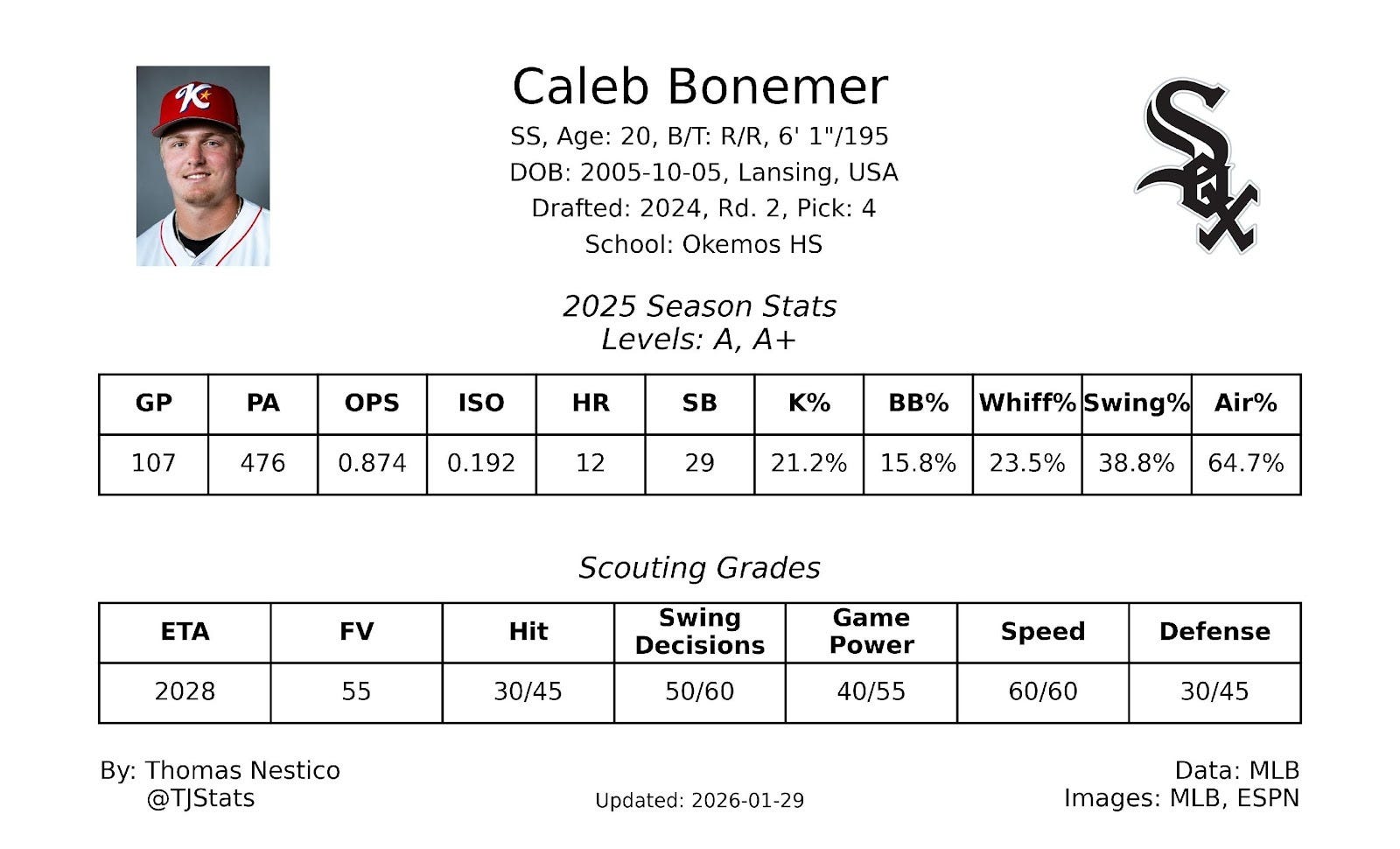
The White Sox convinced Caleb Bonemer to forego his commitment to Virgina with a comfy $3M signing bonus and they must be happy with the outcome now. Bonemer raked in his first pro season, posting a 151 wRC+ across 107 games including 12 HR and a phenomenal 15.8% walk rate. The carrying trait for Bonemer is his excellent sense for the strike zone. His 20% chase rate ranked amongst the best of any 2024 prep draftee. He also flashed encouraging power upside with a strong 104.6 MPH 90th% EV and 40% HardHit rate. As he develops expect the slugging results to remain fruitful as his quick hands and compact swing led to a boatload of pull power this season. He quelled concerns about his hit tool this, however, there still remains some concern regarding his bat-to-ball skills, most notably against spin. He grades out comfortably as an above average runner, yet his lack of range and arm strength may pigeonhole him to second base. Bonemer’s offensive upside is tantalizing and if he can stick at shortstop he has the potential to be one of the most valuable prospects in baseball.
30) Bryce Rainer - SS - DET
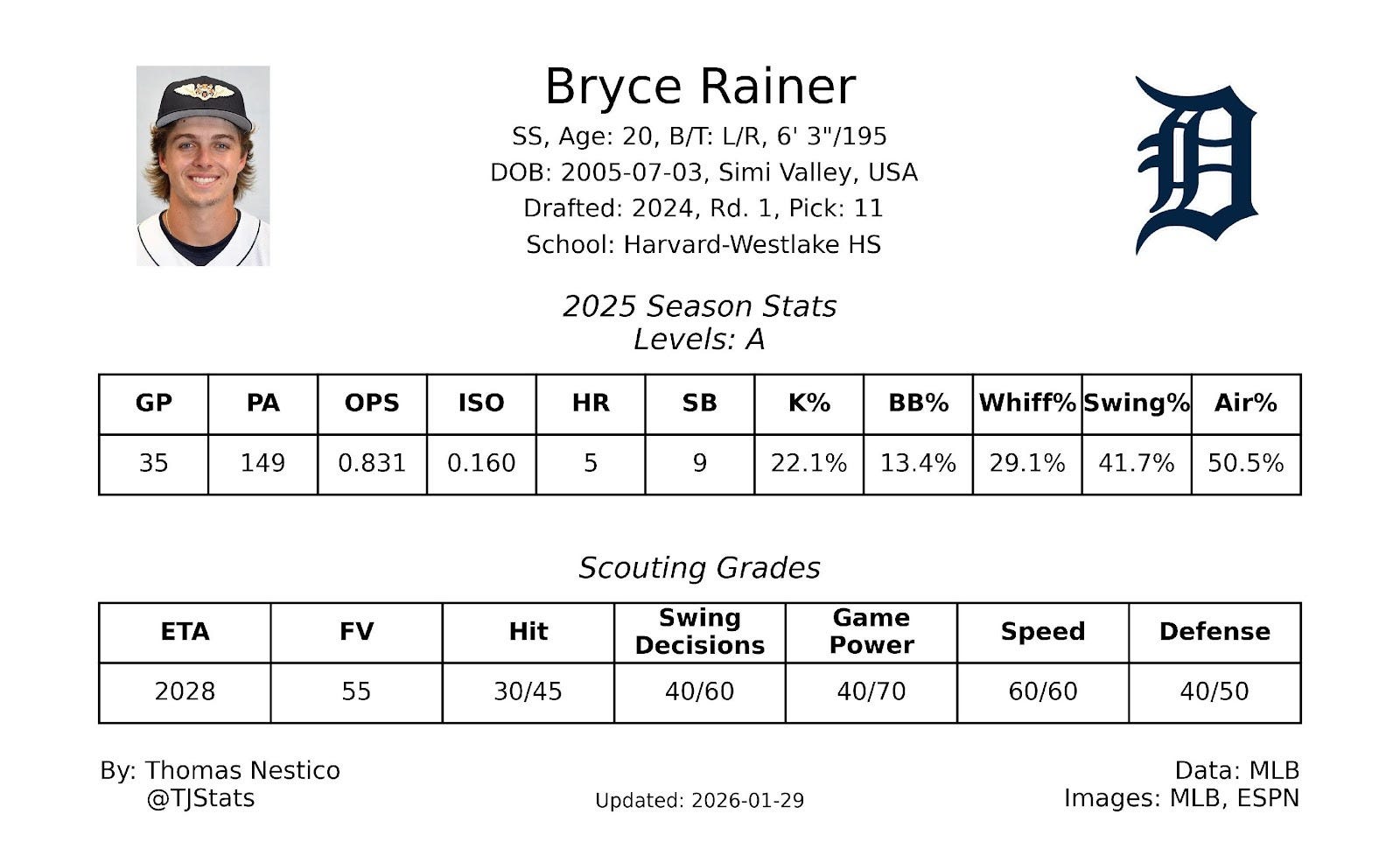
Bryce Rainer was on the trajectory of being a Top 10 Prospect before a shoulder injury ended his pro debut after just 35 games. Similar to fellow draft classmate Konnor Griffin, Rainer was head and shoulders above his peers in terms of power output and athleticism. He looked like a natural at SS and his 108.0 90th% EV easily explained how he maintained a HardHit rate above 50%. His swing decisions were also exceptional, running a O-Swing% near 20% and patiently battled back into at bats when sitting on 2 strikes. It wasn’t all smooth for Rainer though as he struggled with in-zone miss, particularly against secondaries. He also hit far too many ground balls, with nearly half his batted balls landing in the infield. It will be telling to see how Rainer bounces back from shoulder surgery as it is notorious for sapping power. If he doesn’t miss a beat, expect him to propel himself up prospect lists and join his fellow Detroit teammates.
31) Luis Peña - SS - MIL
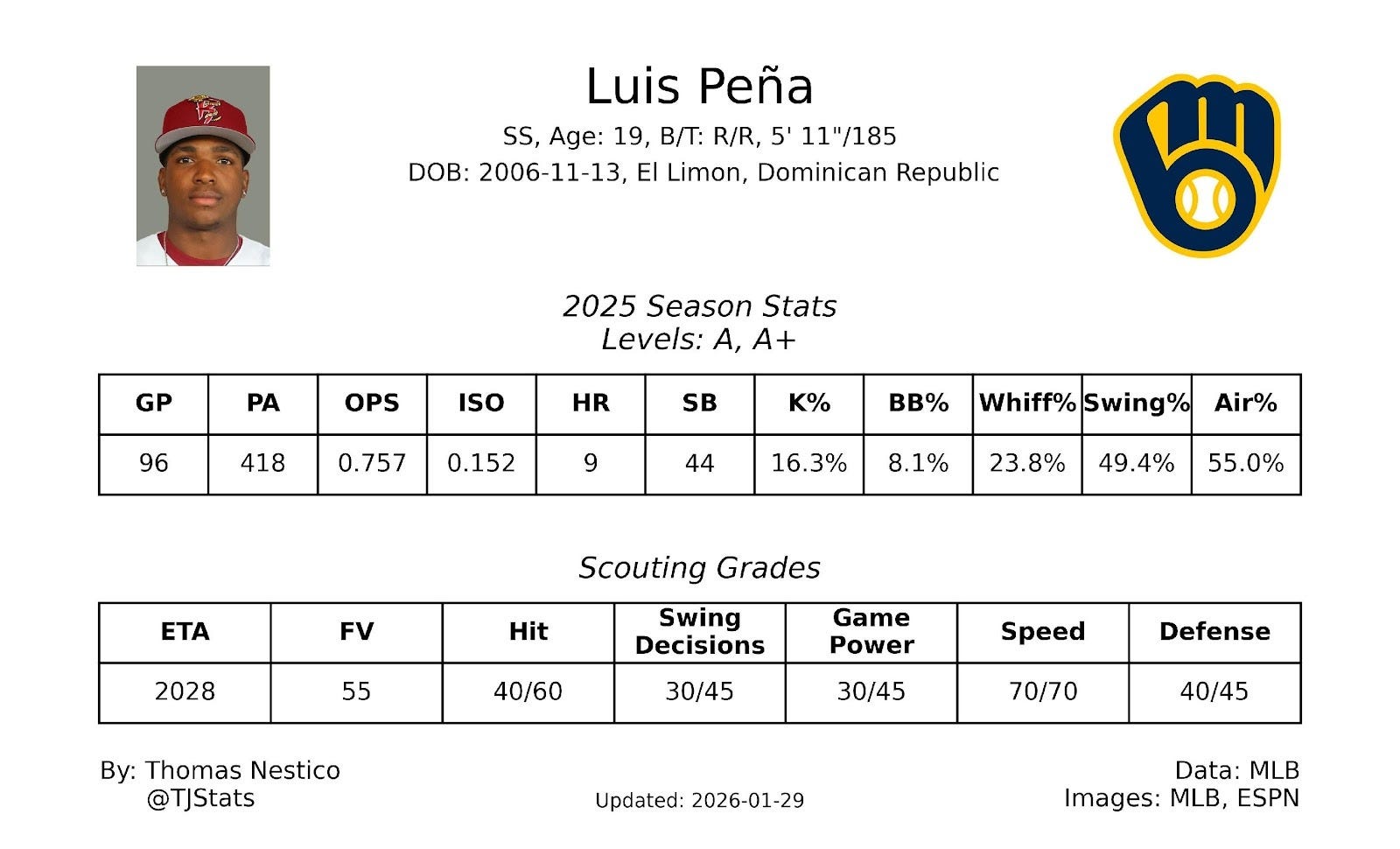
Luis Pena’s 2024 DSL season overshadowed by his teammate Jesus Made, but that shouldn’t detract from how excellent it was. He posted a 173 wRC+ while tacking on 39 SB in just 44 games, a showing that earned him a spot in full season ball less than a year later. With the Mudcats (Lo-A), Pena continued the stellar start to his pro career with an excellent .844 OPS while flashing his elite speed and exhibiting more power. His 104.4 MPH 90th% EV aligned him amongst some of the best at the level and looks more impressive given both his size and age. Despite this, his flatter bat path greatly limits his slugging potential. His hit tool is advanced and projects to be plus despite a major roadblock upon reaching Hi-A, especially against breaking balls. The biggest hole in his profile remains his lacklustre approach, which sits well below average thanks to an imbalance of chases and in-zone aggression. The Brewers positioned him all around the IF this season, however he will likely end up at 2B given his poor arm strength. Pena will have plenty of time to iron out his kinks, with his innate hit tool and speed to keep him afloat against tougher competition.
32) Josuar Gonzalez - SS - SF
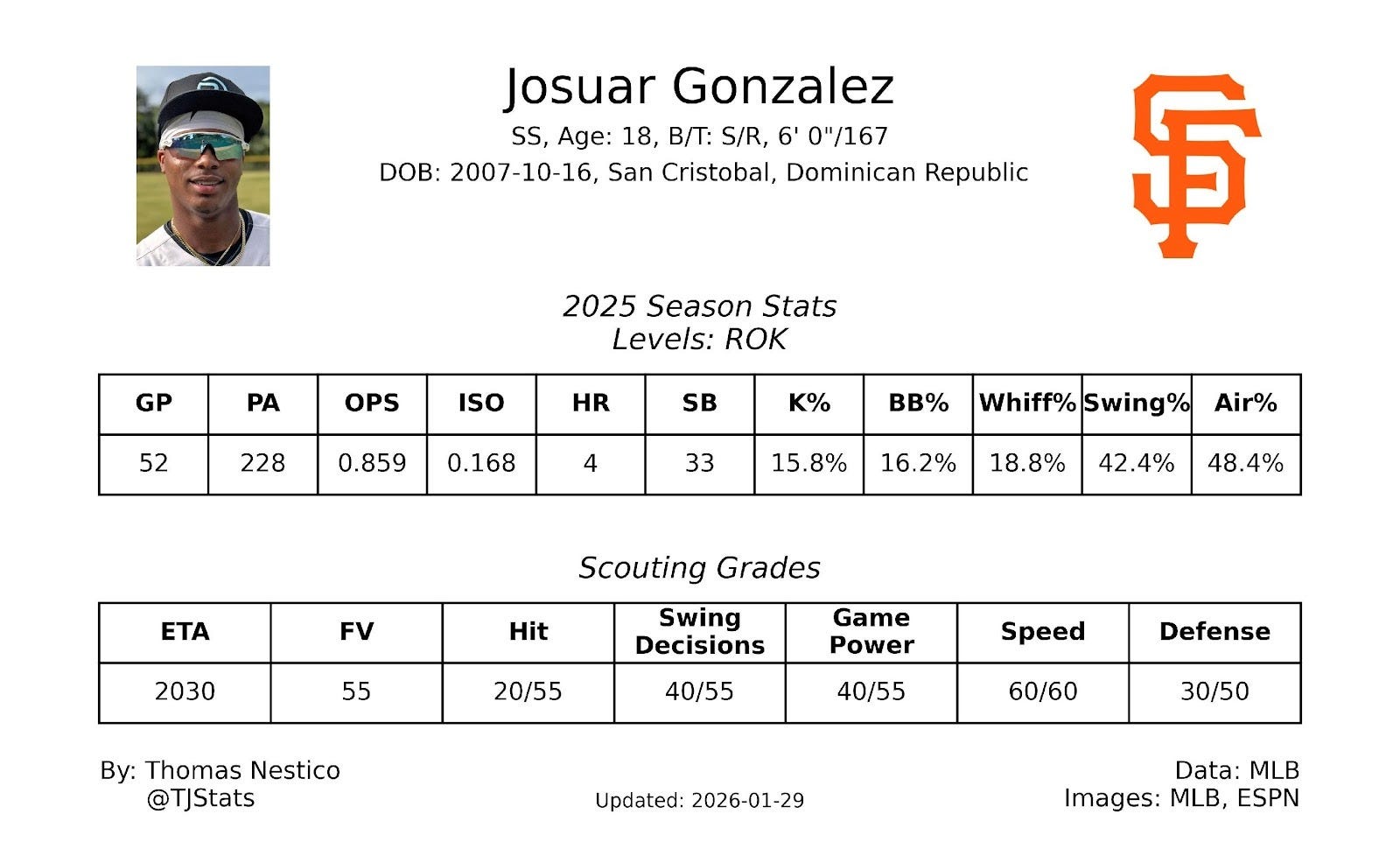
Josuar Gonzalez landed a lucrative signing bonus from the Giants in 2025 international amateur class and went straight to work proving he was easily worth the money. His results in the DSL were strong (129 wRC+), but the true value came from his underlying metrics. He displayed sophisticated bat-to-ball skills exhibited by a remarkable 88% Z-Contact rate with more walks than strikeouts. His entire toolkit projects to be at least average across the board which is ridiculous to hear about a 17-year-old in his first taste of pro baseball. All eyes will be on Gonzalez next season where he should make his stateside debut and continue storming up prospect lists.
33) Bryce Eldridge - 1B - SF
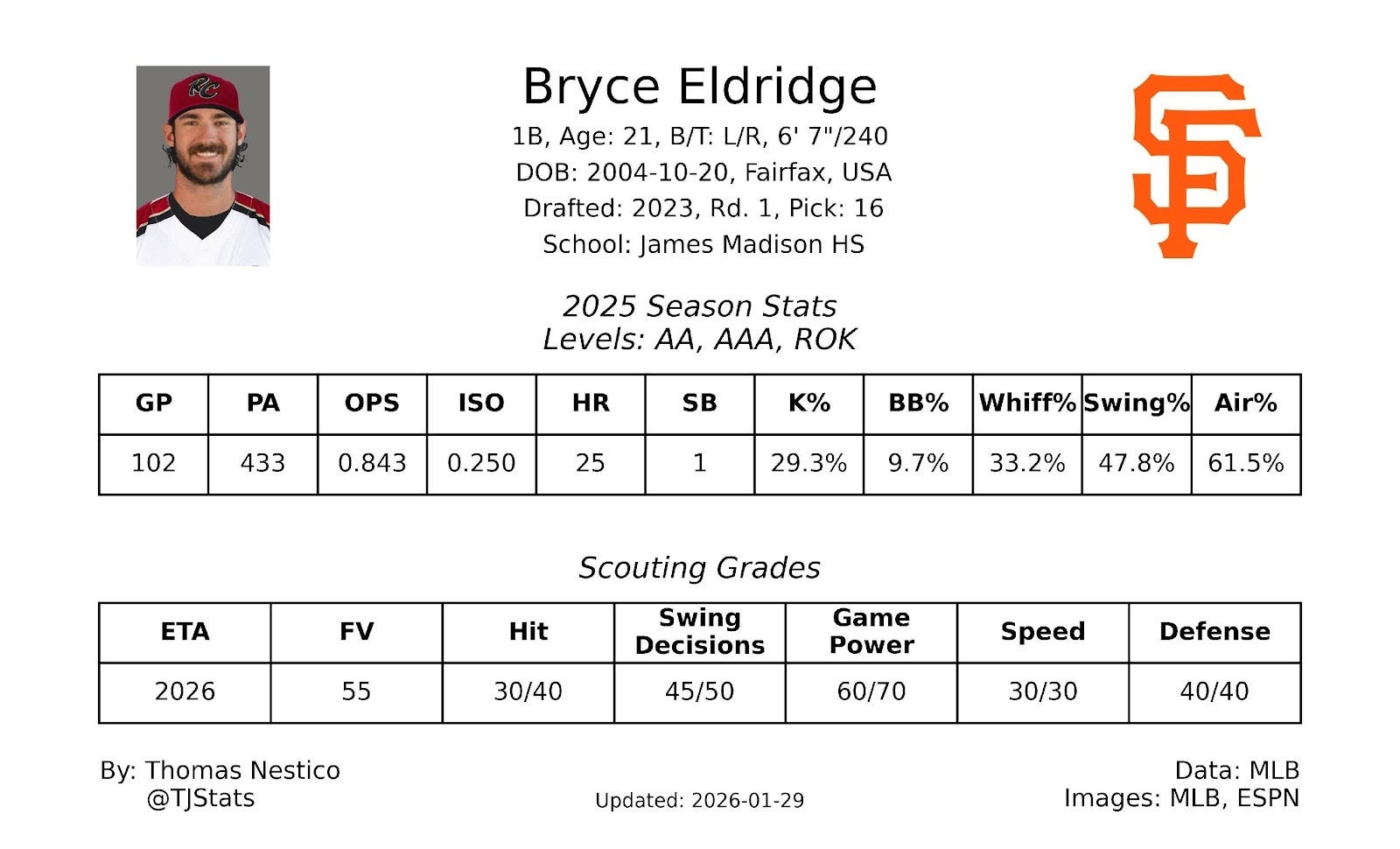
Bryce Eldrige looks like he was built in a lab with the goal to build the best power hitter ever. Standing at a staggering 6’7”, it is no surprise that he already ranks amongst the best sluggers in MLB in every conceivable power metric. He has a perfect swing to barrel up the ball and his 62.3% HardHit rate helped fuel his .250 ISO and 25 home runs. With such great power typically comes big hit tool concerns, and that is the case with Eldridge. His 33.2% Whiff rate ranked near the bottom of AAA and was significantly worse against secondaries. He also doesn’t provide much on the basepaths and is likely a fulltime 1B/DH. The power upside is quite possibly the highest of any prospect, but the hit tool flaws and lack of defensive versatility hamper his outlook.
34) Josue De Paula - CF - LAD
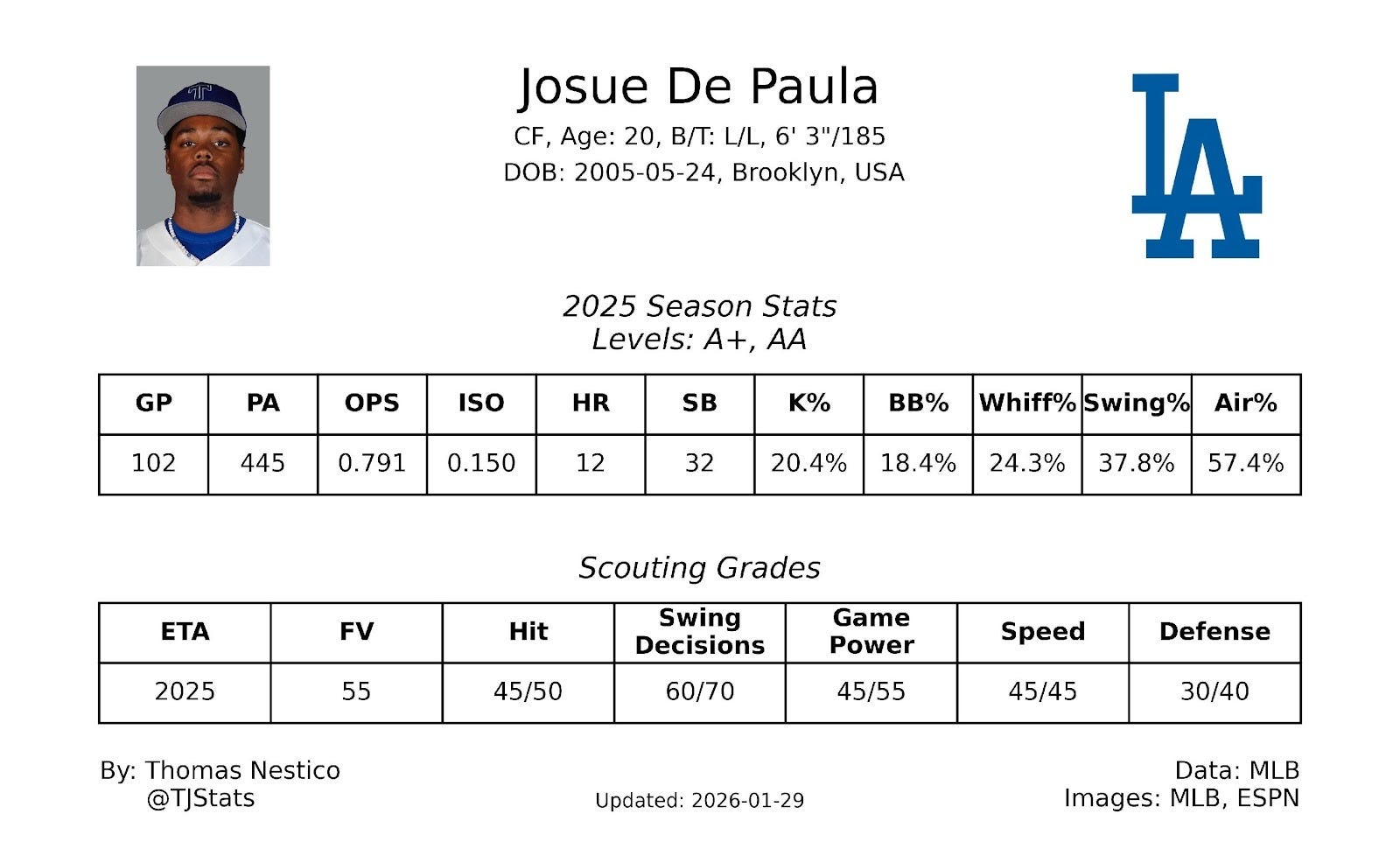
Josue De Paula may have the sharpest eye of any prospect in baseball. His ability to identify pitches of all types is outstanding and fuelled his incredible 18.6% walk rate and 14.6% O-Swing rate. On top of his extremely patient approach, he boasts a towering 6’3” frame with plenty of room to fill out and develop strength. He has a fluid swing which he showed off brilliantly after smacking a home run in the Futures Game this season. He ran average contact rates this season, however they dipped to below average against in-zone offerings, particularly secondaries. He grades out as a below defender in the outfielder, but his elite arm strength should make him a mainstay in the corners as he moves through the system. Overall, De Paula is a prototypical patient slugger with a tantalizing power projection.
35) Zyhir Hope - CF - LAD
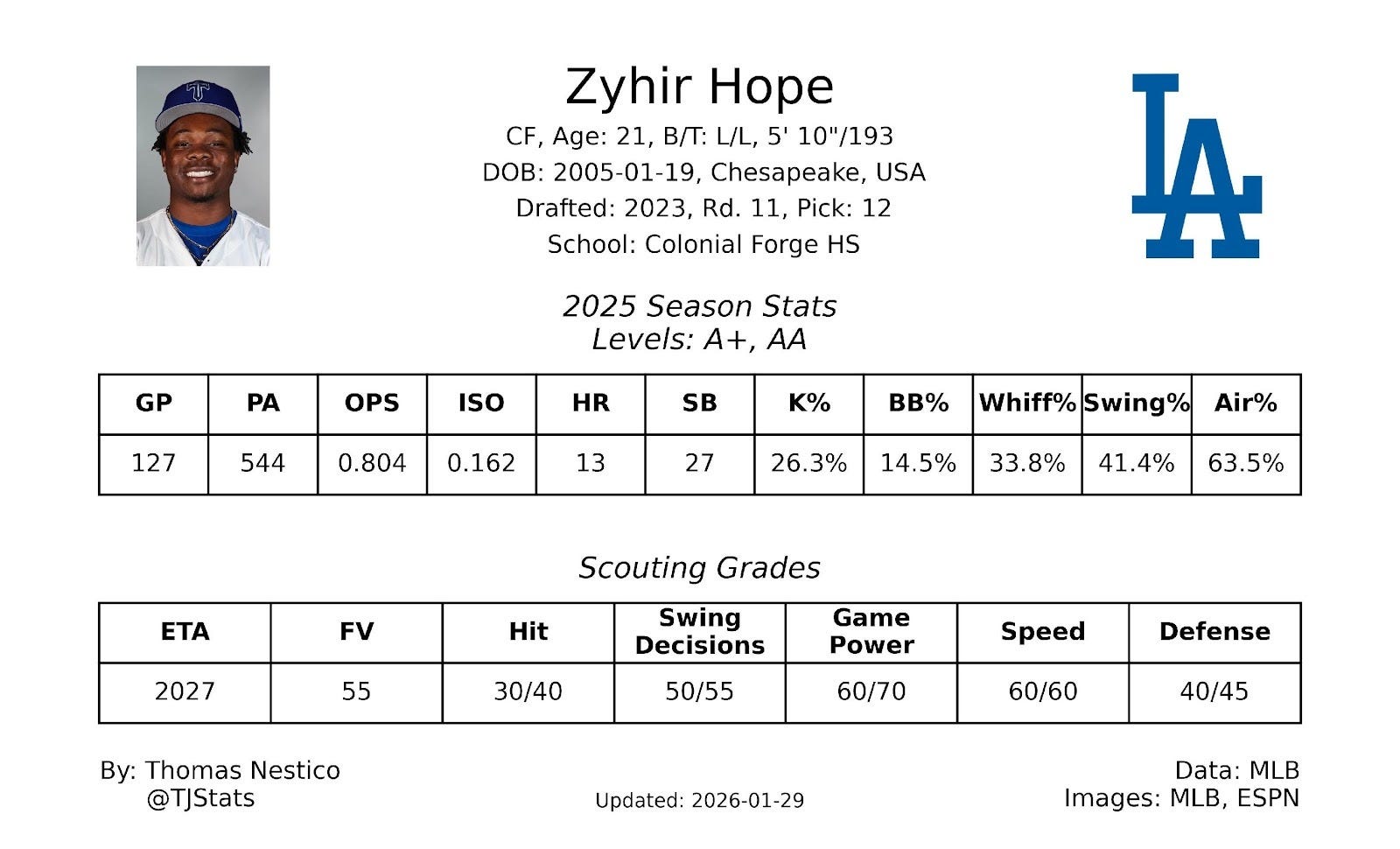
Zyhir Hope doesn’t look too imposing at the dish, but that shouldn’t detract from the pop he holds in his bat. With plus-plus bat speed and an upward swing path which oozes staggering home run potential, Hope has the virtue of one of the highest power ceilings of any prospect in baseball. Supporting his quick hands is his astounding ability to identify secondaries and both lay off and punish them when appropriate. His 109.2 90th% EV ranks amongst the best of his peers, including some of the more well-established sluggers in the majors. Akin to those very same sluggers, Hope struggles mightily with swing and miss, particularly against both in-zone and off-speed pitches. These issues only worsened throughout the season despite being more familiar with opposing pitchers in Hi-A. Hope’s plus speed and blistering arm strength should play very well in the outfield with his less-than-ideal route efficiency likely forcing him to the corners. Overall. Hope is an extremely tooled up slugger with alarming hit tool concerns that are partially quelled by his sharp eye.
36) Eduardo Quintero - OF - LAD
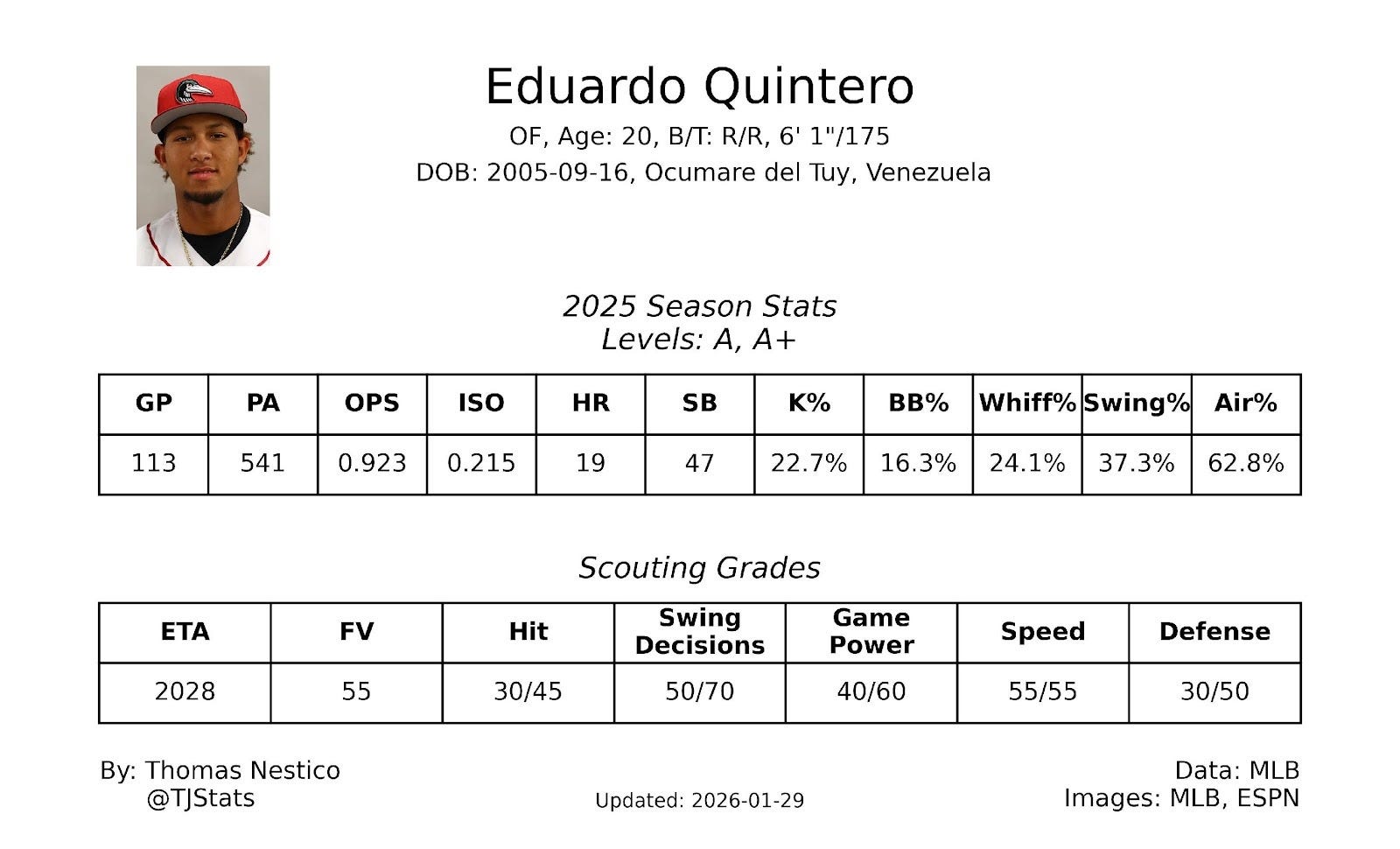
It really does feel like the Dodgers spawn electric prospects out of the nowhere, and Eduardo Quintero is yet another example. The athletic righty cruised in his first year in full-season ball which saw him wrap up the year in Hi-A with a 153 wRC. Quintero’s profile feels like a blend of fellow farmhands Josue De Paula and Zyhir Hope. This is to say that his offensive profile mirrors the steady and sharp hit tool and approach of DePaula and marries it with the uber-athletic and powerful tools of Hope. Quintero is also an excellent runner that projects to be above average defender in center field. It is an impressive skillset that lines Quintero up for a meteoric rise up the Dodgers farm system.
37) George Lombard Jr. - SS - NYY
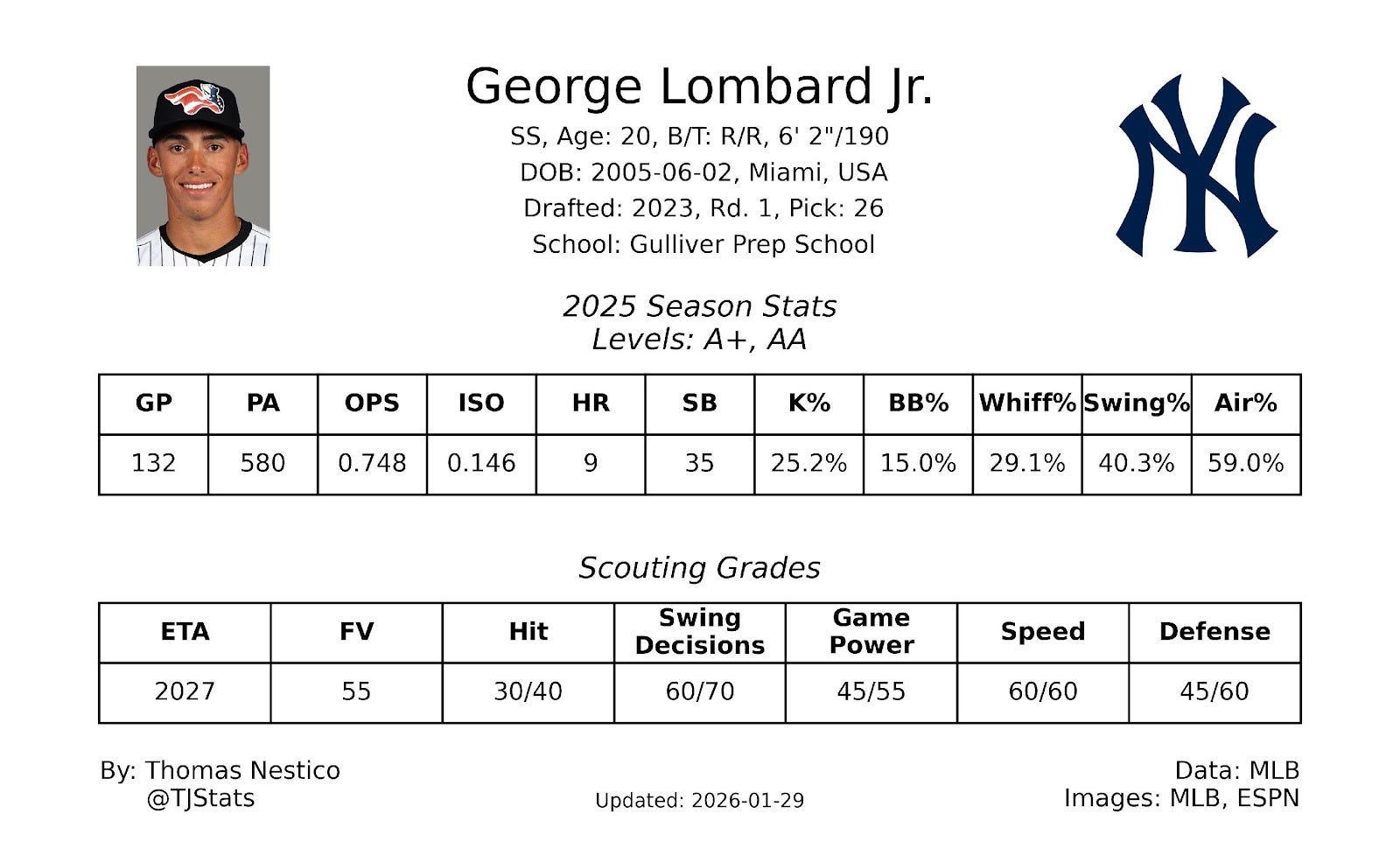
The Yankees told us how they view George Lombard Jr. after he was swiftly promoted to AA before his 20th birthday. While Lombard had some growing pains against upper minors competition, he maintained his skills that prompted his rapid rise through the system: his incredible eye, plus baserunning, and excellent SS defense. He ran an impressive 16.6% O-Swing rate to support his exceptional 15.0% walk rate and held back on chasing with two strikes to simmer down his strikeout rate. His hit tool needs the most work as he struggled with in-zone whiff, with fastballs being the biggest culprit. His power metrics indicate that he can reach at least average game power with the potential to be above average. His speed and defensive talent push his ceiling to towering heights, both projecting to be at least plus in each department. He will need to prove that he can outduel tougher competition before rising higher, but the floor screams everyday starting SS.
38) Andrew Painter - P - PHI
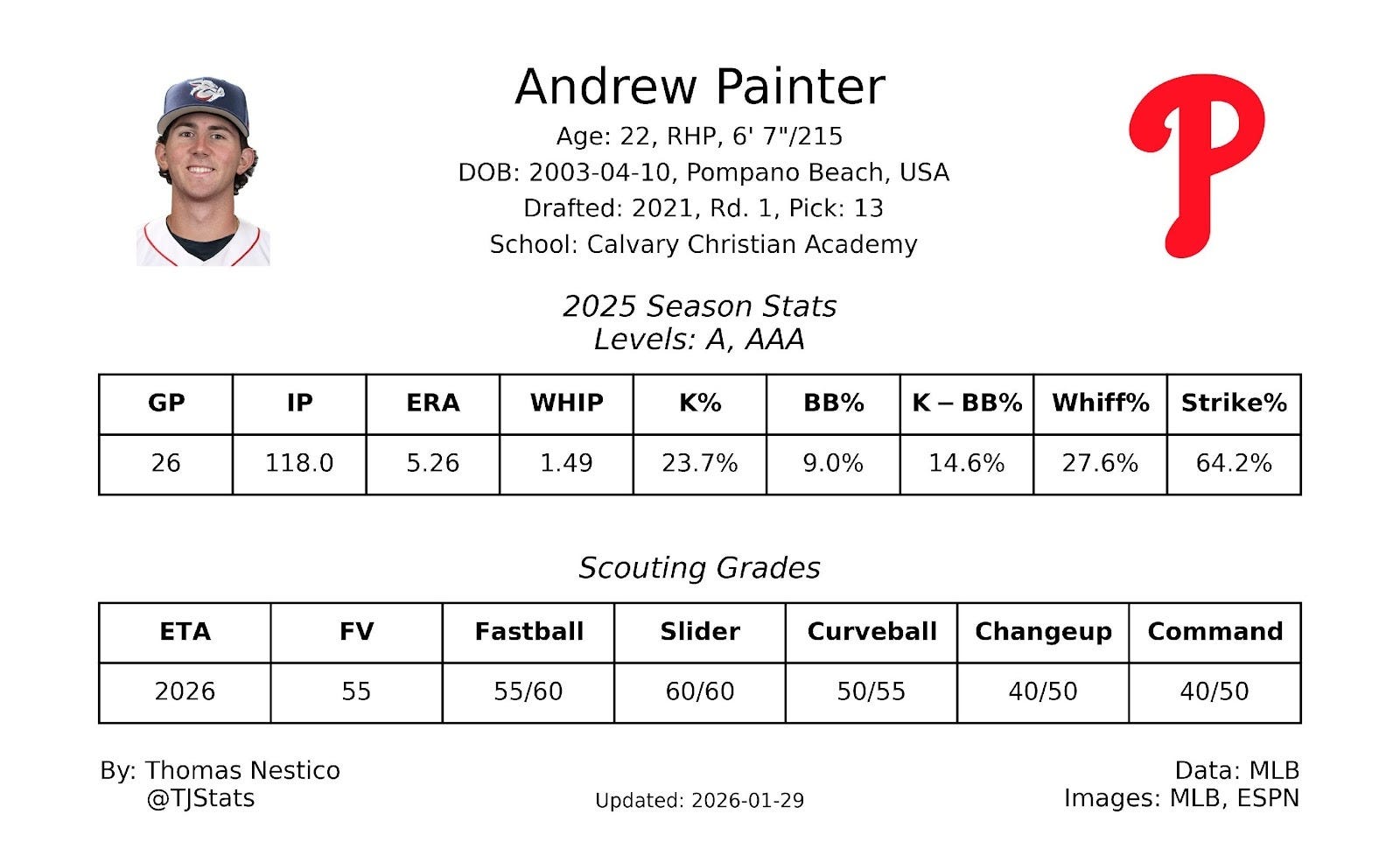
Nominative determinism worked overtime with Painter as he projected to be a top of the rotation starter with bonkers stuff and great command. Painter was on the fast track to Philadelphia as he mowed through MiLB batters in his first full professional season while showcasing elite stuff and pin-point command. Unfortunately, Painter has had his Major League debut delayed for 2 years since suffering an elbow injury during 2023 Spring and undergoing Tommy John Surgery later that year. Painter returned in the 2024 AFL and has been ramping up for his MLB debut with an extended stint in AAA. His fastball is sitting at 96-97 MPH, matching his 2022 levels, but he hasn’t registered a pitch over 100 MPH yet. He wields two different breaking balls: a slider at 86-88 MPH with 7” HB and a curveball at 80-82 MPH with two-plane movement. His changeup is still a work in progress, but thanks to Painter’s command and drastically different velocity bands, the pitch should be effective at inducing whiffs. Tapping back into his fastball dominance is the focal point, and with Painter’s command looking unfazed following his elbow injury, it bodes well for a quick path to Philadelphia and a future mid-rotation projection.
39) Jonah Tong - P - NYM
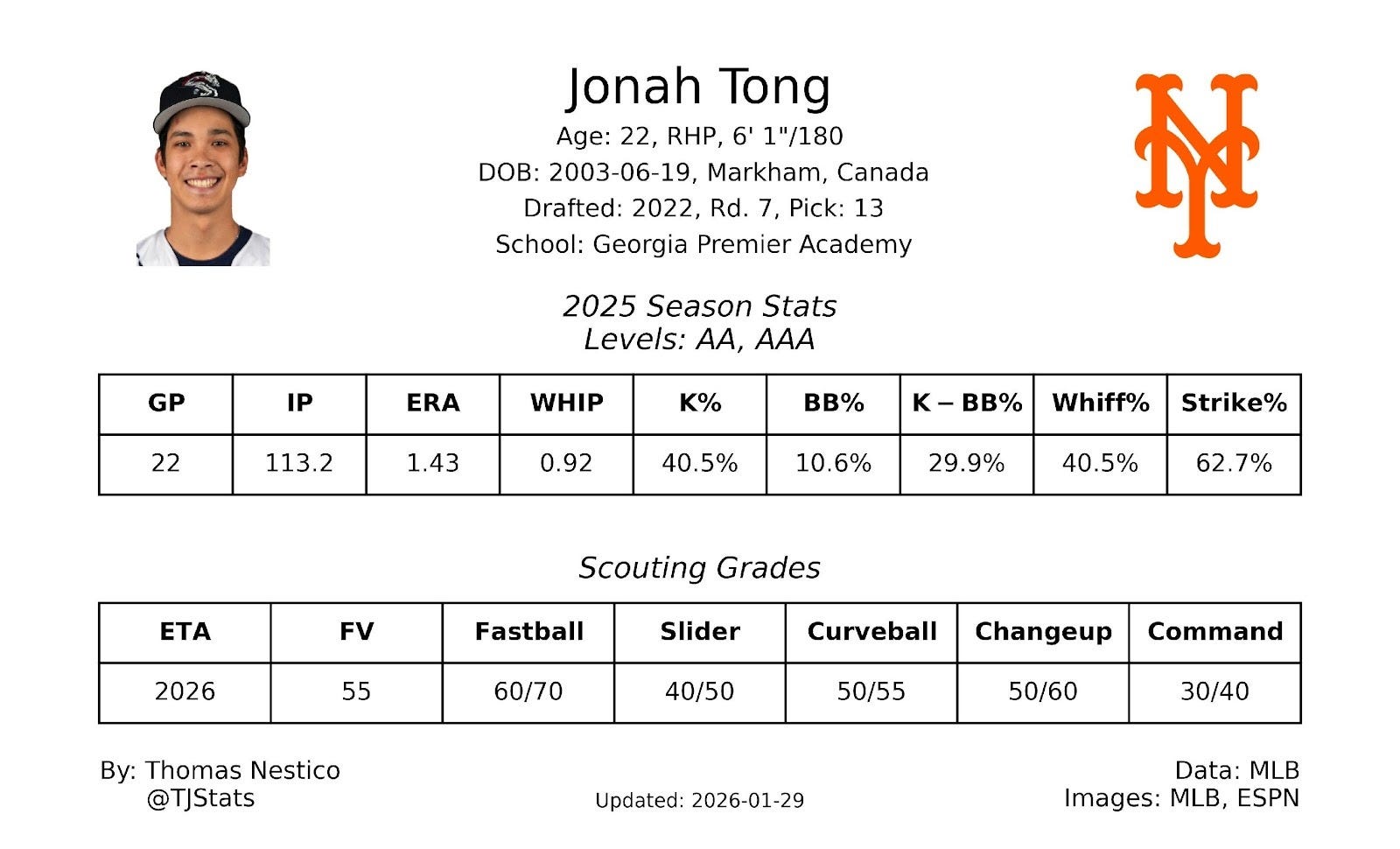
Jonah Tong struck out the world in 2025 while doing a fantastic job at limiting damage on all his offerings. His cut-fastball leads the way here thanks to the incredible ride on the pitch. This season it is averaging ~19” iVB while sitting 94-96 MPH, which is +2 MPH harder than in 2024. His over-the-top delivery is a massive driver into its high riding nature. Thanks to his smaller stature and above-average extension, he is able to get down to a ~6 ft vertical release point. The combination of massive ride from an unorthodox release aides in its effectiveness. Tong’s secondaries are a big point of discussion regarding his future as a starter. He has a wide array of them, including a changeup, curveball, slider, and a new cutter. The development of his changeup has been imperative to his success against LHH. It sits in the mid 80s, showcasing good velocity differential from his fastball. The biggest changes have come in its shape as it is showcasing a lot more depth as well as his feel of the pitch. He has been excellent with both its consistency and control, which has pushed it from a below average offering to plus. His curveball may be his most memorable pitch thanks to its massive vertical separation from his fastball. It sits at 76-78 MPH and can reach -20” iVB. That is over 3’ of separation from his fastball! He commands the pitch well, but there are concerns that the massive drop on the pitch in the mid 70s may not fool Major League hitters. Tong’s slider and cutter are his least used offerings and for good reason. He doesn’t have the greatest feel for them, and each exhibit subpar movement traits. Control still seems to be the biggest hurdle for Tong as he is struggling to throw strikes and get ahead of batters early in the count. His stuff is untouchable and his gaudy whiff rates and excellent damage metrics back it up, however his inability to generate chases keeps his walk rate well below average. His fastball will make him a stud bullpen arm in a pinch, but he needs more time to refine its command before being a mainstay in the Mets rotation.
40) Seth Hernandez - P - PIT
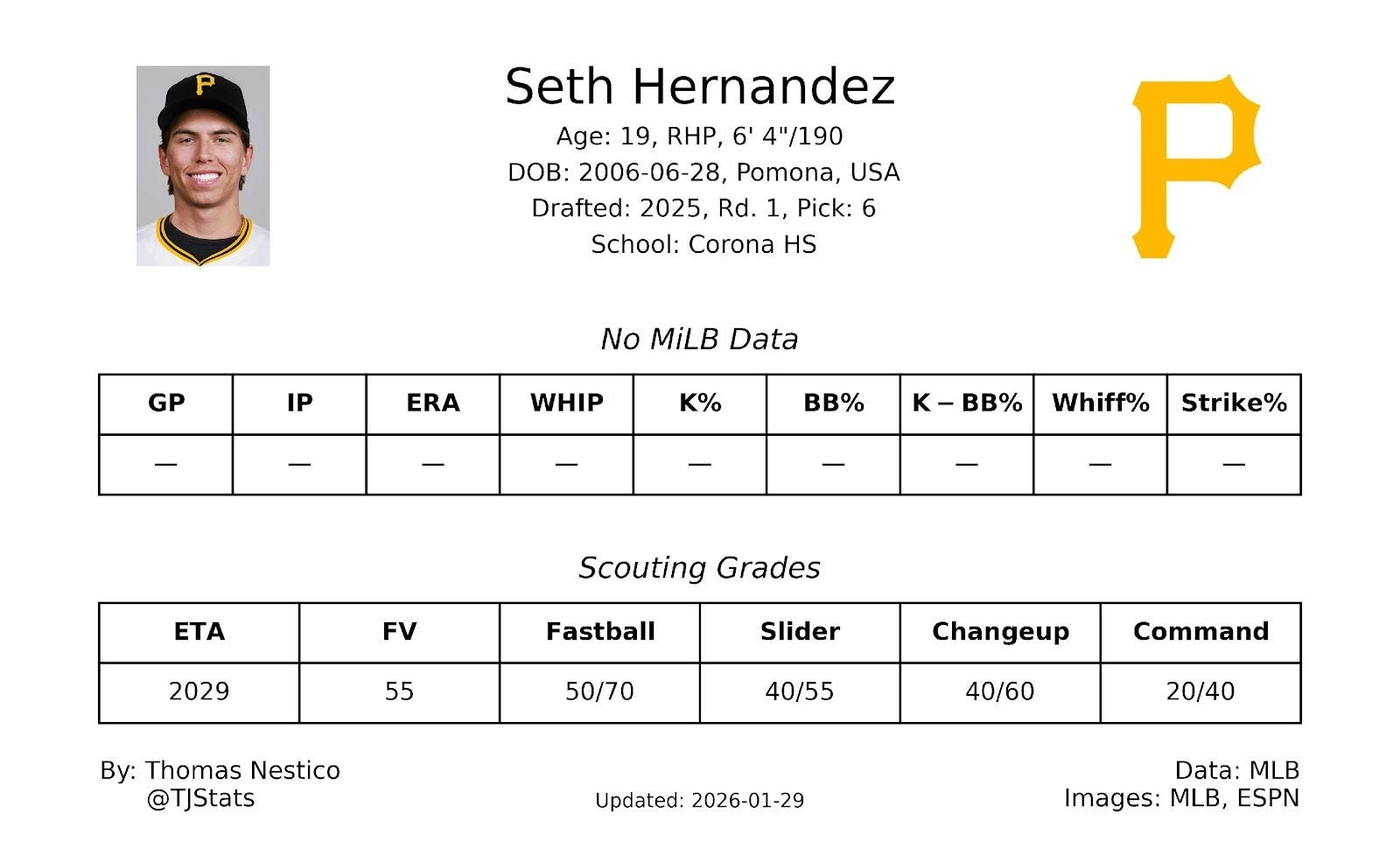
Seth Hernandez was a force to be reckoned with in high school. Standing at 6’4” with room to grow, Hernandez already had enough power to sit in the mid-to-upper 90s and touch 100 MPH on a whim. He supports his elite arm strength with an above average ability to spin the ball and generate both ride and run on his fastball. His changeup has the potential to be a plus-plus offering thanks to Hernandez’s arm speed and its deceptive tailing action. He also wields a pair of breaking balls: a slider with tight gyro-movement and steep curveball which sits in the upper 70s. Like most high school arms, Hernandez is plagued by inconsistencies with the command and shape of his pitches. His upside alone warranted his 6th overall selection in the draft, although he was considered one of the most volatile high-profile arms available.
41) Joshua Baez - RF - STL
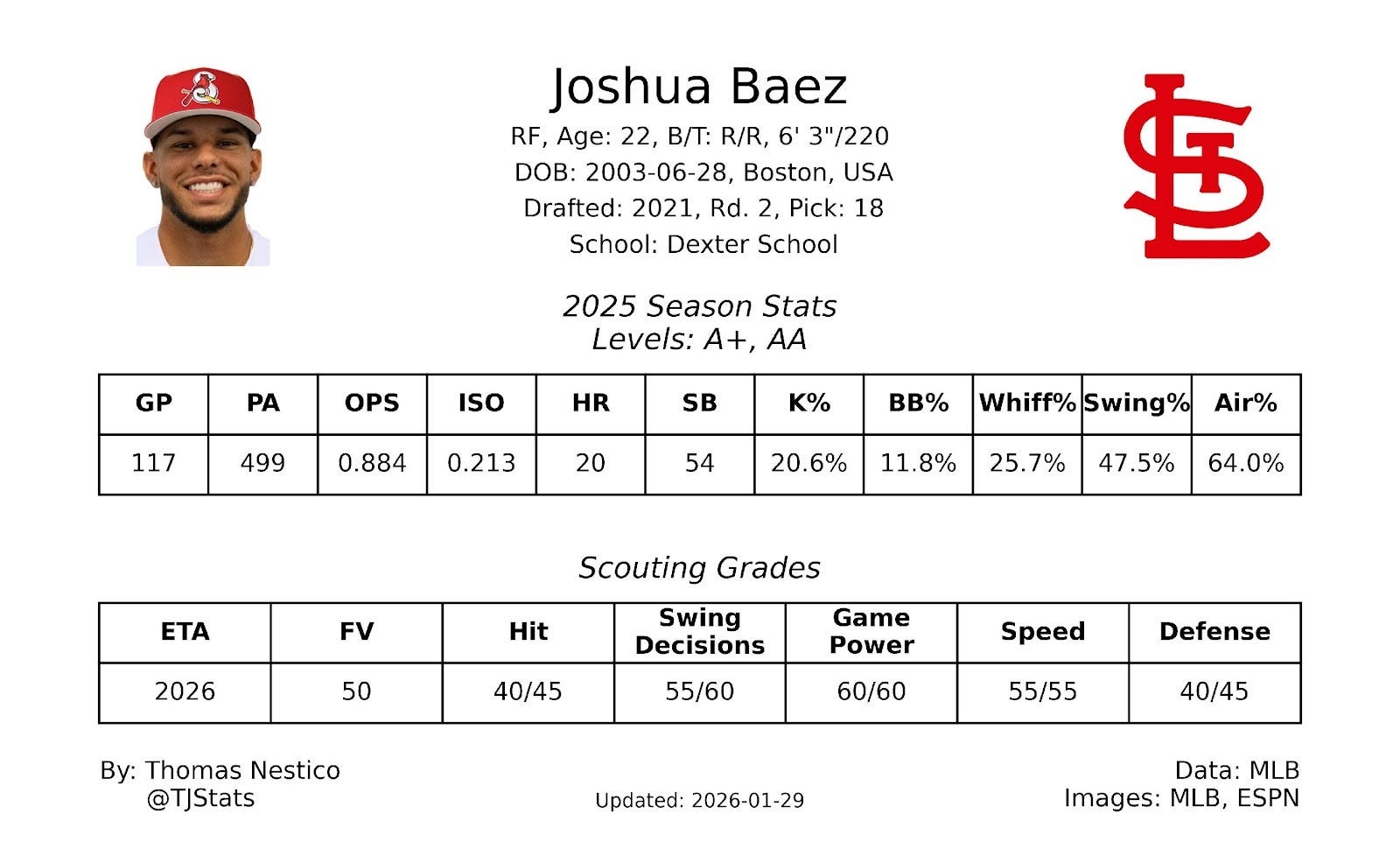
Joshua Baez put it all together in 2025 after launching 20 home runs and stealing 54 bases across 117 games. He took massive strides with bat-to-ball skills, slashing his whiff rate from 37.4% all the way down to 25.9%. These gains were accompanied with a more refined approach (24% chase rate), bountiful power (107 MPH 90th% EV), and a 15% reduction in strikeout rate. Essentially everything astronomically improved from a year prior and now Baez looks to be complete slugger with both the speed and defensive skillset to provide value outside of his bat.
42) Ryan Waldschmidt - OF - AZ
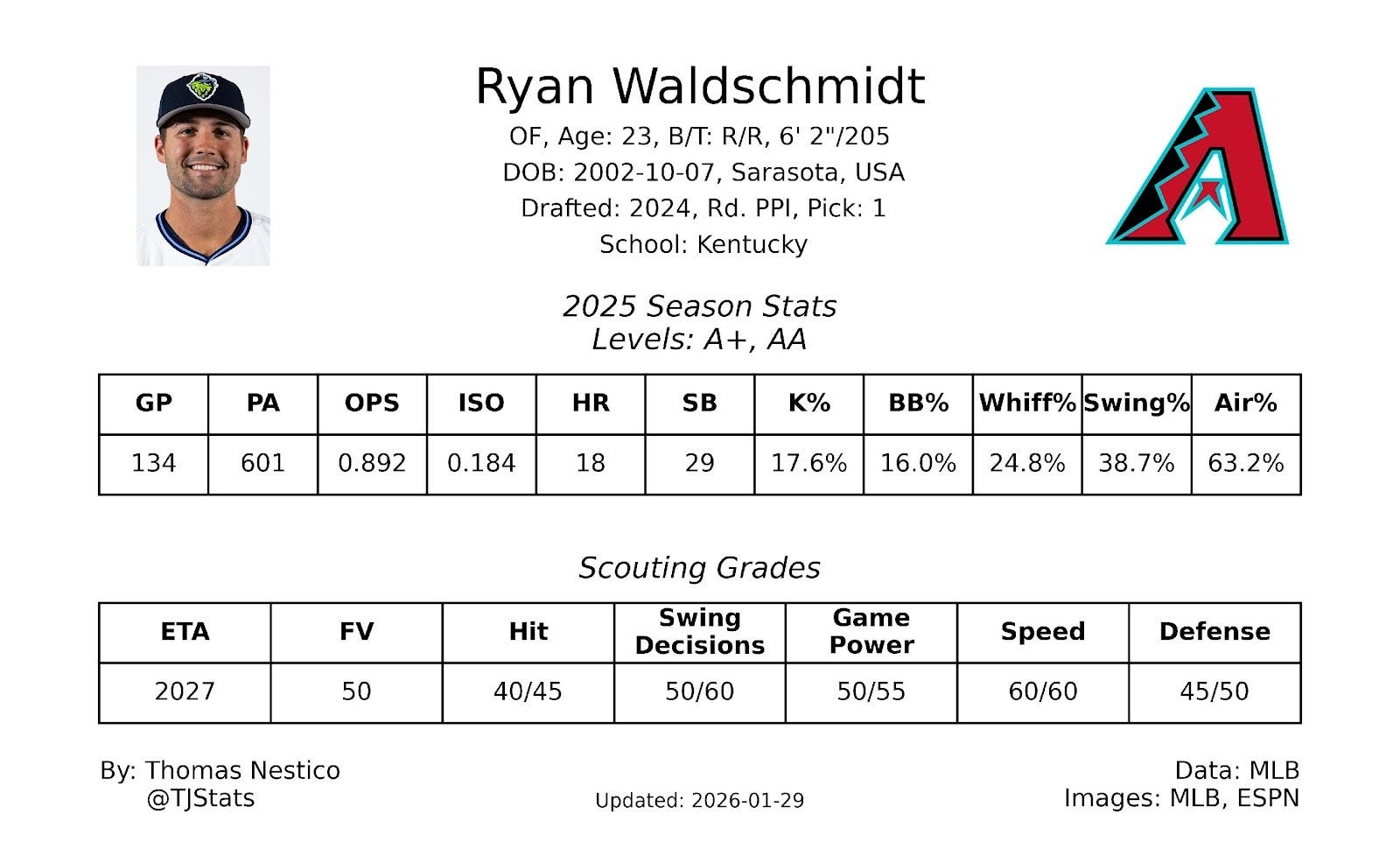
Ryan Waldschmidt is remarkably consistent. He posted nearly identical wRC+ marks at Hi-A (142) and AA (145) in his first pro season, showing that the jump in competition had no impact on his performance. Waldschmidt’s approach is the standout trait; he rarely expands the zone with two strikes and consistently battles deep into counts, supporting a solid walk rate while keeping strikeouts in check. He combines this approach with an average hit tool and projectable power that allows him to pull and lift the ball effectively. He is an above-average runner with a strong arm and should stick in either corner outfield spot.
43) Dylan Beavers - RF - BAL
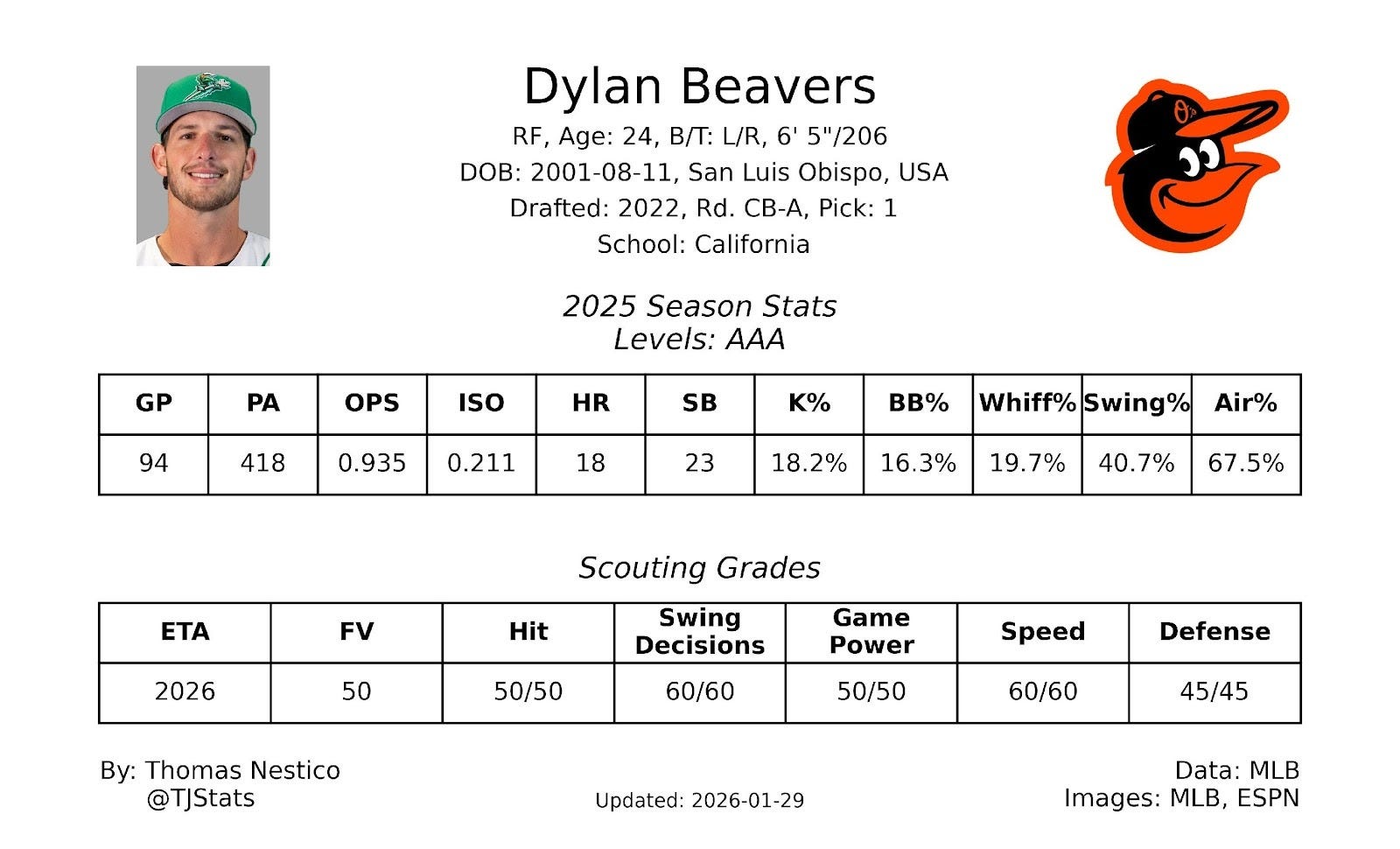
Dylan Beavers excelled in AAA this season, posting a 153 wRC+ across 94 games before receiving a promotion to Baltimore where more success was found. His offensive profile is balanced with solid tools across the board and sharp eye to tie everything together. He has a knack for lifting the ball which should allow his otherwise average power metrics play up. He is a plus runner and projects to be a formidable option in either corner outfield spot. Overall, Beavers is a well-rounded prospect with the caveat that he is likely destined for a platoon role given his struggles against LHP.
44) Michael Arroyo - SS - SEA
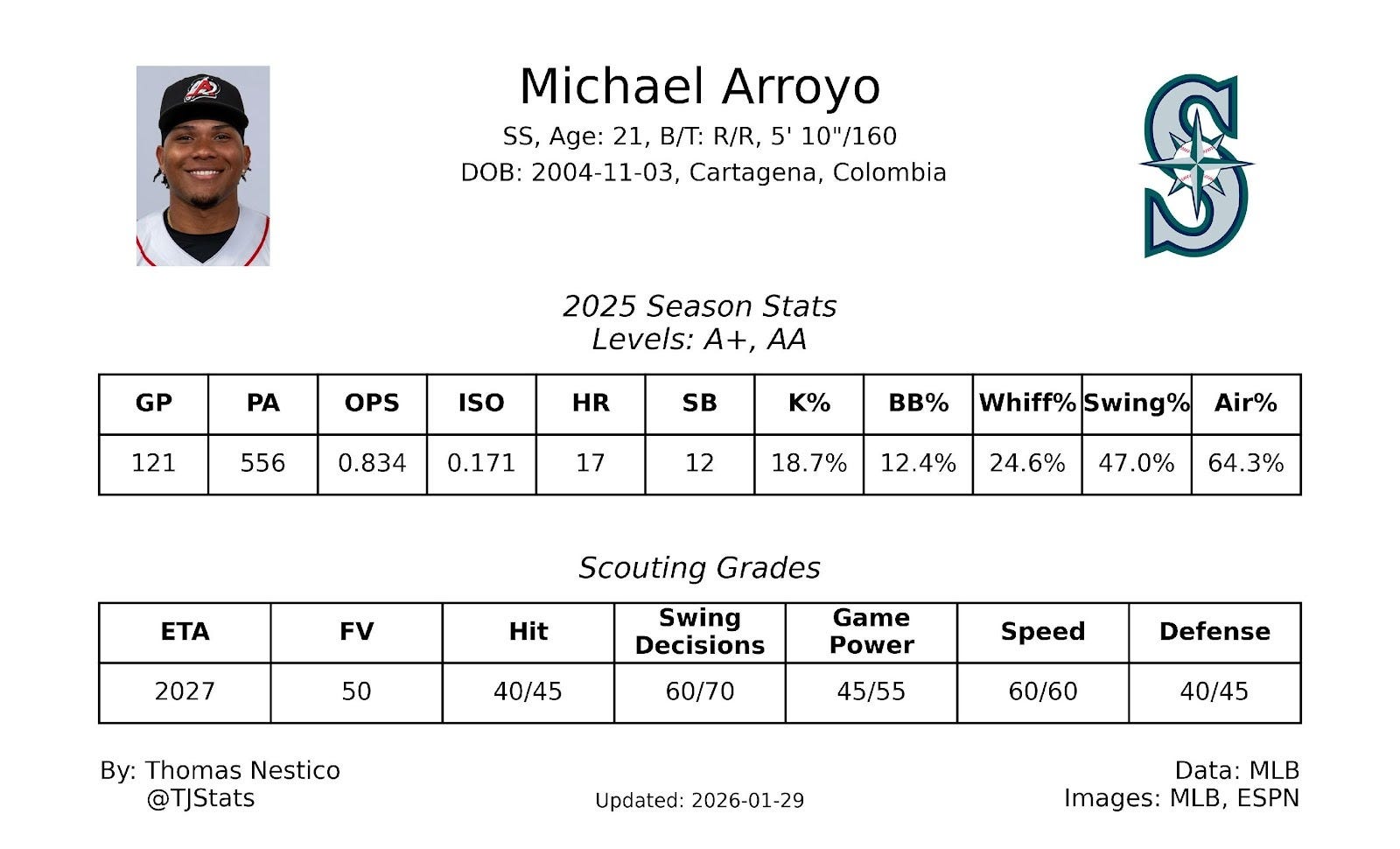
Michael Arroyo is a stocky second baseman with one of the most refined approaches in the minors. He exhibited an excellent pairing of in-zone aggression and out-of-zone patience that he further heightened with his ability to pull fly balls. His bat-to-ball skills hinder his offensive profile with his most glaring hole being in-zone miss against breaking balls. He flourished in some of the harshest environments in MiLB against pitchers that are much older than him. There was concern that Arroyo did not have the footwork nor range to man an infield spot, but his defensive outlook greatly improved this season. There is an avenue for him to provide average defense up the middle despite his well below average arm. Overall, Arroyo’s bat carries his stock while his defensive question marks will dictate his future on the diamond.
45) Jacob Reimer - 3B - NYM
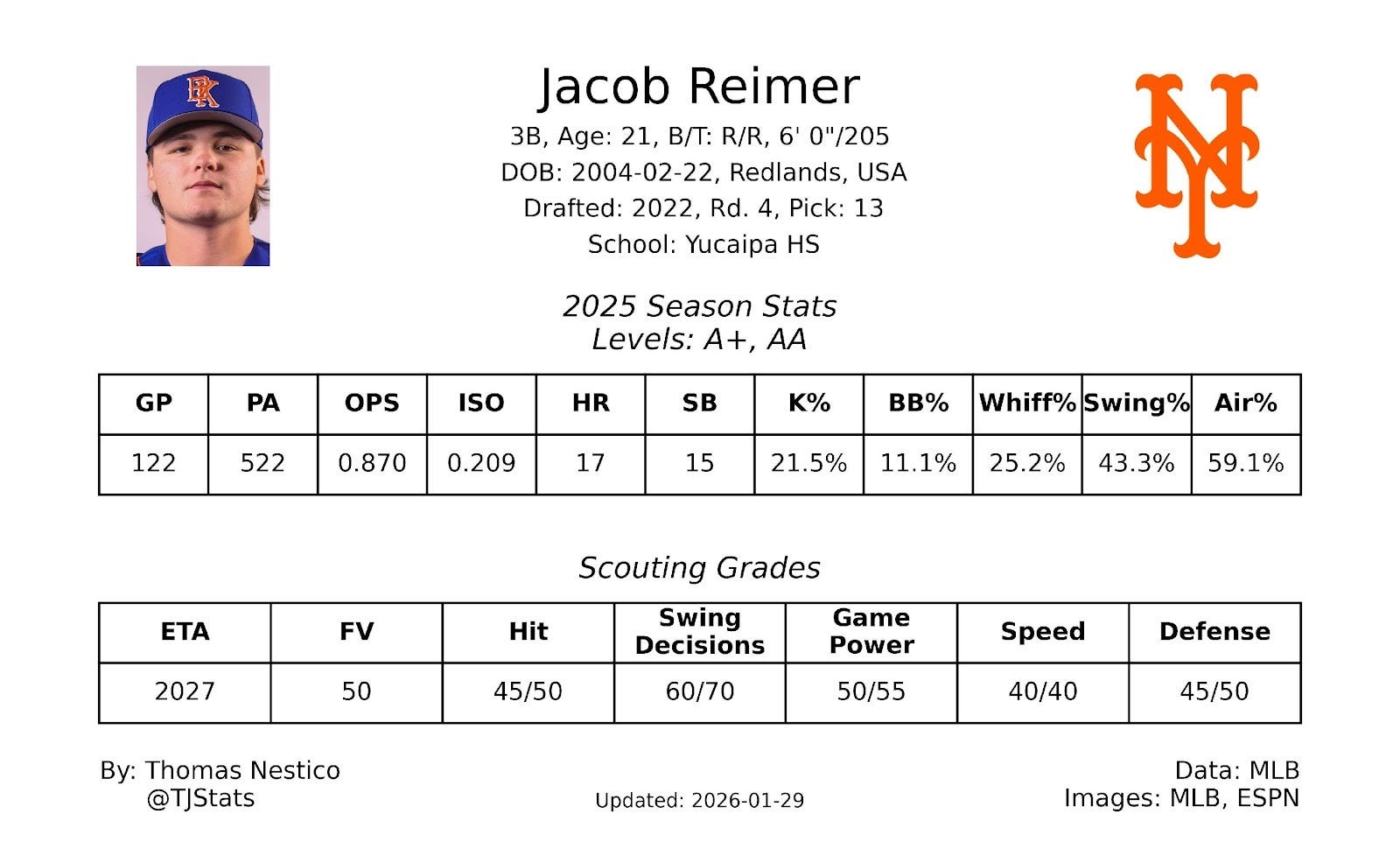
Jacob Reimer broke out in a big way during the 2025 season, making his way to AA while posting a 157 wRC+. Every aspect of his offensive profiles paints him as an above average bat with his most impressive traits being his excellent approach and silky-smooth swing geared for loft. His 11.1% walk rate was supported by a strong 22% O-Swing rate. He rarely expanded the zone with two strikes, allowing him to battle back into counts frequently. While his contact metrics hovered around average, he struggled to consistently connect with breaking balls. His defensive future remains a question moving forward; however, he looked more comfortable manning the hot corner this season and projects to be third baseman. Reimer is a well-rounded hitter with no discernible flaws at the dish who should find his way up to MLB soon.
46) Jett Williams - SS - MIL
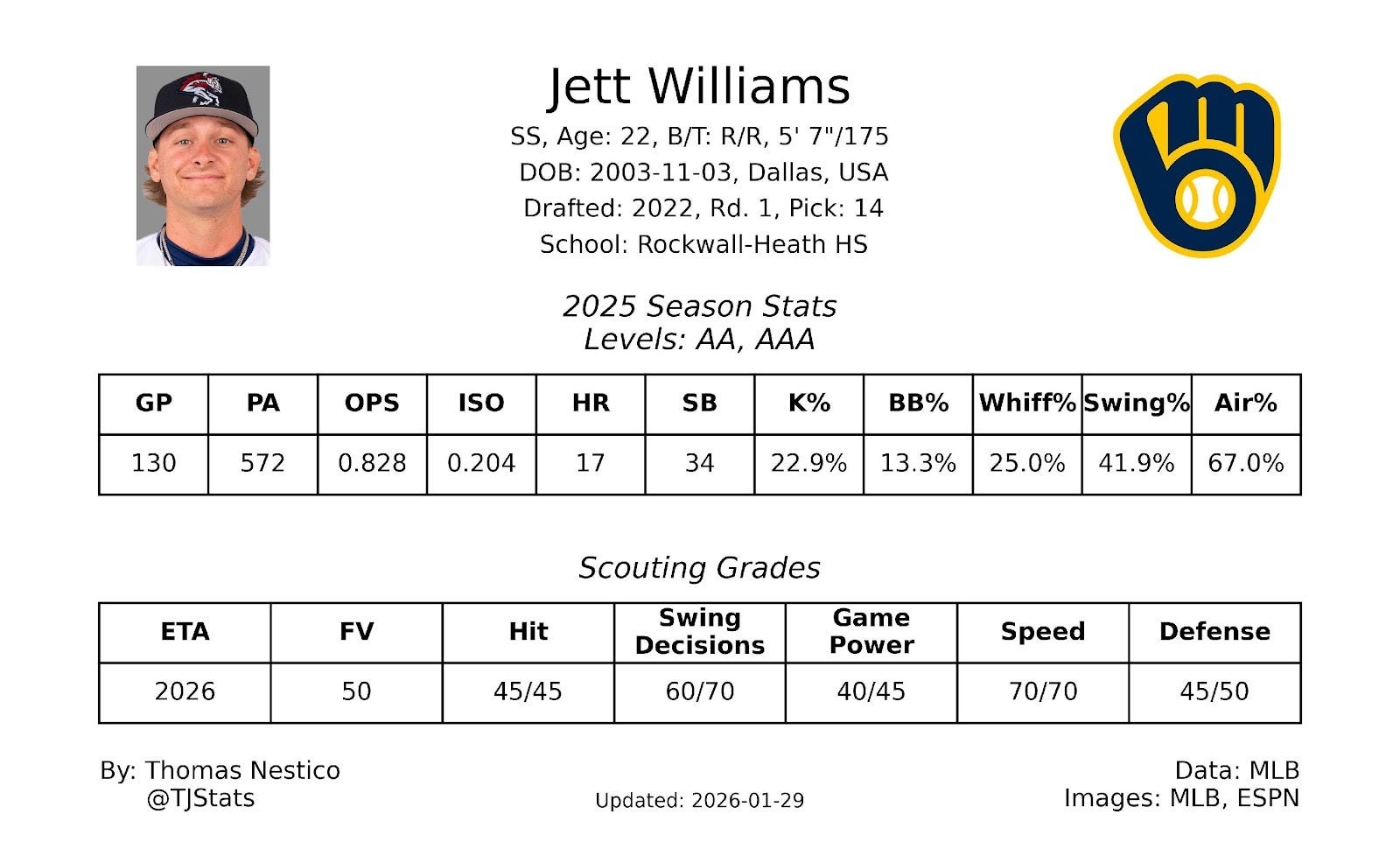
Jett Williams packs a mighty punch from his 5’7” frame. He smacked 17 HR this season and made his way to AAA thanks to one of the most patient approaches in MiLB. His 19.5% O-Swing rate led to an impressive 13.3% walk rate, and more importantly Williams rarely expands the zone with two strikes. His hit and power tools lean slightly below average which limits his offensive potential. To counteract this Williams keeps the ball in the air and utilizes his elite speed to leg out extra bases. He has the ability to man any position up the middle with his most likely home being second base.
47) Travis Bazzana - 2B - CLE
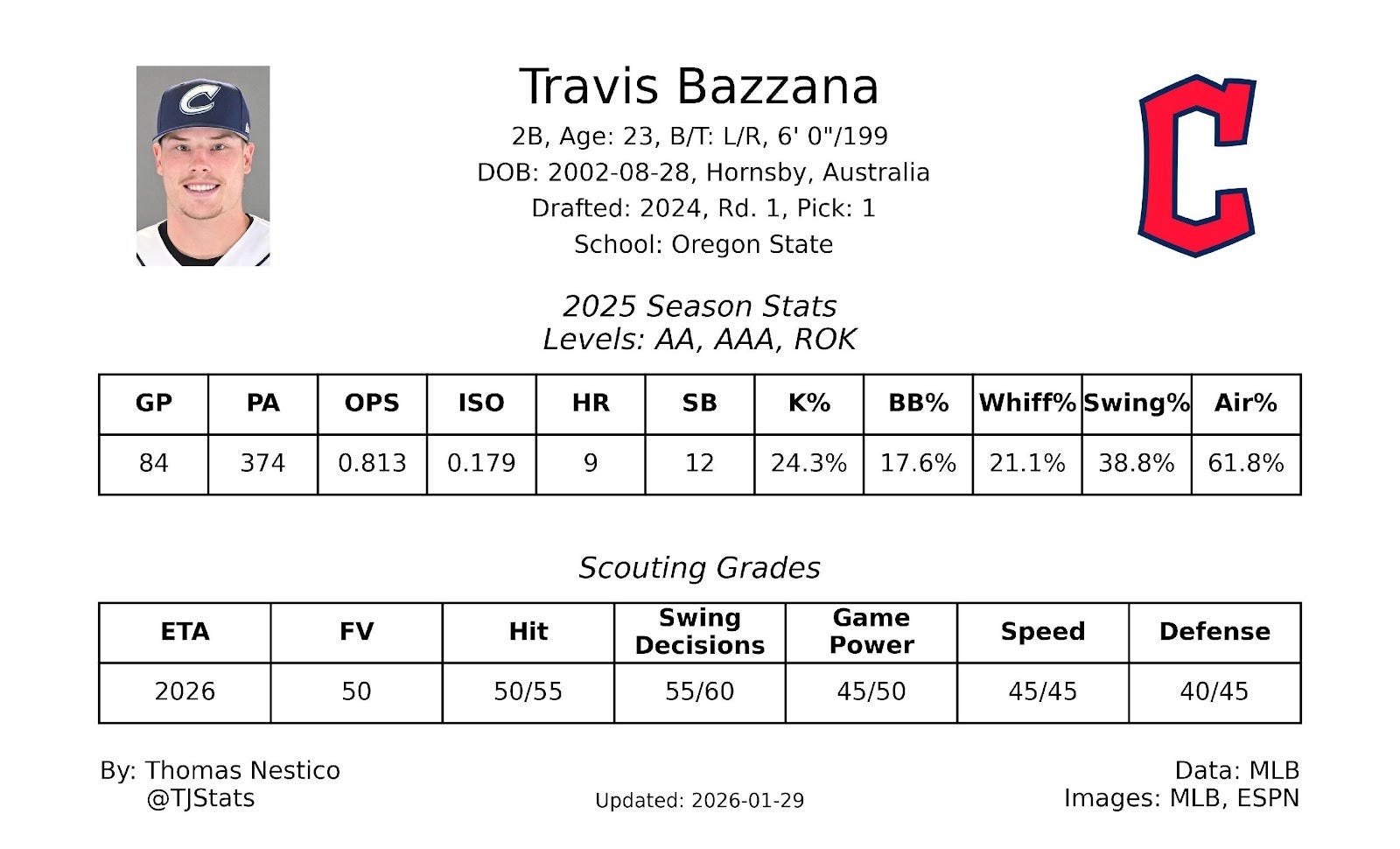
The #1 Overall pick from the 2024 draft hasn’t joined the parade with his peers yet after an injury wiped out about a third of his season. He didn’t let that slow him down though as he posted an excellent 136 wRC+ powered by an elite 17.6 walk rate. Patience is a virtue, and Bazzana possesses a lot of it. His 15.1% O-Swing rate sits amongst the best in MiLB and he pairs it with a strong 21.1% Whiff rate to be a thorn in the side of opposing pitchers. His lack of aggressive does backfire from time to time, which resulted in a less than ideal 24.3% strikeout rate. On the power side, Bazzana grades out as average with a lot of his slugging coming in the form of doubles. He projects to be a decent runner and 2B without much upside in either facet. Strong contact rates, excellent swing decisions, and a knack for lifting the ball give Bazzana the foundation to be a productive MLB bat.
48) Ralphy Velazquez - 1B - CLE
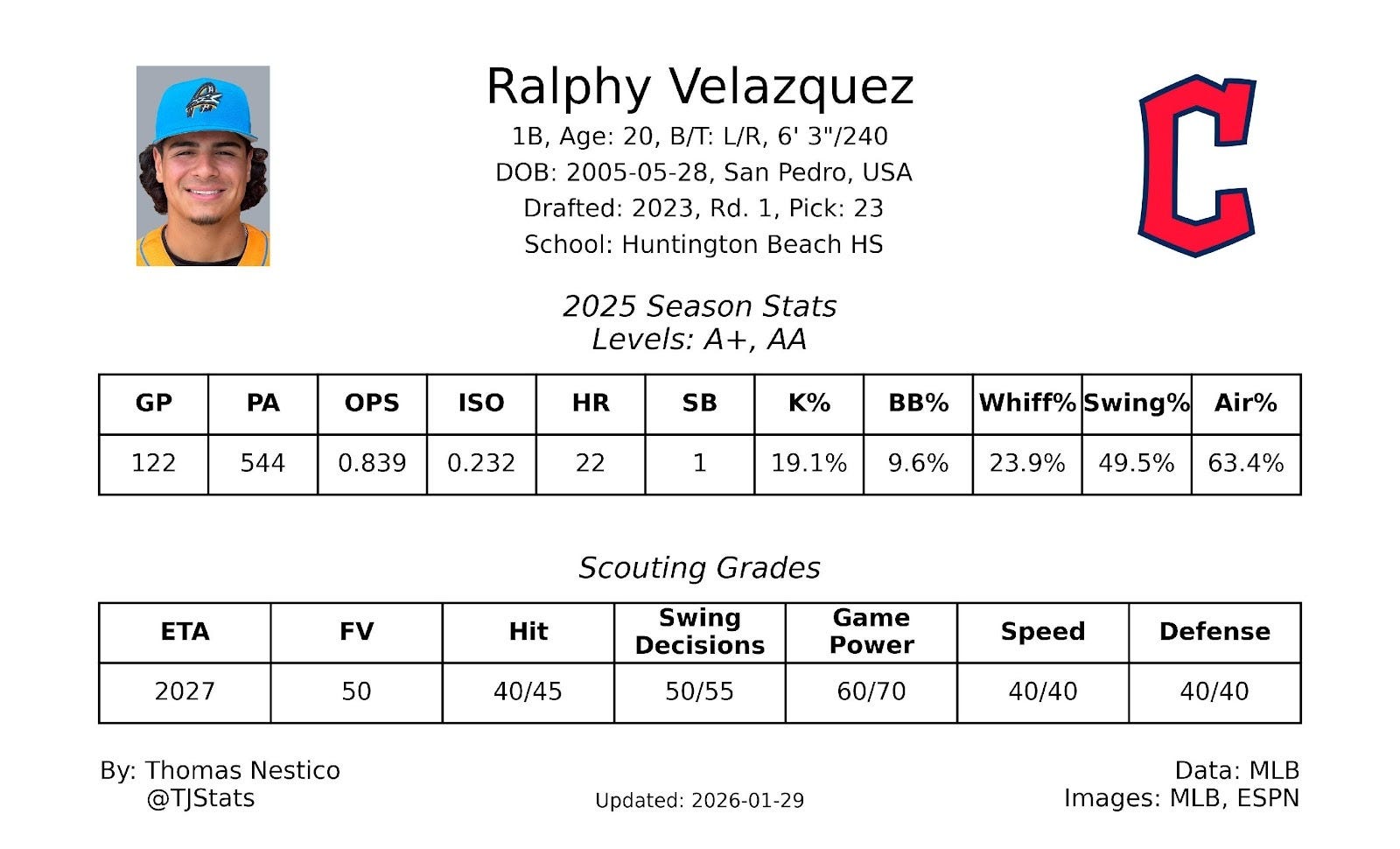
Ralphy Velazquez gave me Josue Briceno vibes in 2025 after he flashed a complete blend of contact, power, and patience to fuel ascent to AA. On the year he posted a 135 wRC+, including an incredible stretch to end season which saw him run an OPS a hair under 1.000 following his promotion. Velazquez wields one of the loudest bats in MiLB with a 107.0 MPH 90th% EV and 50% HardHit rate. He has both the bat speed and swing to sustain excellent slugging results without troublesome swing and miss concerns of players with similar power potential. There is not much defensive utility nor speed in Velazquez’s profile as he projects to be a first baseman. Nonetheless, Velazquez is one of the more complete hitting prospects in baseball and has excelled in the upper minors (albeit in a shorter stint) as a 20-year-old.
49) Moisés Ballesteros - C - CHC
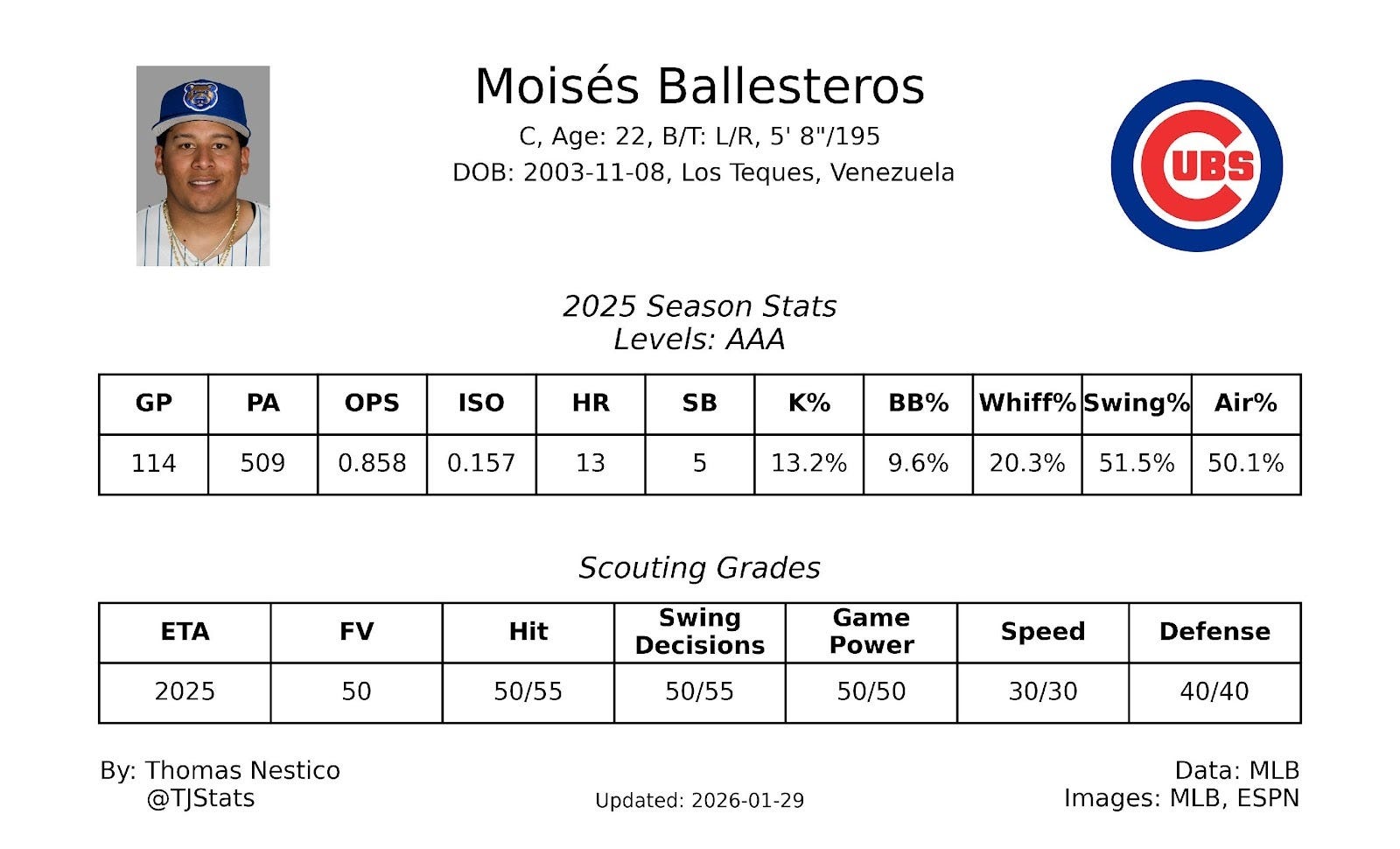
Moises Ballesteros is a stocky catcher who has raked at every level since signing with the Cubs as an international free agent in 2021, and he continued that trend in 2025 with a 121 wRC+ across 114 games in AAA along with a similarly strong debut in the majors. His profile is carried by an above-average hit tool supported by an aggressive approach and above-average raw power, but his flatter swing causes him to put too many balls on the ground or in the infield. This flaw is exacerbated by his extremely slow foot speed, which makes him a liability on the bases. Defensively, he looks stiff behind the plate, raising concerns about his ability to remain a full-time catcher. Ballesteros projects as an above-average hitter, but his lack of speed and questionable defensive outlook hinder his overall upside.
50) Aiva Arquette - SS - MIA
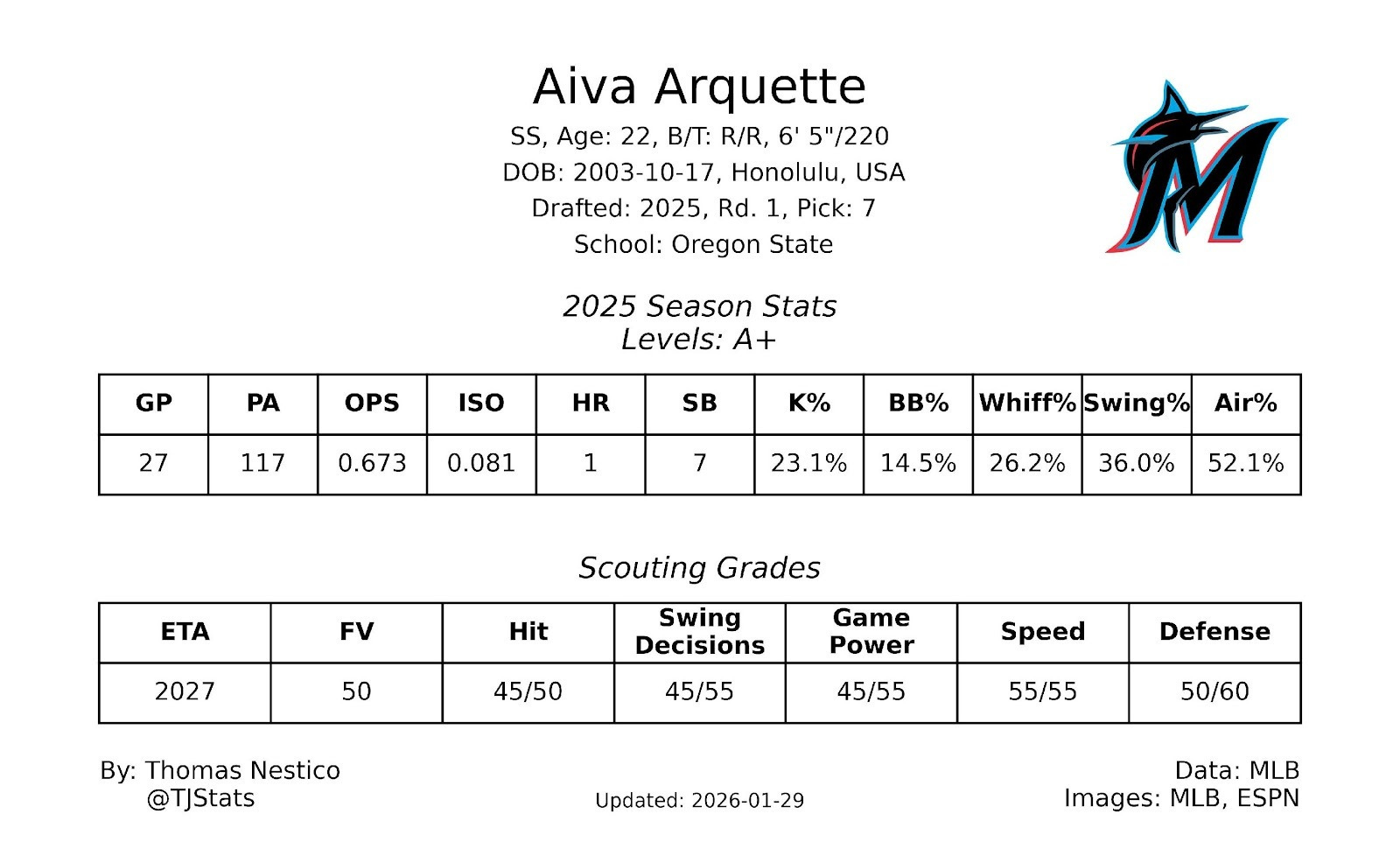
Plus-power and above average defence for the big-bodied Aiva Arquette made him a menace at Oregon State. In his short pro stint to end off 2025, he exhibited an extremely patience approach while flashing the same power and athleticism that secured his spot as a Top 10 draft selection. It is a well-rounded profile that should move rather quickly through the Marlins thriving sea of prospects.
51) Joe Mack - C - MIA
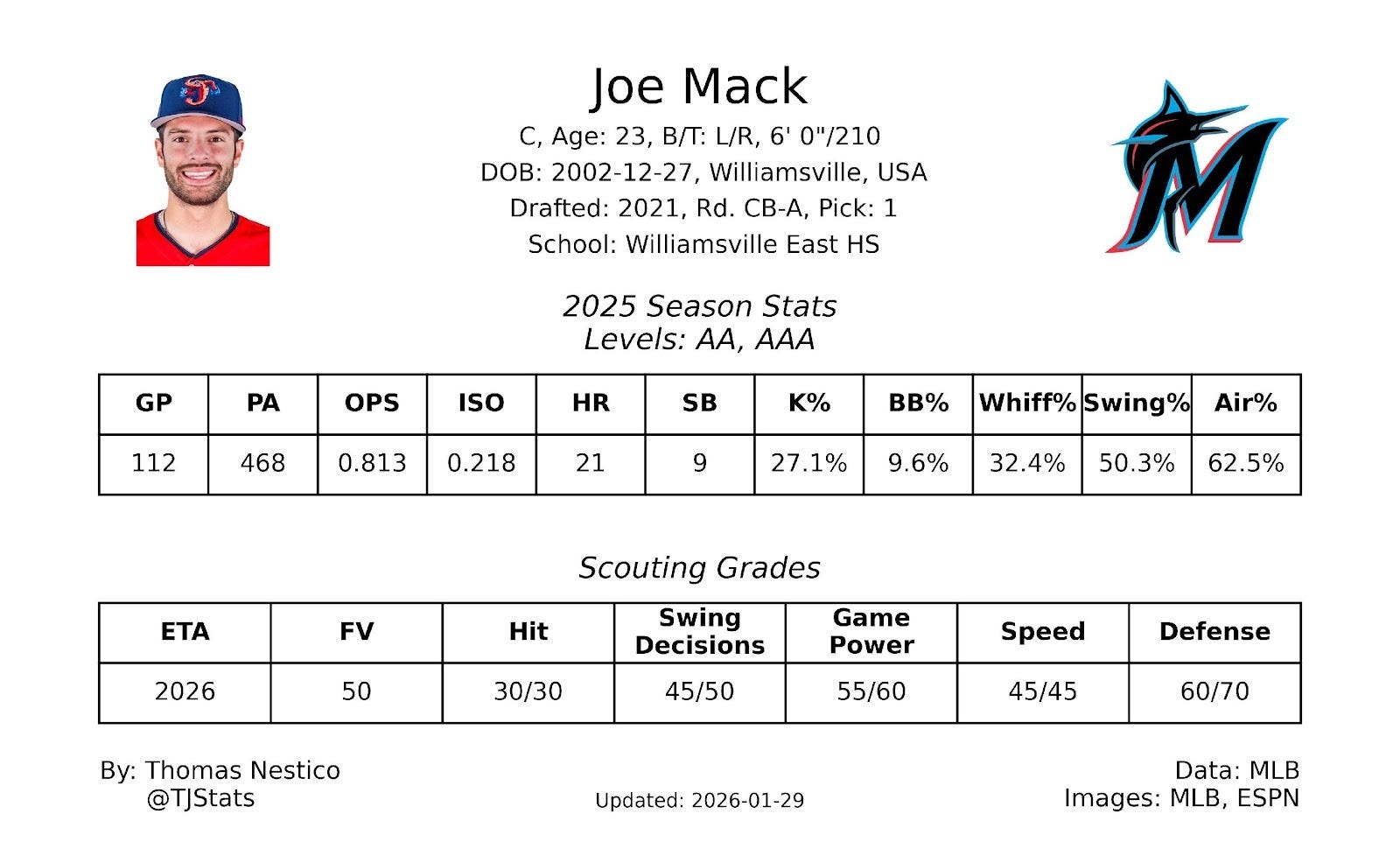
Joe Mack is going to be a big leaguer, and there is little doubt about that, thanks to his game-changing defensive ability behind the plate and immense raw power, both of which will translate immediately. The variable is his hit tool, which will determine how consistently he can stay in a major league lineup. He carried a troubling 73.8% Z-Contact rate, which would place him in the bottom 5th percentile of MLB hitters, with most of his issues coming against breaking balls and off-speed pitches, a key developmental checkpoint for a prospect on the verge of the majors. Despite the offensive risk, Mack’s defensive profile is exceptional; he grades out as one of the best framers in MiLB and should instantly rank among MLB’s best defensive catchers upon debut. If he can make even modest gains in contact, he has the tools to be an impact bat.
52) Mike Sirota - CF - LAD
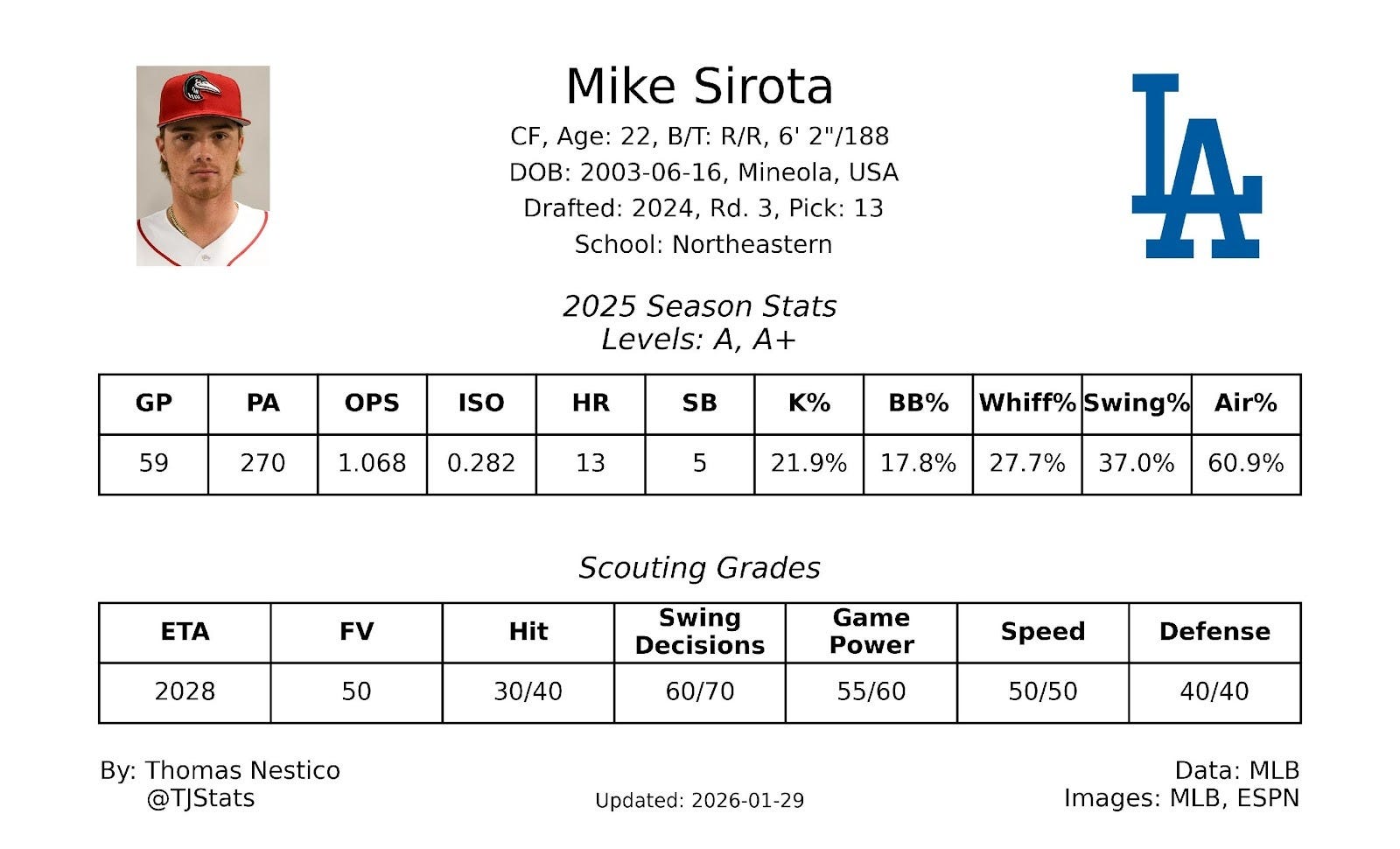
Mike Sirota saw substantial gains in his raw power this season which spearheaded one of the most dominant MiLB seasons in 2025. He posted a grotesque 190 wRC+ in 59 games before a knee injury cut his season short. The abridged nature of his campaign should not detract from its excellence. Sirota posted a stellar 106.5 MPH 90th% EV while keeping the ball in the air and sustaining a HardHit hit rate over 50%. He also exhibited one of the sharpest eyes in the minors with a 14% chase rate without detrimental levels of in-zone passiveness. The bat-to-ball skills leave a little to be desired, but the supporting vase of tools make Sirota a very well-rounded hitter. He supports his imposing bat with plus speed and decent defence, although he projects to be a corner outfielder. Overall, Sirota improved his stock mightily in 2025 and joins a thriving crop of Dodgers outfield prospects.
53) Chase DeLauter - RF - CLE
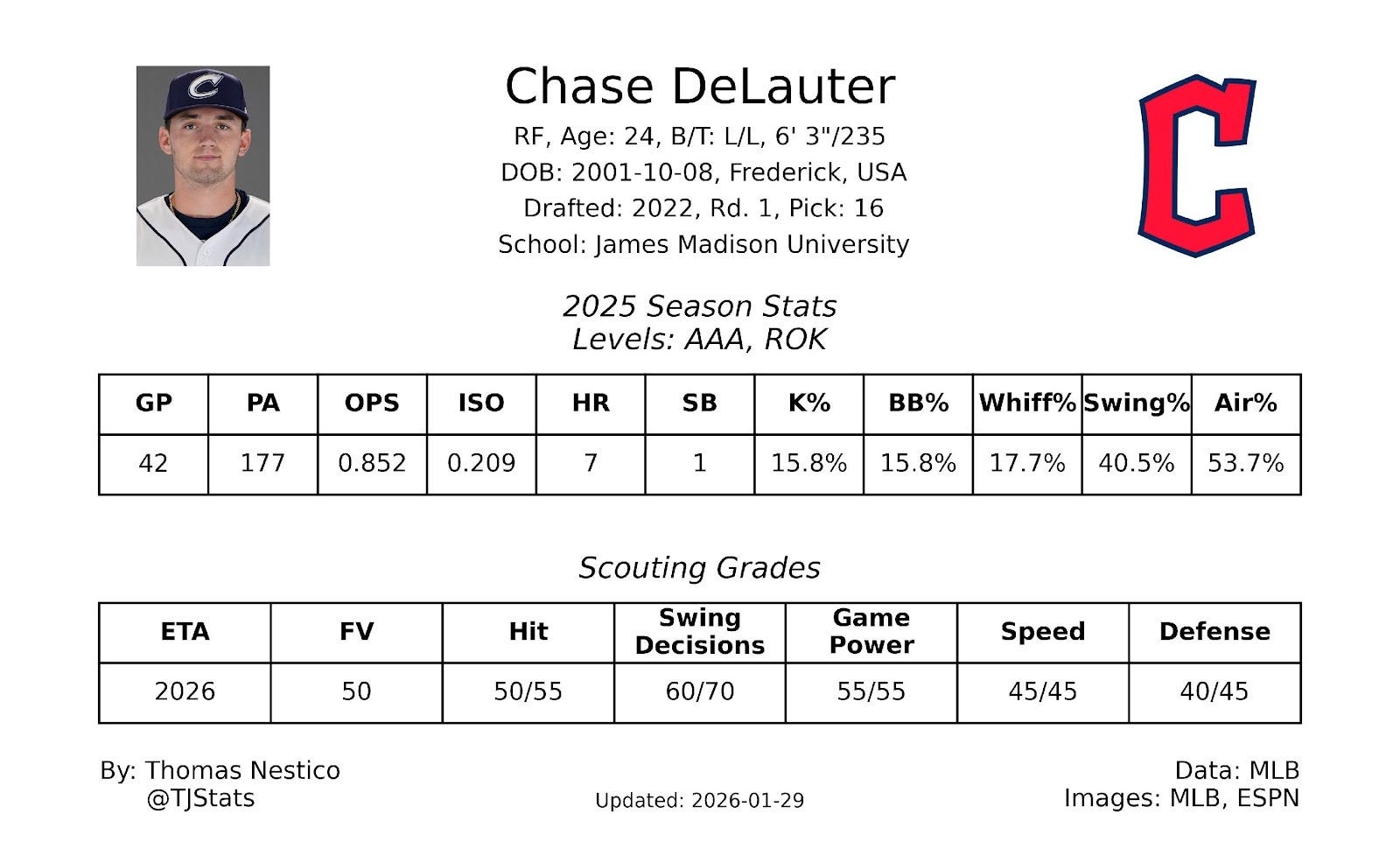
Chase DeLauter continued his domination of MiLB this season, but yet again it was limited due to a multitude of lower body injuries. His blend of patience, power, and bat-to-ball skills ranks amongst the best of any prospect while remaining a solid runner and defender. He does all this while wielding a unique swing with a jarring follow through. Like the old adage states, don’t fix what isn’t broken. Without injuries DeLauter likely already graduates from this list, but for now he projects to be a middle of the order bat with a concerning injury history.
54) Emmanuel Rodriguez - CF - MIN
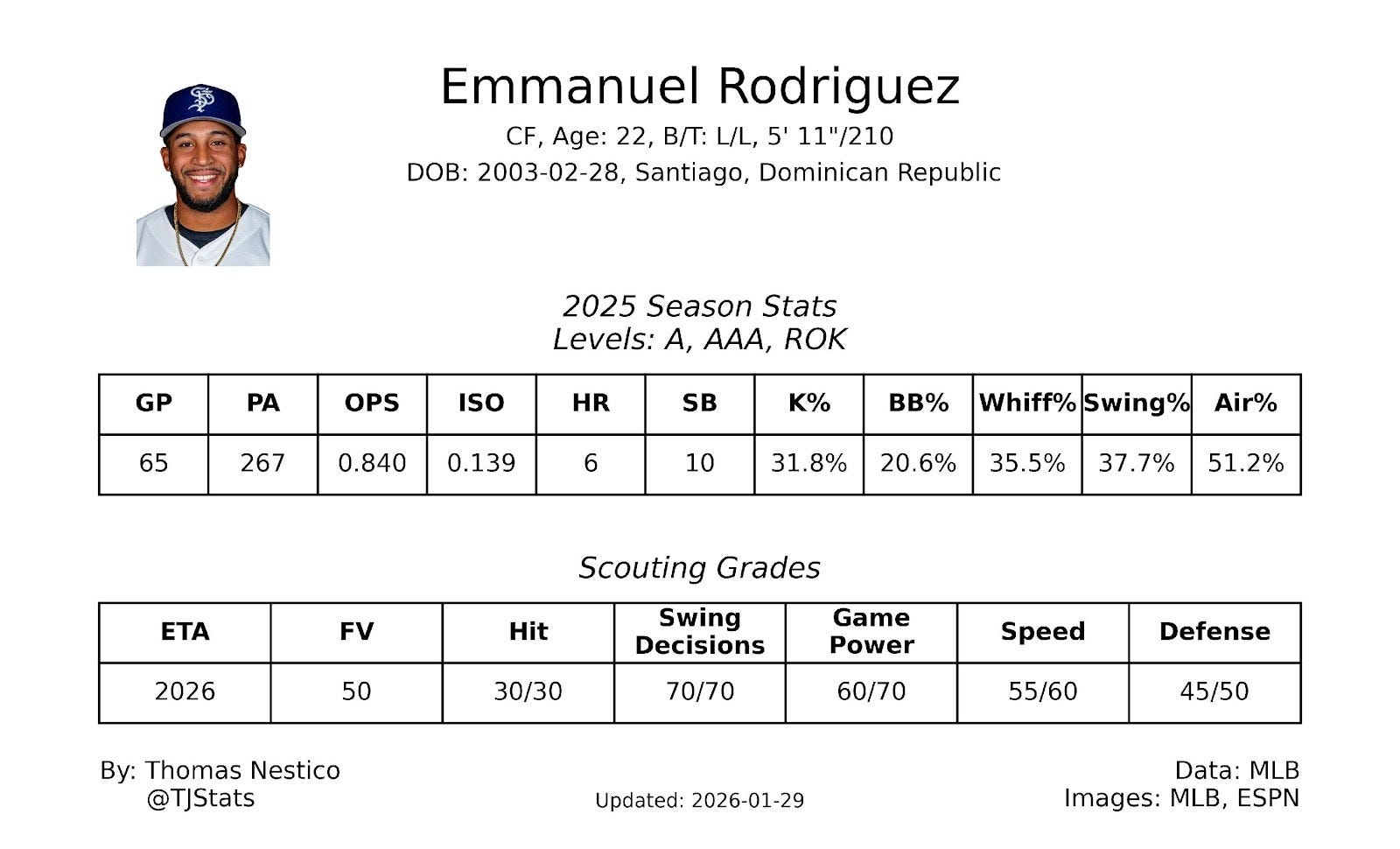
There may not be a prospect with a better sense of the strike zone than Emmanuel Rodriguez. His 13.4% O-Swing rate makes pitchers shudder in fear, and it remains steady when he is sitting on two strikes. He is also one of the strongest batters in MiLB as explained by his cream of crop bat speed, upward swing plane, and elite 108.4 MPH 90th% EV. His sprint speed and defense also grade out above average. Unfortunately, Rodriguez has some very glaring downsides that neuter his upside. Most important, he has missed a lot of time since his pro debut with various ailments ranging from season-ending hip surgery to persistent hand issues. On top of this, his bat-to-ball skills and lack of aggression make him a massive strikeout culprit. Rodriguez’s profile is one of high risk with a sizable reward; however, the extreme range of outcomes makes him one of the hardest prospects to assess.
55) Michael Forret - P - TB
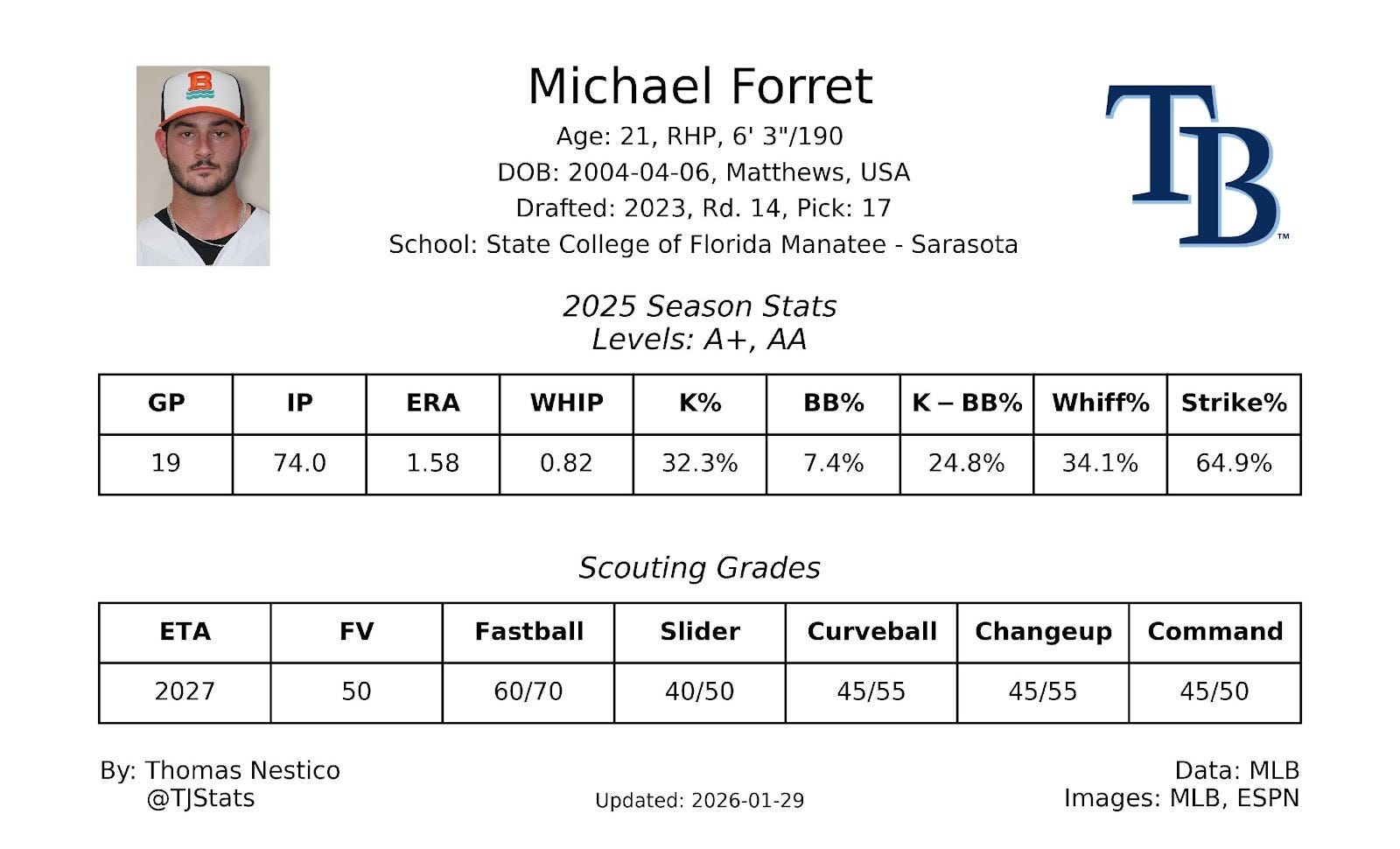
Michael Forret excelled following his 14th round selection of the 2023 draft as he worked his way to Hi-A in his first pro season. Before heading to the IL with a back injury in late April, Forret flashed a vastly improved fastball and more refined command, which sparked his hot start to the season. His fastball velocity still sits at 93-95 MPH, however it is generating over +2” IVB this season, where from his 5.8 ft release propelled it into plus territory. His cross-bodied release leads to some funky angles, including a flat vertical approach which has devastated batters this season. He is also doing a much better job zoning the offering after he struggled throwing it for strikes last season. Forret supplements his strong fastball with a wide array of secondaries, including a sinker, a pair of breaking balls, and a changeup. His sinker is exclusively used against RHH where it’s nearly a foot and half of run jams batters on the inner thrid. The first breaking ball is a curveball with “deathball” shape, and the other being a slider with two-plane movement. Both pitches sit in the low 80s and have returned strong results this season. We are not done with Forret’s arsenal because he throws changeup. He opts to use it against LHH as a putaway pitch, where their movement differential from his fastball helps the offering play up. His changeup’s low spin nature and ability to kill vertical movement flashes plus traits. Forret wields an extremely deep arsenal headlined by a plus fastball. The command gains are the most important part of his development and make him one of the most intriguing arms in Baltimore’s system.
56) Caden Scarborough - P - TEX
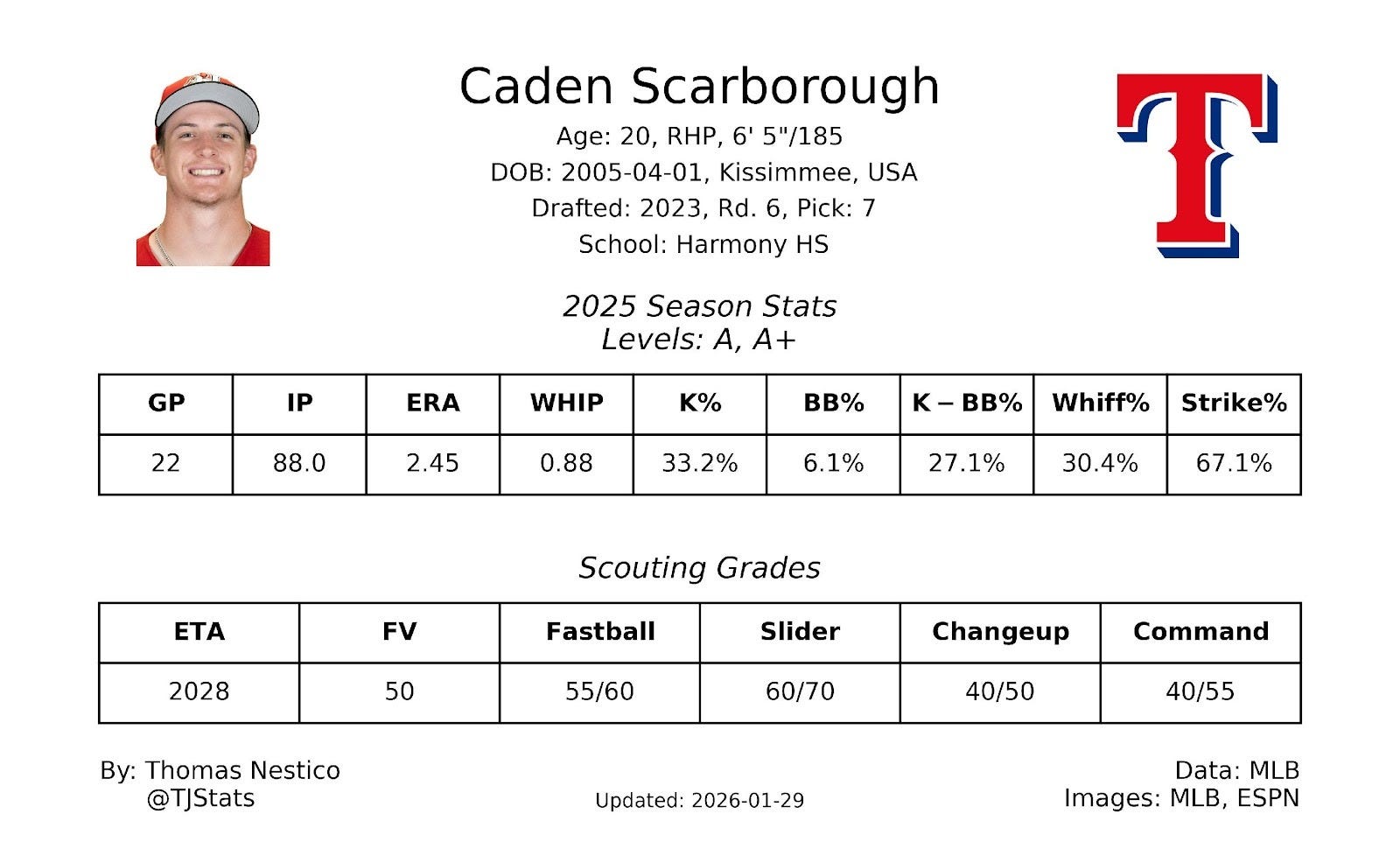
Caden Scarborough was selected in the 6th round of the 2023 draft out of Harmony High School but didn’t make his pro debut until July 2024 following a strained lat. Despite the late start, Scarborough hit the ground running with an impressive display of athleticism and stuff. He has a projectable frame and has started to tap into more power this season with an additional +2 MPH on his fastball, which now sits at 94-95 MPH and maxes out at 97 MPH. He generates a flat VAA on the offering from his lower 3/4 slot which helps it generate plenty of swing and miss high in the zone. It also exhibits 14-16” glove-side movement to help it run away from LHH ands keep RHH honest on the inner third. The biggest knock on his otherwise strong fastball is his inability to land it for strikes early in the count. Scarborough pairs his fastball with a low 80s slider with a ton of sweeping action. From a stuff perspective, it is easily a plus offering and flashes plus-plus traits when it is located well, especially against RHH. He rounds out his arsenal with a changeup that sits in the mid 80s and flashes solid traits, but his feel for the offering is poor. Scarborough has a silky-smooth delivery and is limiting walks while throwing much harder. His fastball and slider combo give him a fantastic foundation to build upon, and he has the perfect frame to develop as a starter.
57) Liam Doyle - P - STL
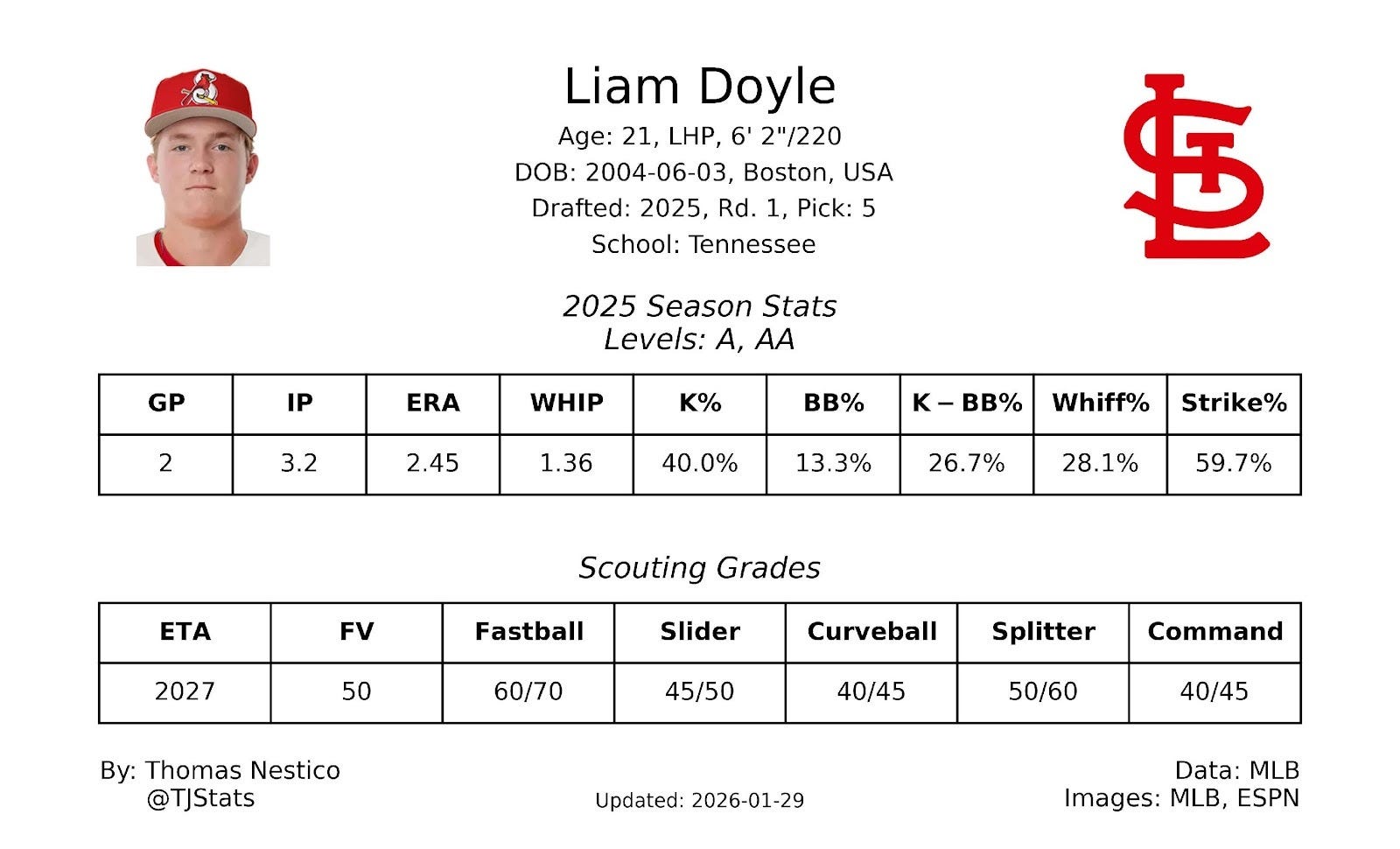
Liam Doyle was heralded as one of the best arms in the 2025 draft thanks to his buzzsaw fastball and wicked changeup. Doyle made his pro debut not long after the Cardinals selected him 5th overall, and he looked just as advertised. His fastball sat in the mid 90s with elite ride from his 5.5’ slot and a ridiculously shallow -3.8° VAA. Add on his explosive delivery from the left side and we are looking at clear plus-plus offering. His changeup exhibited similar quality with its immense depth. He rounds out his arsenal with a pair of breaking balls, both of which grade out around average. His slider sits in the mid 80s with slight glove side movement while his curveball demonstrates more two-plane action from a slightly lower velocity band. Doyle’s reliance on his fastball provides some reliever risk, however he quelled those concerns throughout his college season with a more diverse pitch mix. His already electric fastball-changeup combo provides him an outstanding foundation to build upon as a starter, with the fallback option being a dynamic high leverage reliever.
58) Juneiker Caceres - OF - CLE
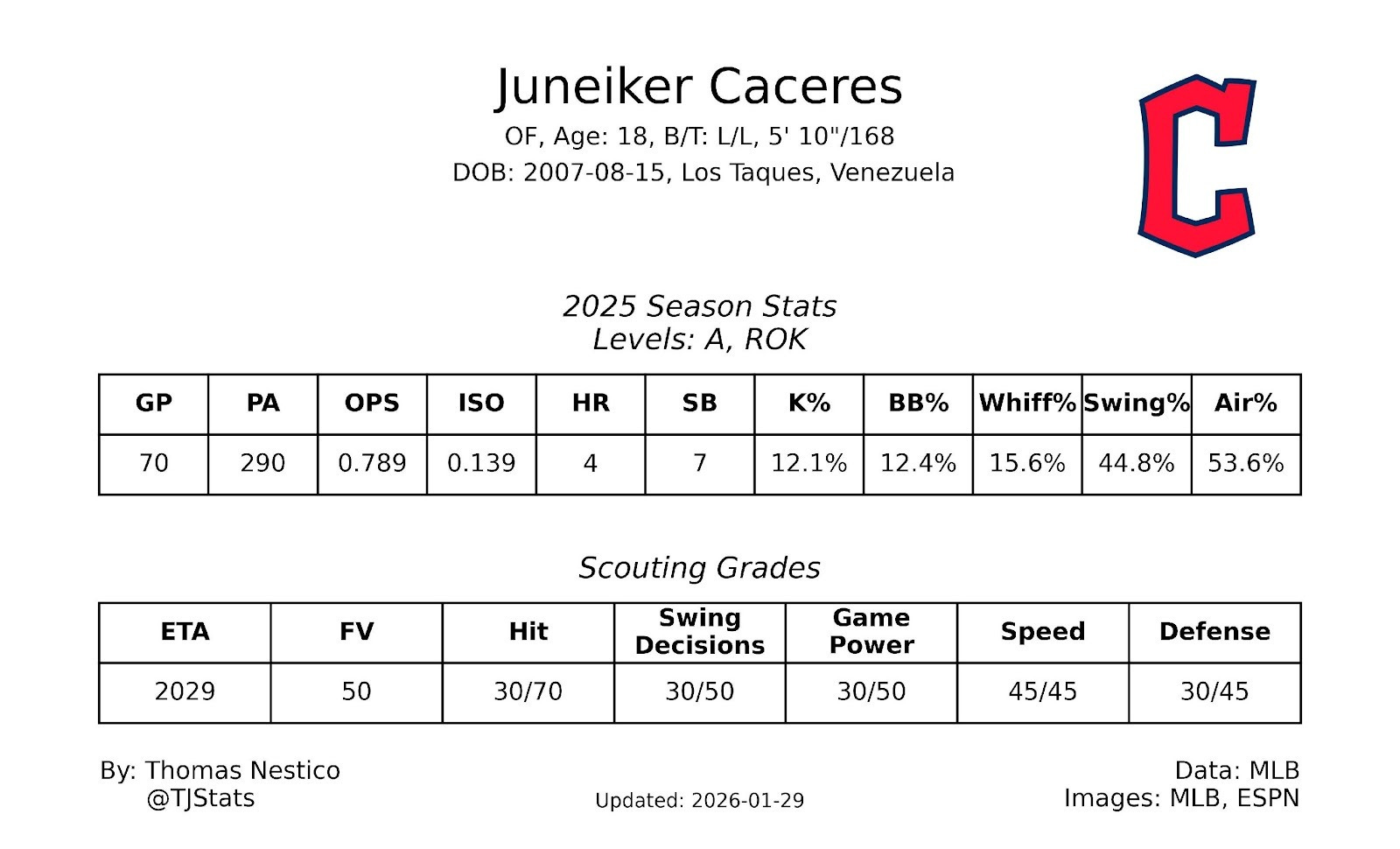
Juneiker Caceres turned heads in 2025 after he reached full season ball before his 18th birthday. He posted an encouraging 121 wRC+ this season while flashing both above average power and vastly advanced bat-to-ball skills. Juneiker’s bat controlis startling for a player his age which only makes his 104.6 MPH 90th% EV look even more impressive. His swing falls on the flatter side which puts a damper on his slugging upside, however his ability to pull the ball with authority quells some concerns. He projects to be a corner outfielder long term where his mighty arm will come to good use. Caceres has the hit tool to succeed against pitchers much older than him, and a realistic growth in power could spark a meteoric rise up Cleveland’s pipeline.
59) Nate George - OF - BAL
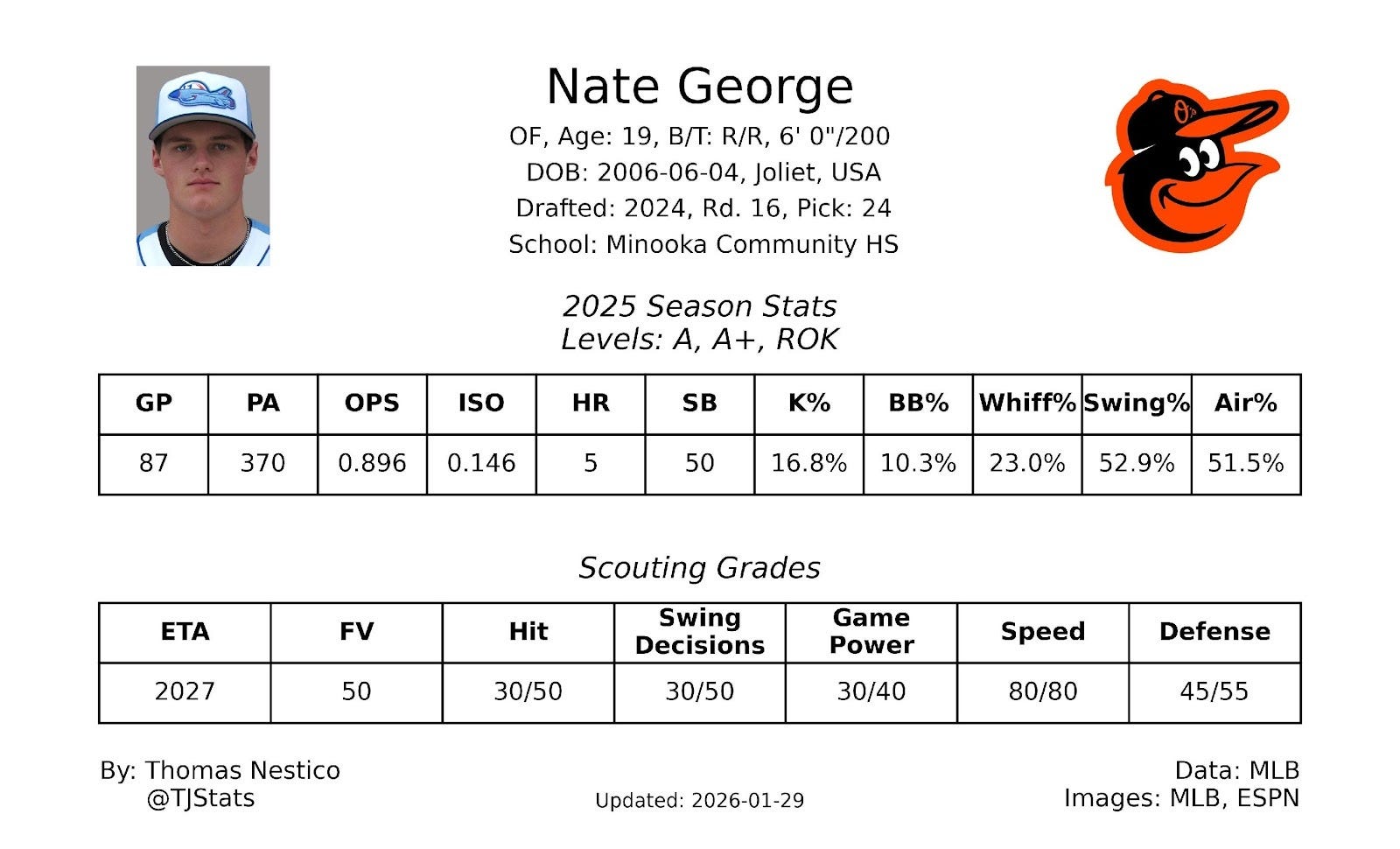
It’s not often you see a 16th round prep selection perform like one of the best players in the draft, but that is exactly what Nate George did in his pro debut. He laid waste in the complex before storming his way to Hi-A shortly after his 19th birthday. On the season he posted an elite 159 wRC+ with a staggering 50 stolen bases. He reached this level of seemingly unprecedented production thanks to an aggressive play style, both at the dish and on the base paths. He punished pitcher’s mistakes and his ability to spray the ball over the field melded well with his elite speed. There is hope that he can tap into more power as he develops, although he filled out most of his frame. George should have no issues patrolling center field given his athleticism and has looked very comfortable no matter where he slotted into the outfield.
60) Eli Willits - SS - WSH
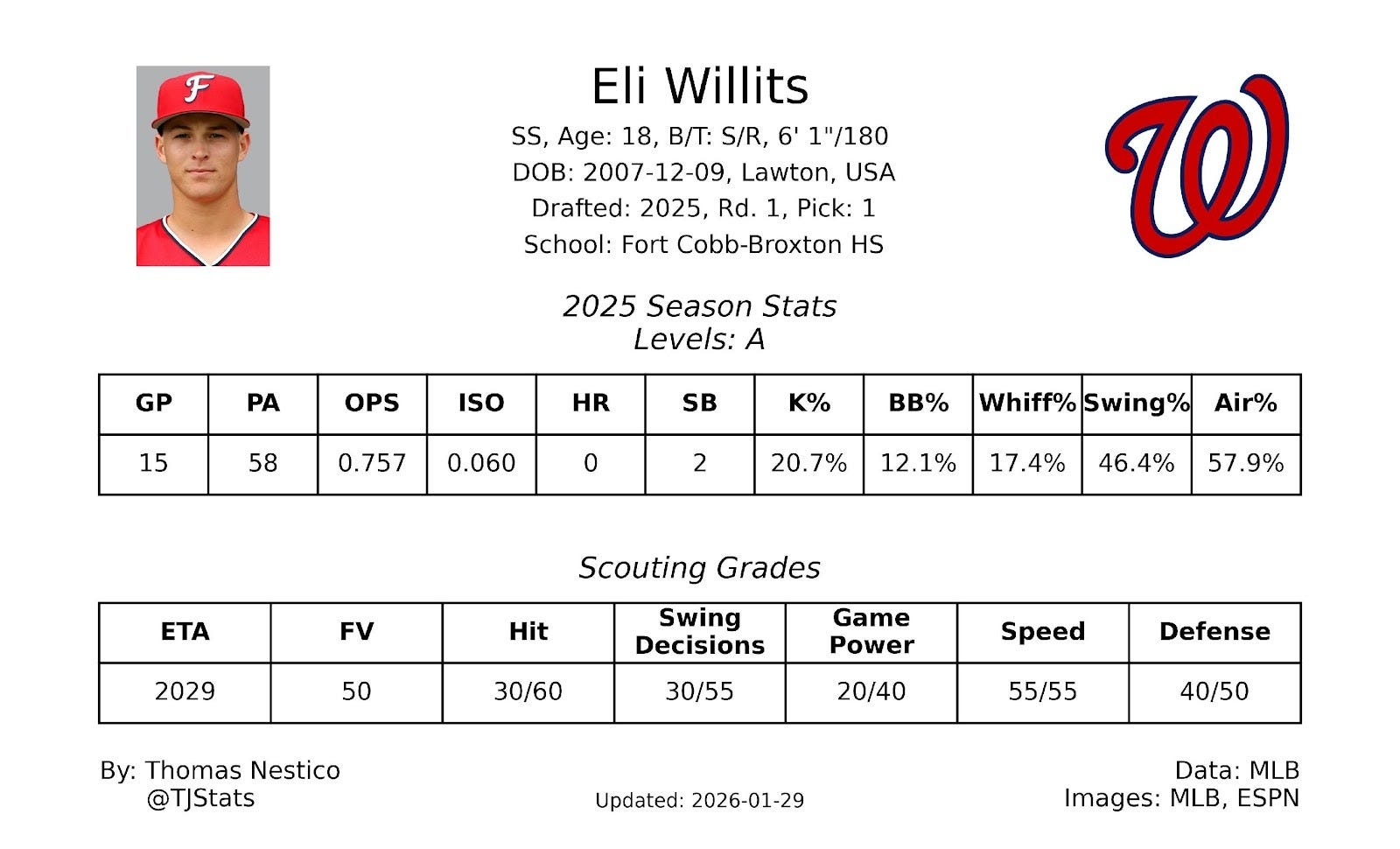
Eli Willits was the #1 selection in the 2025 draft and made a statement in his first taste of pro ball. He debuted before his 18th birthday and demonstrated an advanced hit tool and sound approach. He did not look overmatched against Lo-A pitchers and continually made productive swing decisions to stay a step ahead. His power projection remains modest with the hope that he fills out his frame. Willits isn’t the most exciting top selection, but he remains a near-surefire bet to an MLB regular.
61) Dasan Hill - P - MIN
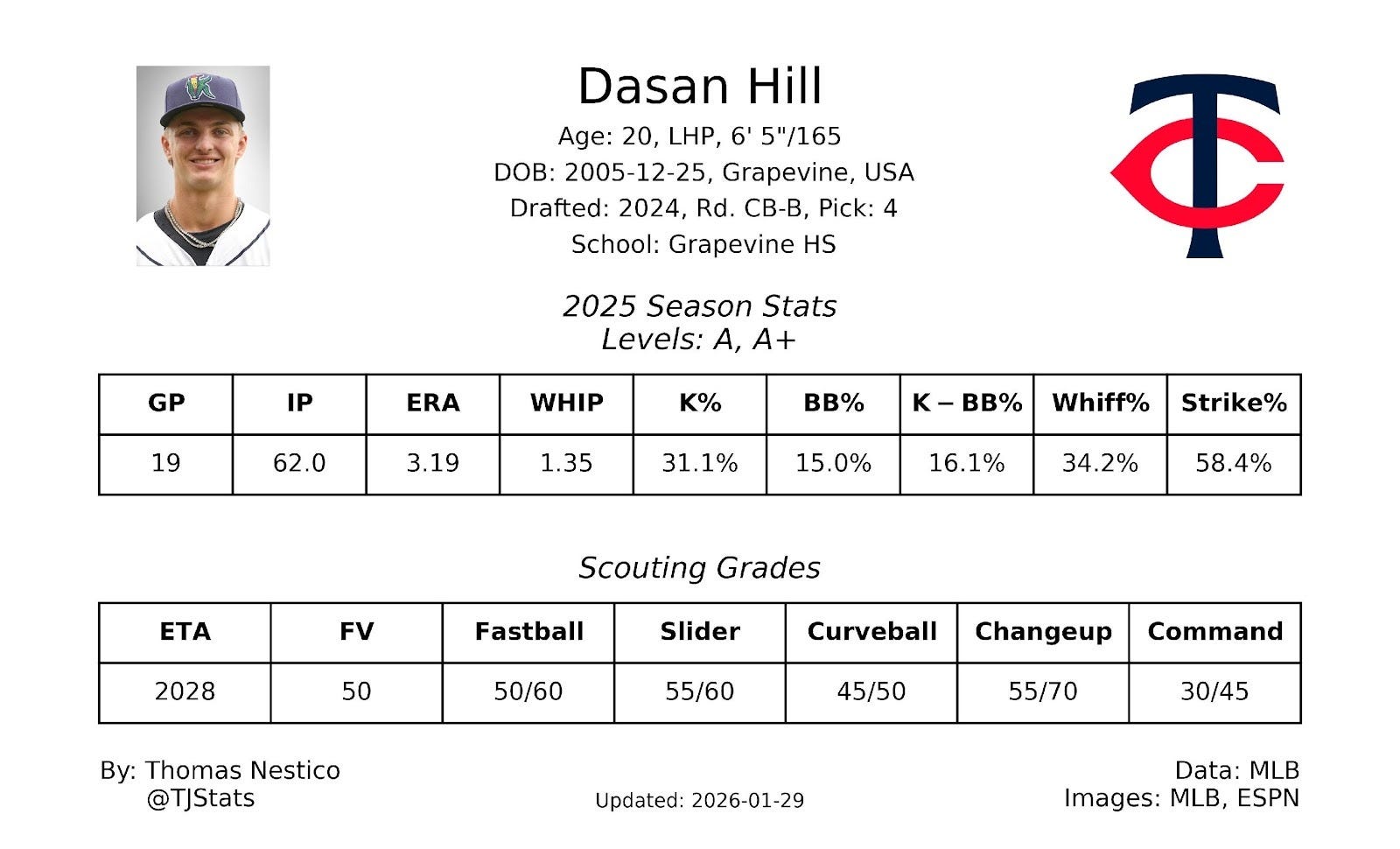
At draft time, Dasan Hill stood at 6’ 5” and 165 lb, making him one of the most projectible arms in the draft. Given his age and size, Hill had a ton of room to fill out his frame and improve his power. The Twins took the chance on Hill, and it has already paid off in spades. Hill sat at 88-90 MPH prior to the draft, and less than a year later he was chucking 97 MPH fastballs in Spring Training. This level of velocity gain is extreme, yet it seems sustainable. He is dat 96 MPG on his fastball in Lo-A, and it feels like this is just scratching the surface of his potential. Hill has the perfect body type for a pitcher, and throwing this hard at 19 years old gives him the foundation to be one of the most intriguing prospects in baseball. He has a smooth and repeatable delivery which portends well for steady improvements in the command department. Hill wields 4-pitch mix with each offering flashing plus characteristics: a fastball, slider, changeup, and curveball. His fastball sits 94-97 MPH, but its steeper vertical approach from his higher release lines it up with batter’s barrels, leading to harder contact allowed. The pitch does however have above average arm-side movement and subtle sinking action which should help it be an effective weapon against LHH. Hill’s slider sits in the low 80s with two-Plane action that he is comfortable throwing against both handedness in all counts. The pitch lives in the zone where its combination of sweep and drop helps it evade bats. His feel for the offering is solid and has made it one of the most effective weapons in MiLB this season. Hill exclusively uses his changeup vs RHH where its late breaking action and unexpected arm-side run stumps batters. I would say that it has the highest ceiling of all his offerings, and his command of the pitch this season looks very mature. As he develops further, I would not be surprised if it is considered one of the best pitches in MiLB. Hill rounds out his arsenal with a high 70s curveball that mimics his slider, but with more depth. I don’t expect this offering to more than an above average pitch given its shape; however, his command of the offering should make it effective as a put away offering against RHH. Dasan Hill’s results in the FSL were exceptional, and it is not a facade. Everything about his profile screams future mid-rotation starter, and he has the tools to develop into one of the most dynamic pitching prospects in baseball. Lefties that throw this hard with this level of pitchability at such a young age are destined to be MLB regulars.
62) Johnny King - P - TOR
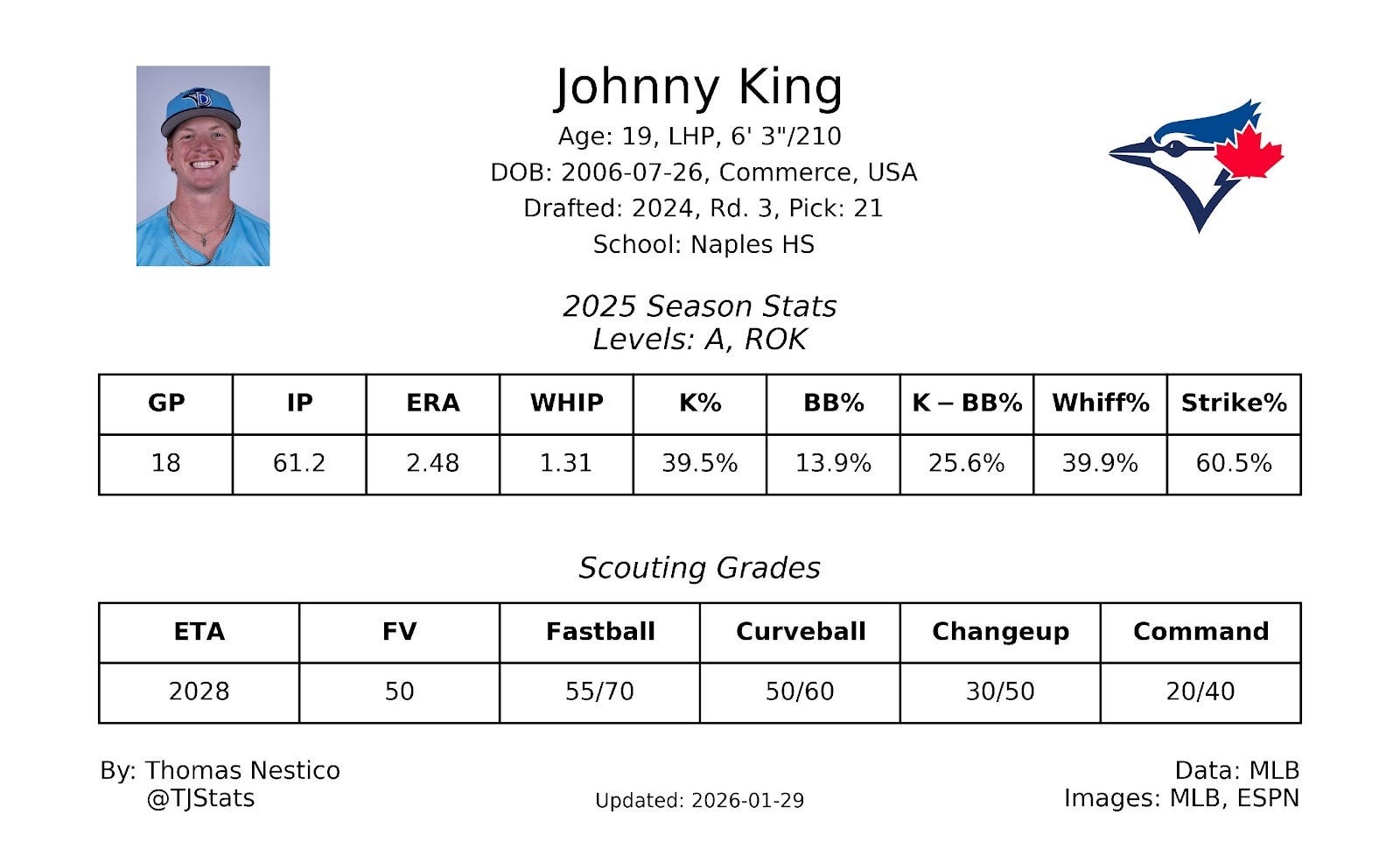
Johnny King was selected in the 3rd round of the 2024 MLB Draft out of high school and dominated the Florida Complex league out of the gate. He was rewarded with a promotion to Lo-A where his raw stuff makes him one of the most intriguing pitching prospects in MiLB. He is an athletic lefty with a prototypical starter frame and throws from a deceptive low 3/4 slot. His fastball jumps out of a 5.6’ release height at 93-95 MPH with plenty of life, grading as a plus pitch. There’s room for a few more ticks as he continues to develop, which could propel it into plus-plus territory and amongst the best fastball amongst any lefty prospect. His lone breaking ball is a low 80s two-plane curveball with an uncanny ability to generate whiffs. He rounds out his arsenal with a high 80s changeup with above average run and ~10” of vertical separation from his fastball. King has showcased an improved feel for the strike zone this season, however inconsistencies lead to wasted pitches. Like all young arms there is massive risk, however King looks like one of the most exciting pitching prospects in the lower minors.
63) Cooper Pratt - SS - MIL
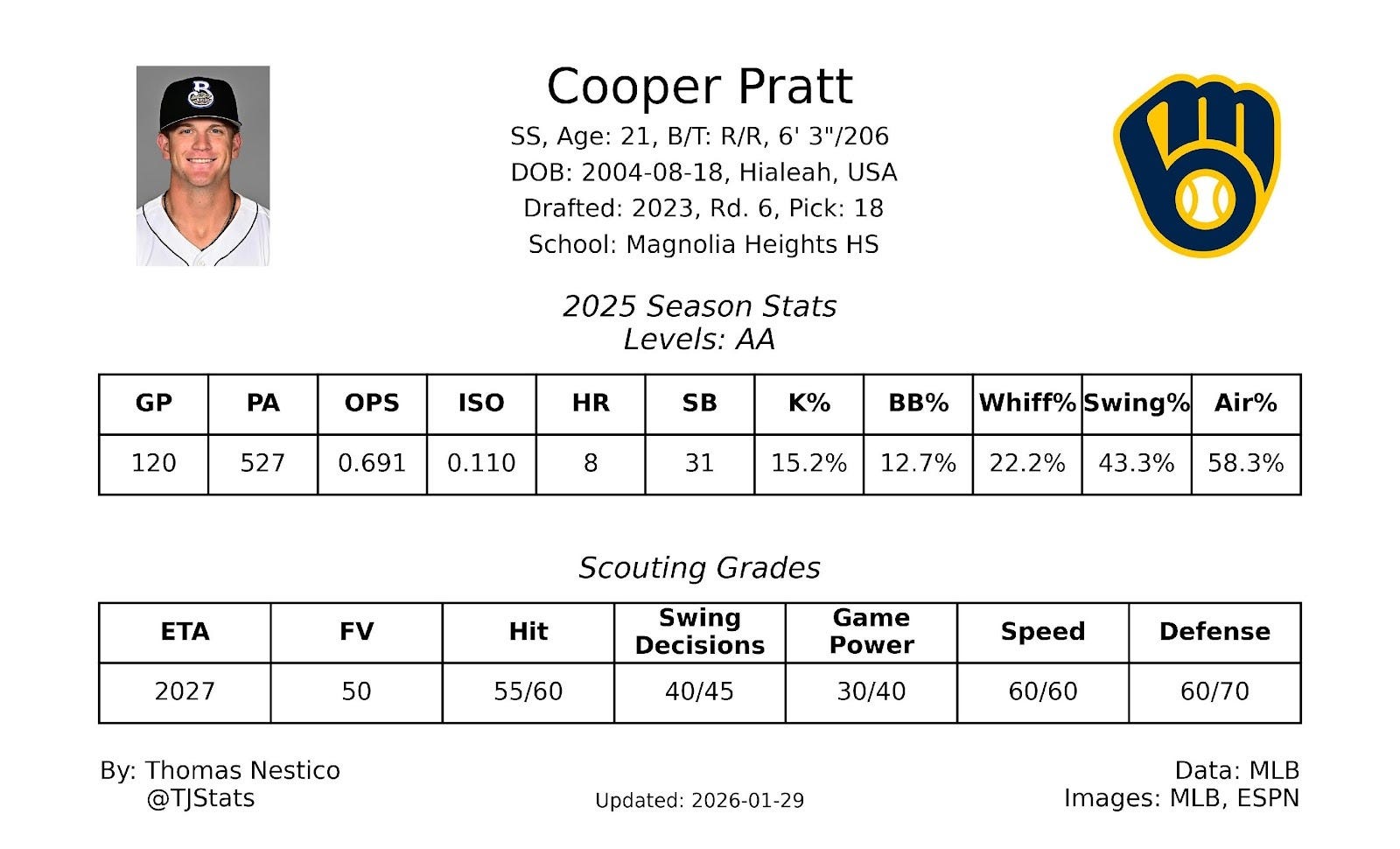
Cooper Pratt is a magician at shortstop. His defensive prowess provides such a stable floor that even league average production with the bat would very easily yield an all-star calibre player. Unfortunately, Pratt’s bat tranded south in 2025 with his most noteworthy deficiency being his power potential. Below average bat speed and exit velocities paint Pratt no more than a 40-grade power bat and he has not made enough of a stride in the hit tool department to counteract this flaw. Not all hope is lost though. Pratt’s large frame indicates that there is more power to tap into and his advanced bat-to-ball skills and plus speed only buoy his floor. Pratt’s top-end outcomes heavily rely on his bat with his most likely outcome being an everyday shortstop with a wicked glove.
64) Franklin Arias - SS - BOS
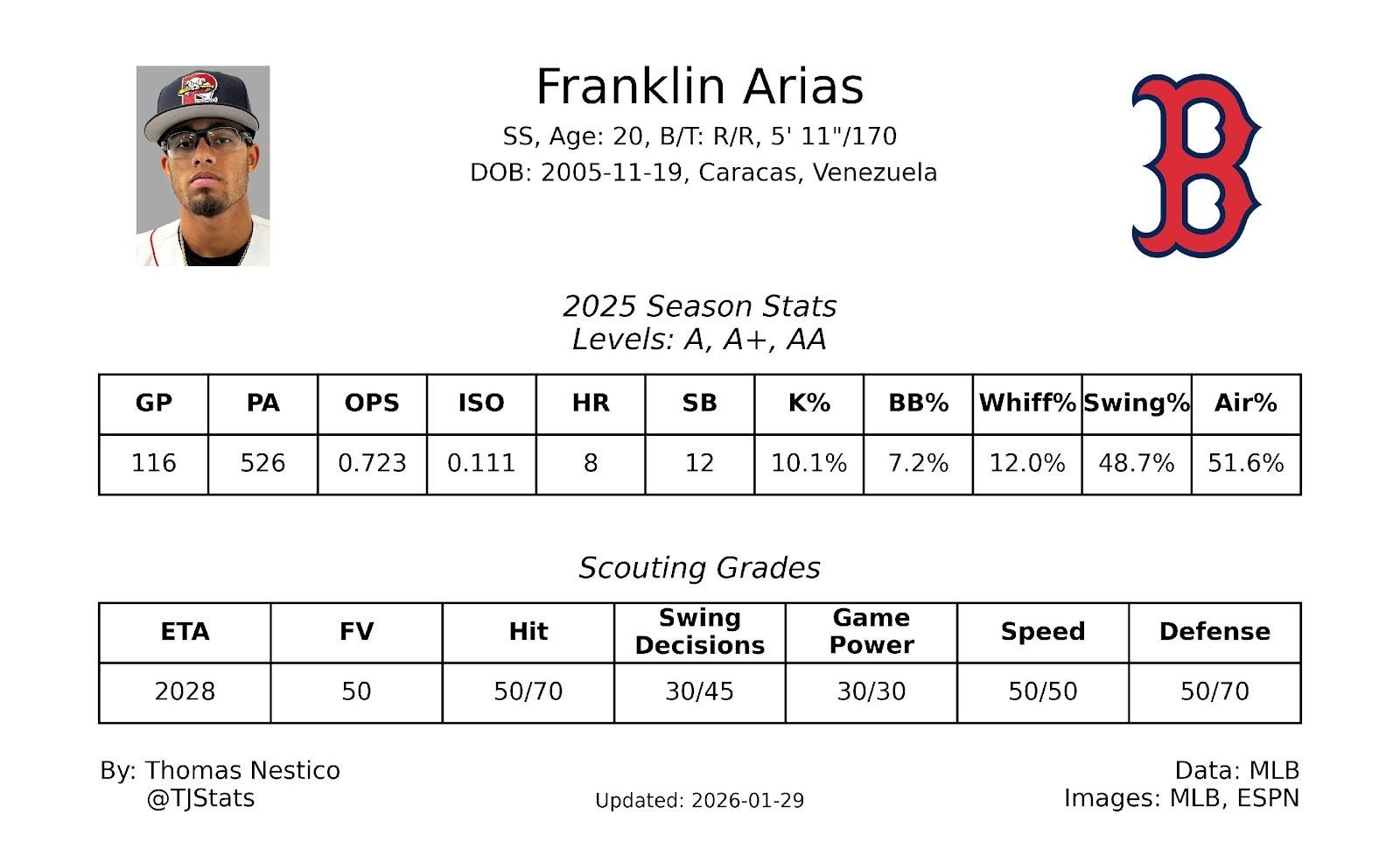
Franklin Arias worked his way up to AA this season on the heels of one of the best hit tools in MiLB and an exceptional glove. His 94% Z-Contact rate is striking on first glance and becomes even more remarkable after realizing that Arias was 19-years-old for the entirety of 2025. He supported his stupendous bat control with a sound approach highlighted by an aggressive in-zone onslaught. One could argue that Arias already possesses multiple MLB-ready tools, but his lack of power heavily deters his projection. His 101.7 MPH 90th% EV sat below his peers, and he also hits far too many ground balls. The bat-to-ball skills and glove scream future everyday SS, but without a substantial power gain Arias’ offensive upside is severely capped.
65) Carson Williams - SS - TB
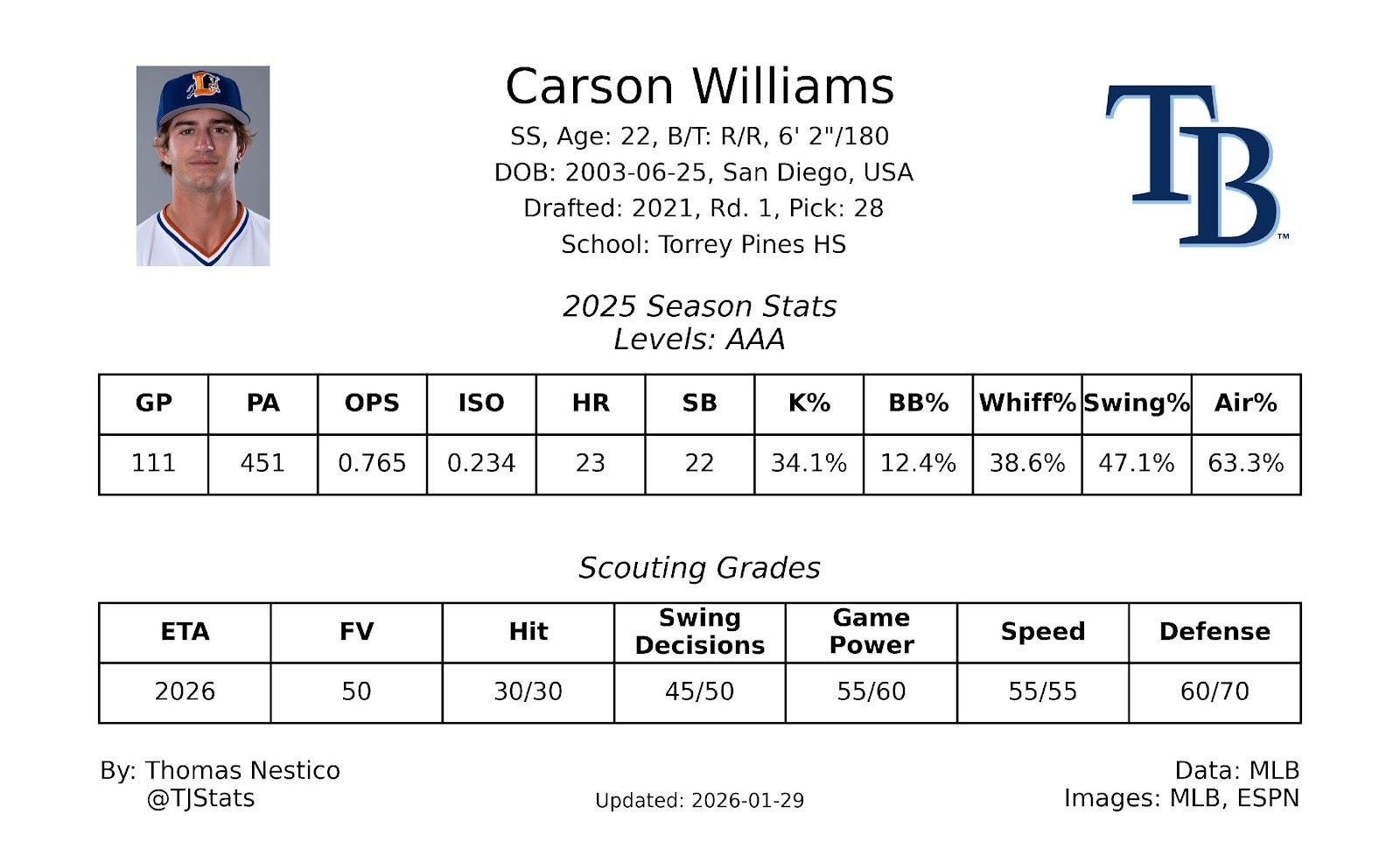
Carson Williams is an outstanding athlete who cruised through his pro career thanks to stupendous defense and above average power. He kept up this success until hitting a roadblock in AAA where his dubious hit tool left him exposed against the rigors of higher-level pitching. He struck out 34.1% of the time which dragged his overall line to below league average for the first time in his career. It was not all discouraging though, as Williams hit 23 home runs driven by plus bat speed and a consistent pulled fly ball approach. He is also poised to be one of the best defenders in baseball. He makes manning shortstop look easy with extensive range, quick footwork, and flashy glove. The hit tool concerns cloud Williams’ upside, with his defensive excellence given him a stable floor if he can find his power stroke in the majors.
66) Braden Montgomery - OF - CWS
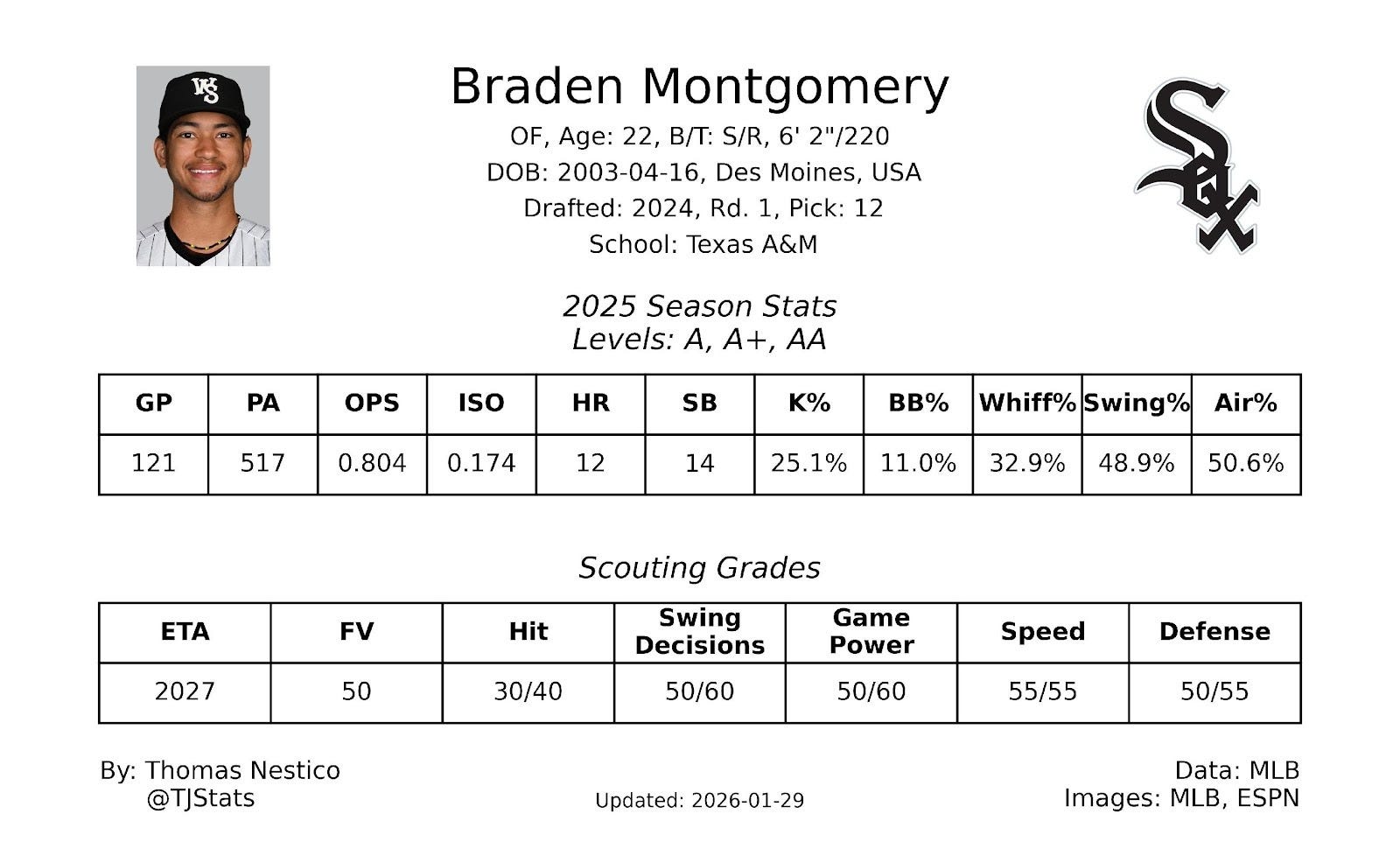
Braden Montgomery was regarded as one of the top players in the 2024 draft, though a severe injury caused him to fall before being selected 12th overall by Boston. He was later traded to Chicago in the Garrett Crochet deal and has already shown his prospect pedigree. Montgomery posted a 136 wRC+ across 121 games in his first pro season, finishing the year in AA. He is a toolsy switch-hitter with a loud bat (106.9 MPH 90th% EV) and an aggressive approach (74% Z-Swing rate), though his contact remains a concern (32.9% Whiff rate). His athleticism allows him to play all outfield positions at an above-average level. Montgomery is a volatile prospect with an impressive tool set and high upside if he can improve his contact skills.
67) George Klassen - P - LAA
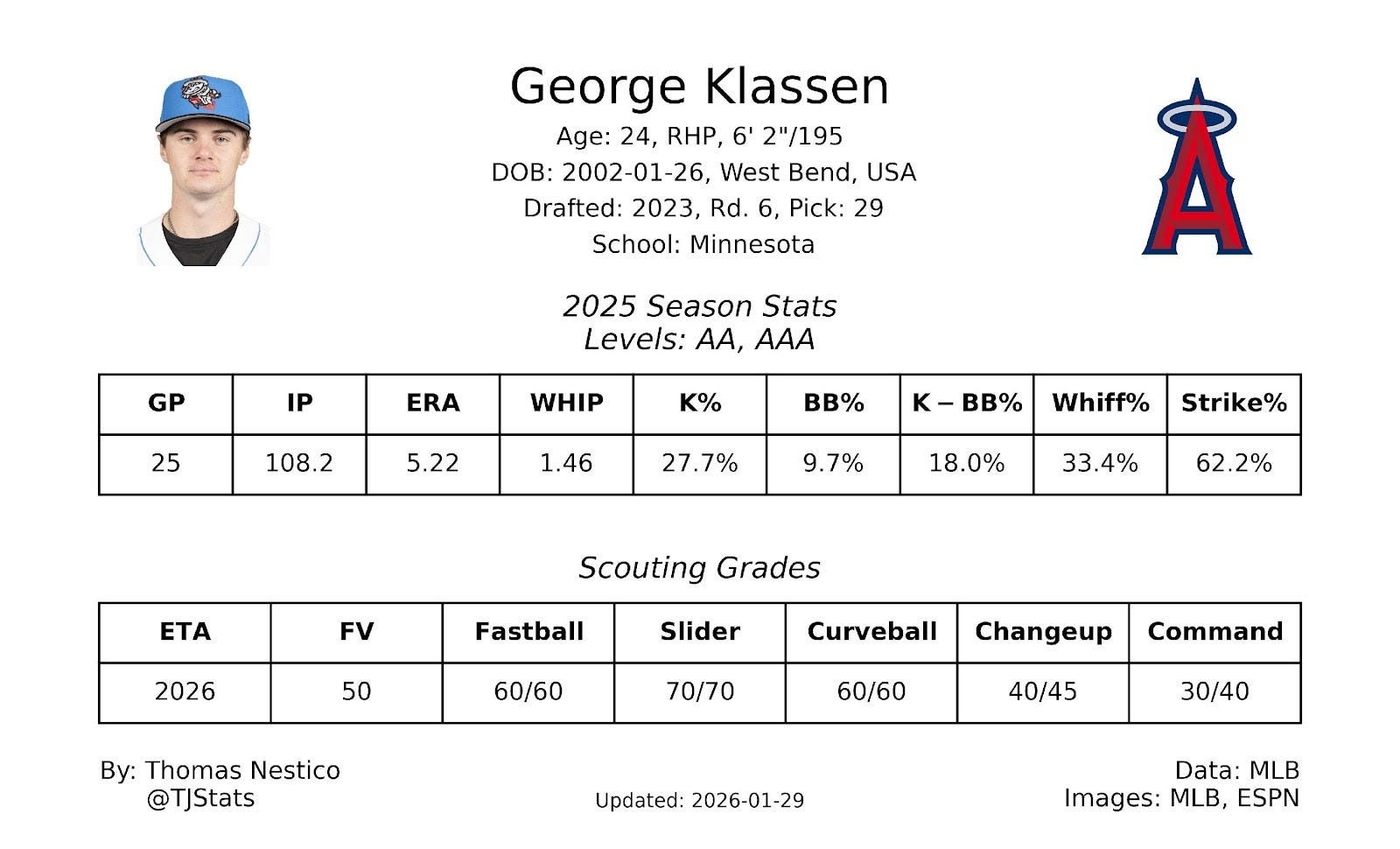
Klassen is a prime example of a team trusting a pitcher’s stuff and letting the command find its way. It was no surprise that Klassen was seen as a RP out of college. He greatly struggled with his command and issued walks at will as a function of his very aggressive and long delivery. The command struggles have continued in his pro career, but Klassen took a massive steps in 2025 to look like a more complete pitcher. Klassen’s fastball sits at 97-98 MPH. Its shape is not ideal, as it hovers in the dead zone, but due to its elite velocity and moderate arm-side movement, the pitch grades out well. He wields two breaking balls, including a power two-plane curveball and an extremely hard bullet slider. His curveball sits at 86-88 MPH, with his slider living in the low 90s. Both pitches are comfortably plus offerings; I would call his slider one of the best pitches in MiLB. The lack of a refined off-speed pitch and his wavering command puts a damper on his future as a starter. His stuff is nasty. He just needs to keep throwing strikes.
68) Brody Hopkins - P - TB
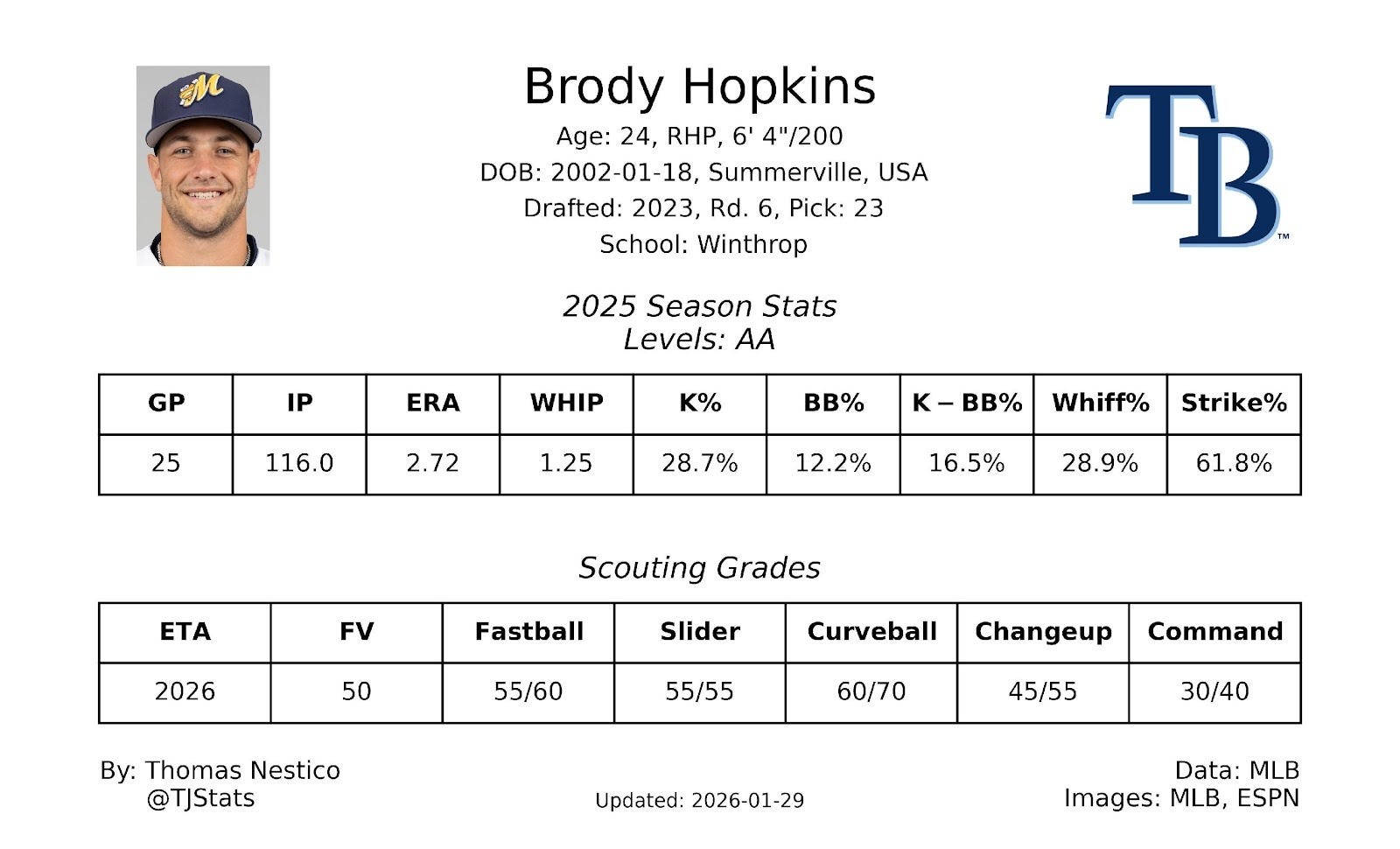
Hopkins, a converted outfielder, was shipped to Tampa Bay as the key return in the Randy Arozarena trade in 2024. He has a large frame ideal for a pitcher, and he wields a deep arsenal packed to the brim with exciting offerings. He tosses two distinct fastballs, a 4-Seam, which sits at 94-96 MPH and gets 15” iVB, and a sinker, which sits in the same velocity band but gets a lot more arm-side action. Despite his tall stature, Hopkins gets a deceptively low release point thanks to his low 3/4 release. This helps his fastballs, especially his 4-Seam, play up, similar to that of former farm mate Bryan Woo. Hopkins breaking balls are plus offerings, with both the curveball and slider sitting in the mid-to-high 80s. His slider acts more like a sweeper, exhibiting large glove-side movement with a bit of drop. His curveball is more like a “deathball” thanks to its velocity and minimal horizonal movement. His high 80s changeup is my favourite offering due to its massive vertical separation from his fastballs and absurd amount of run. The biggest knock-on Hopkins is his inability to consistently land pitches in the zone. He registered a 62% strike rate in 2025, which by no means is a poor number, but is not indicative of reliable command. With that being said, his stuff sets up a floor for a high-leverage reliever, with the potential of a mid-rotation arm if his command takes that next step.
69) Jarlin Susana - P - WSH
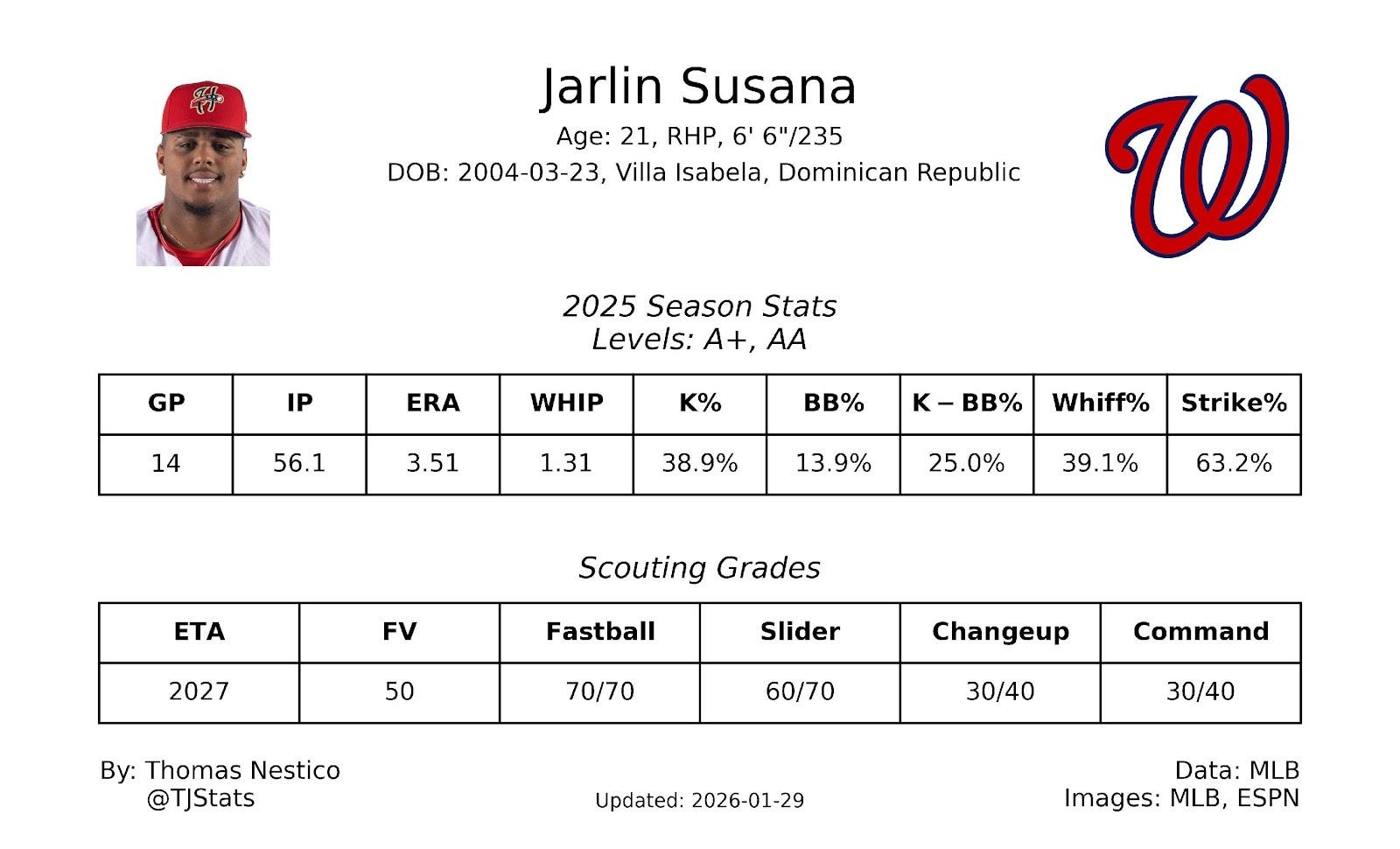
Jarlin Susana was one of the pieces acquired in the trade that sent Juan Soto from Washington to San Diego. Susana has always had very raw stuff, flashing elite velocity as a teenager without a lick of command. His strike throwing greatly improved in 2024, however it seems to have worsened following his promotion to AA. Susana wields two fastballs, a four-seamer and a sinker, which average 100 MPH and 99 MPH, respectively. He averages 12” iVB on his 4-Seam, which is slightly below average for his ~6.0’ release, but that hardly matters when he can reach 103 MPH. One downside to his four-seamer is its steeper approach, which limits the offering’s swing and miss potential. His sinker gets more arm-side run with ~14” of arm-side movement. Susana’s secondary of choice is his slider, which features more 2-plane movement than a typical 88-90 MPH slider. Thanks to its downward movement, he is able to miss under bats often and use the pitch to induce weak contact. His changeup looks to be developing well as a whiff-induing offering, but he has struggled to generate strikes with it. Susana has the stuff of an elite closer, and the strides he made in the command department have buoyed his floor and elevated him into the upper echelon of pitching prospects. He is currently rehabbing from a right lat tear.
70) Carlos Lagrange - P - NYY
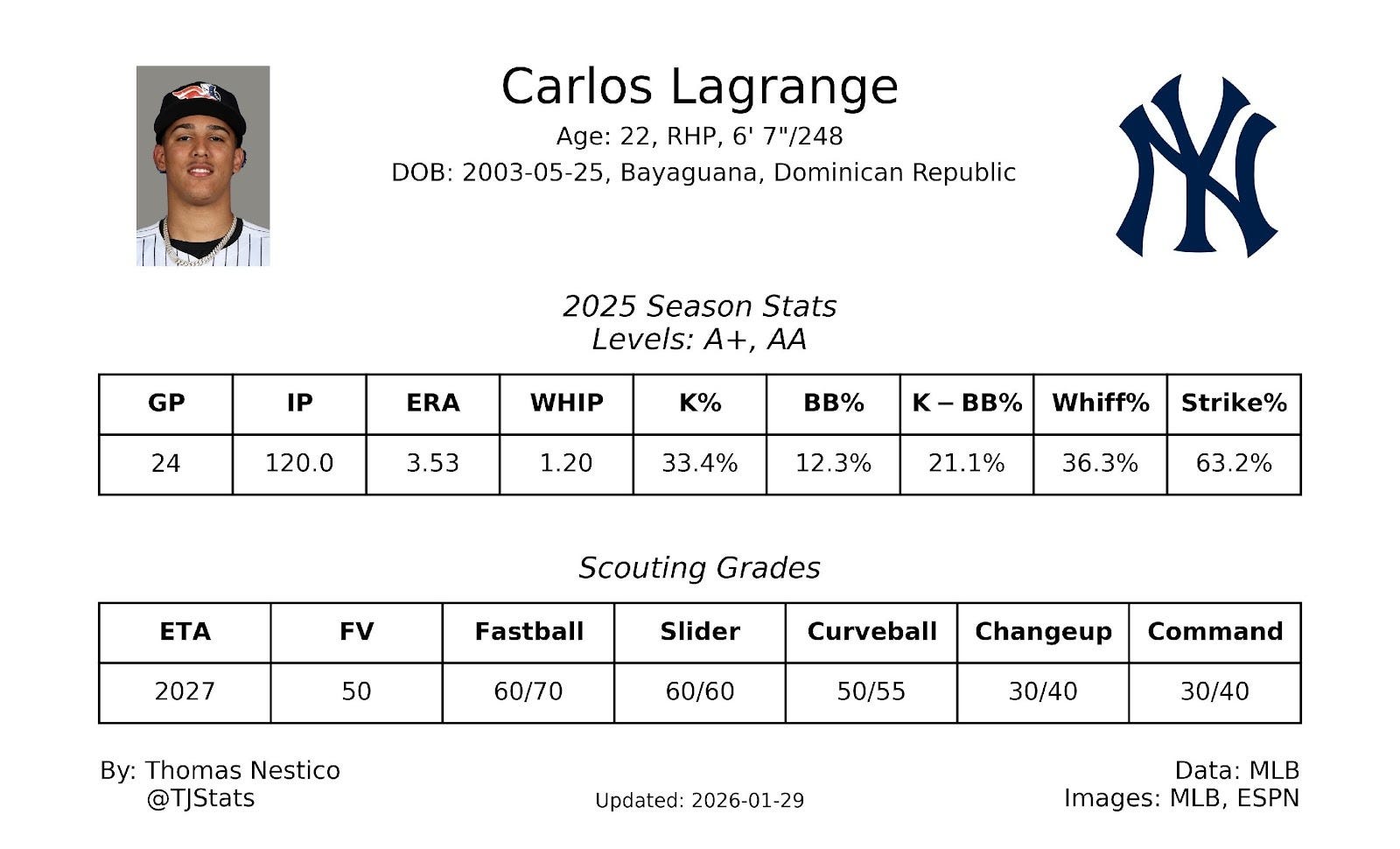
Carlos Lagrange is a mountain of a man, standing tall at 6’7” with plenty of room to fill out his frame. A lack of command has been the biggest knock on Lagrange throughout his pro-career. His delivery was stiff and inconsistent, which has led to putrid walk rates and a poor ability to consistently throw strikes. He lowered his arm slot this season and is exhibiting better command while getting ahead of batters quickly. His fastball sits in the high 90s with 16” iVB and 14” HB, pushing it to plus-plus status. He seems to have a much better feel of the pitch and is not afraid to toss it high in the zone to generate whiffs. He maintains his velocity well, which is encouraging for his prospects as a starter. He tosses a pair of breaking balls. The first is a slider at 82-84 MPH with minimal depth and slight glove-side action. It is his primary secondary against LHH. Against RHH, he opts for a sweeper which sits in the low 80s with over a foot of horizontal break. Both breaking balls exhibit plus characteristics and are elevated by his approach depending on batter handedness. He rounds out his arsenal with a changeup that is still a work in progress. It has ~10 MPH difference from his fastball, but lacks the depth to be an effective offering at this stage. Lagrange has a wide range of outcomes given his inconsistencies in the command department, but he possesses such elite arm speed that he should fall back into a higher-leverage relief role rather easily. Maintaining his seemingly improved strike throwing ability is the most important step for Lagrange because if it clicks, he has sky-high potential.
71) Jaxon Wiggins - P - CHC
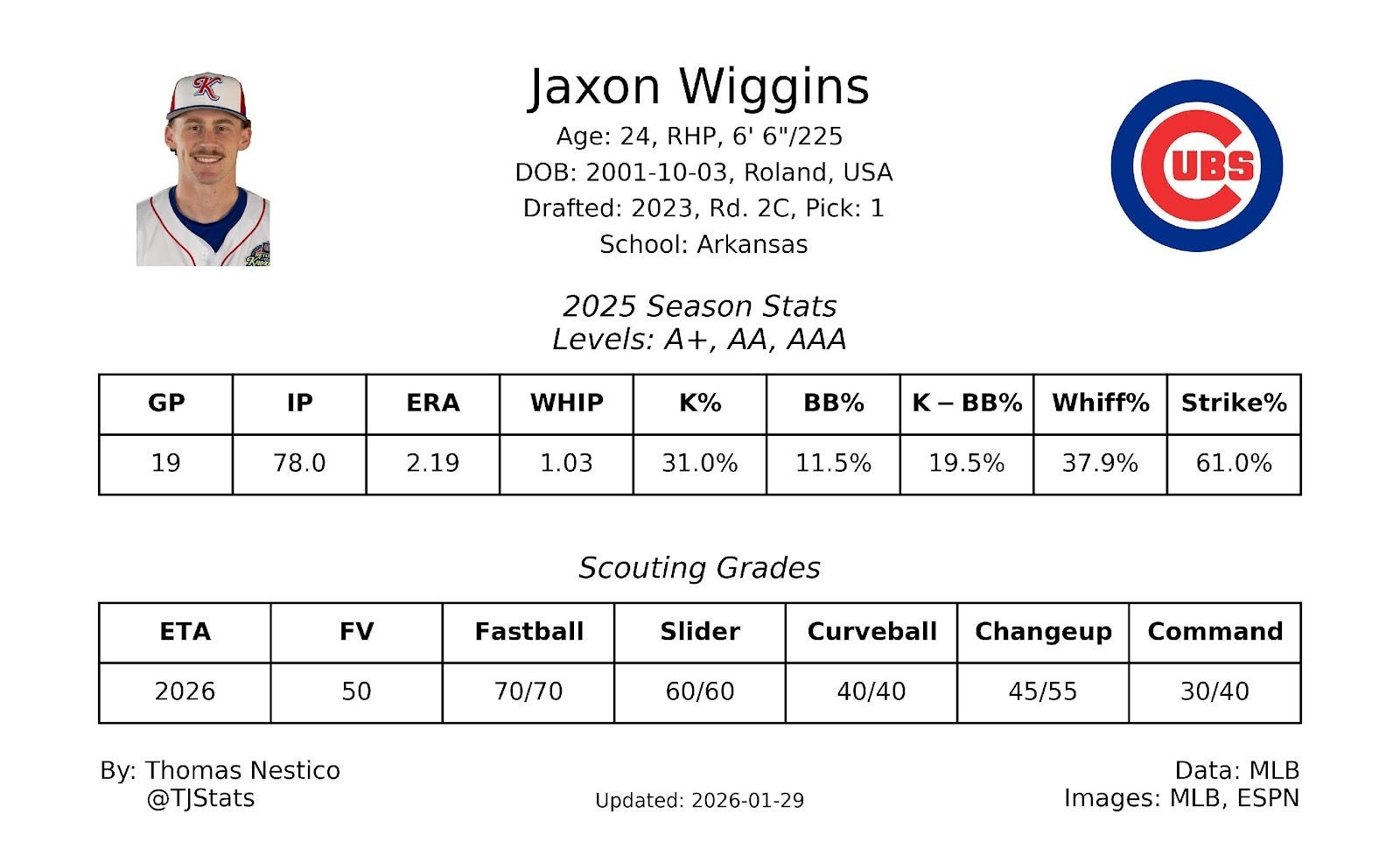
Jaxon Wiggins is a big-bodied righty with a flamethrower of an arm who took AA by storm in 2025. He sits amongst the most prolific whiff generators in MiLB backed by an elite fastball and plus slider which he further supplements with a changeup and curveball vs LHH. Wiggins’ fastball sits in the upper 90s with an above average ride from his high 3/4 slot. It does a stupendous job at inducing whiffs in the zone, however its steeper approach leaves it prone to damage. His slider exhibits tight cut-gyro movement and averaged 88-89 MPH. He commands the offering well, leading to strong whiff rates and above average chases rates. His changeup’s combination of vertical and velocity separation from his fastball provides him the necessary weapon to tackle LHH. Although it is a rawer offering, it has flashed exceptional results this season. The biggest concern in Wiggins profile is his inconsistent command which continues to hamper him in starts this season. He ranks near the bottom in most conventional control proxies including Strike%, Zone%, and First Pitch Strike%, indicating that he may ultimately end up in the bullpen. Nonetheless, Wiggins has some of the most exciting stuff of all MiLB pitchers and if he can keep the walks in check, his ceiling as a starter is very tantalizing.
72) Theo Gillen - OF - TB
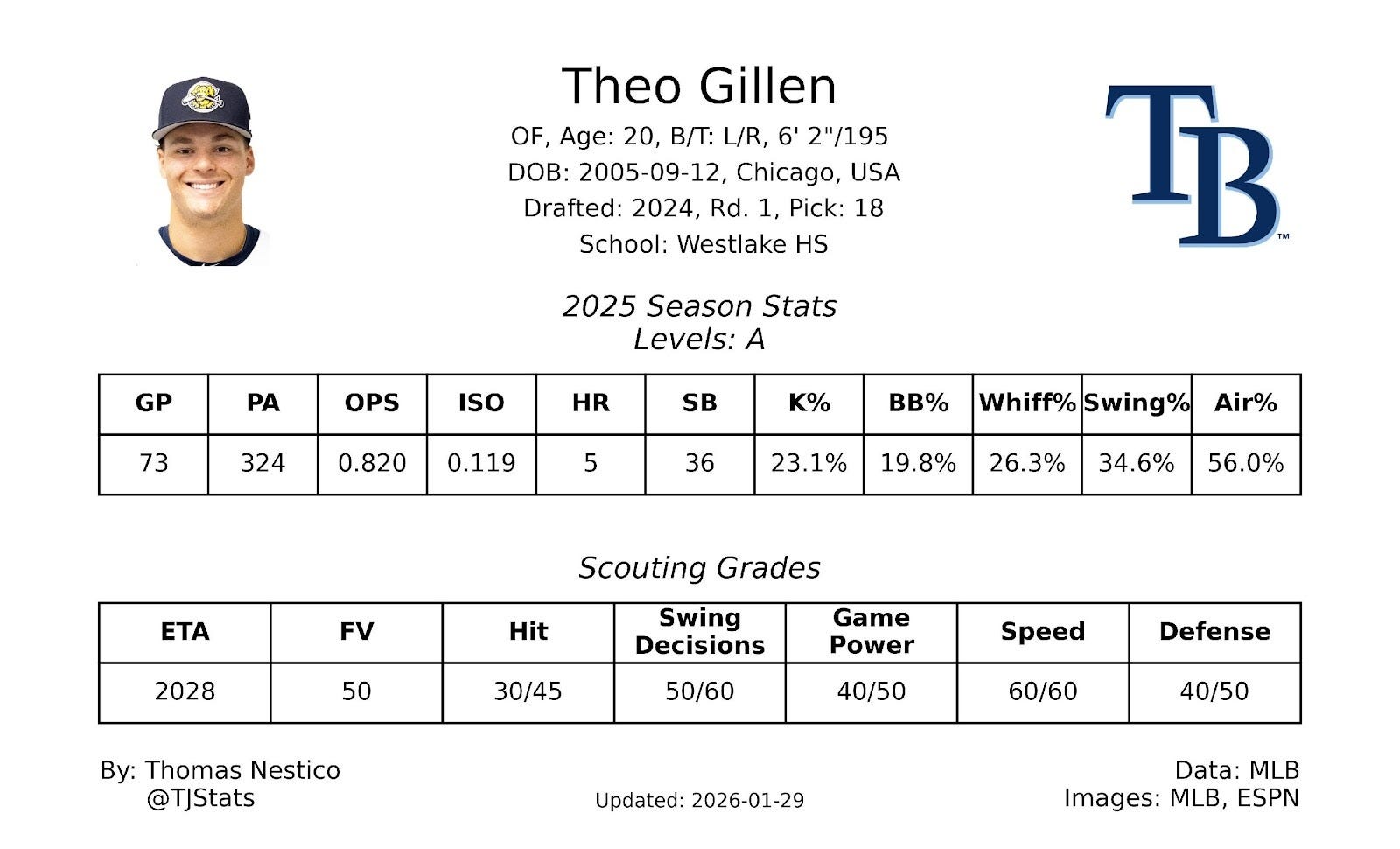
Theo Gillen made a statement in his first season of pro ball. He registered a 149 wRC+ in Lo-A while walking nearly 20% of the time. His ability to identify and lay off outside pitches is stunning and provides confidence that he will succeed as he moves through the Rays system. He returned average contact rates this season and encouraging power metrics (103.3 MPH 90th% EV, 44.2% HardHit rate). The biggest holes in his approach are his extreme lack of in-zone aggression and inability to hit off-speed pitches. Gillen grades out as a plus runner and projects to be an effective defender in center field. Overall, Gillen has looked excellent after injuries cut down his draft stock and has quickly made up for lost time.
73) JoJo Parker - SS - TOR
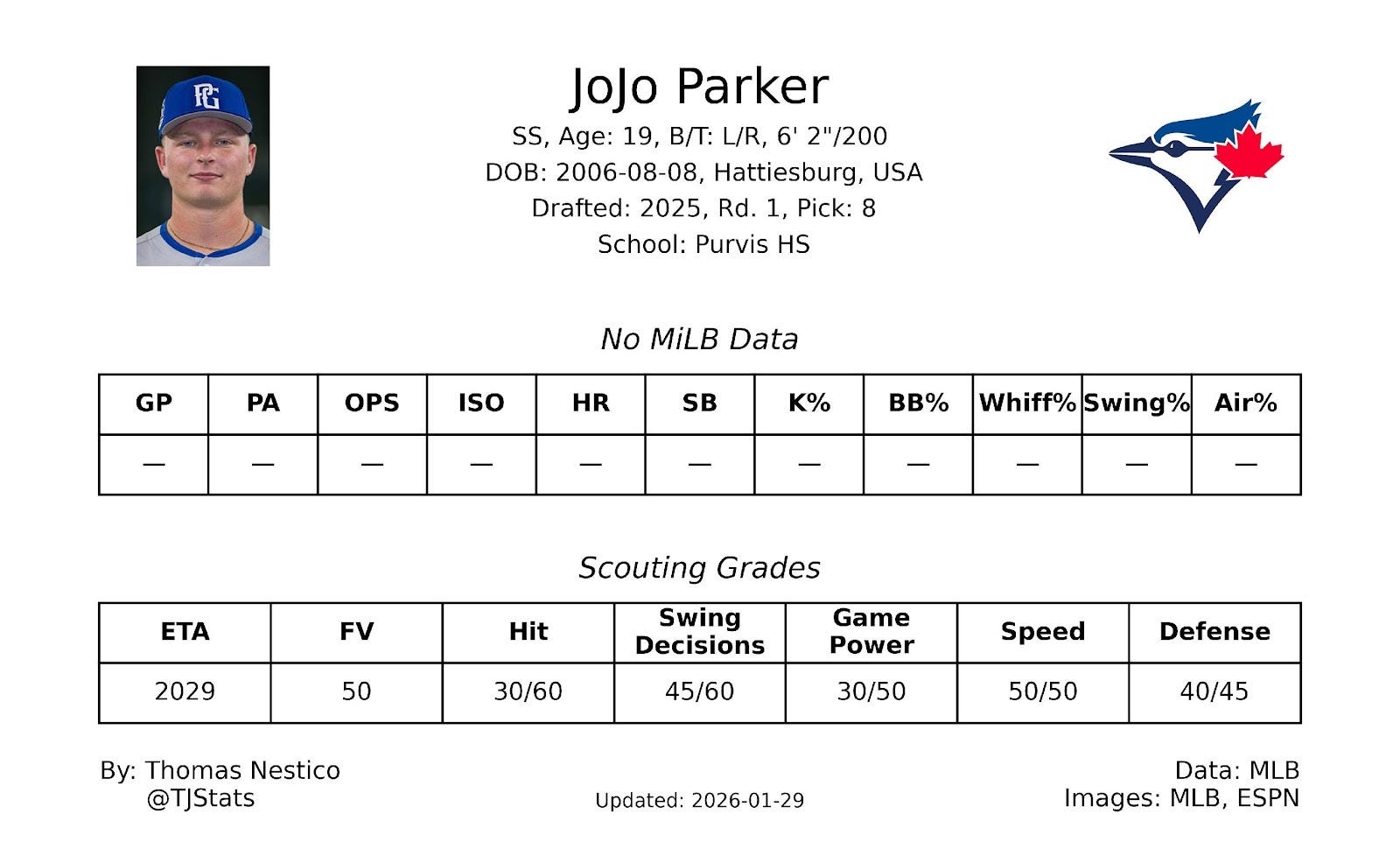
JoJo Parker was arguably the best pure hitter of the 2025 prep class after an excellent showing in his senior year. He flashed a blend of advanced swing decisions with a refined hit tool to land himself a top 10 selection in the draft. He has the size to tap into at least league average power and the swing to spray hits into the gaps. His athleticism provides enough confidence that he can stick at shortstop and provide solid value on the base paths. Parker provides a complete suite of tools that bode well for his future in pro ball.
74) Dax Kilby - SS - NYY
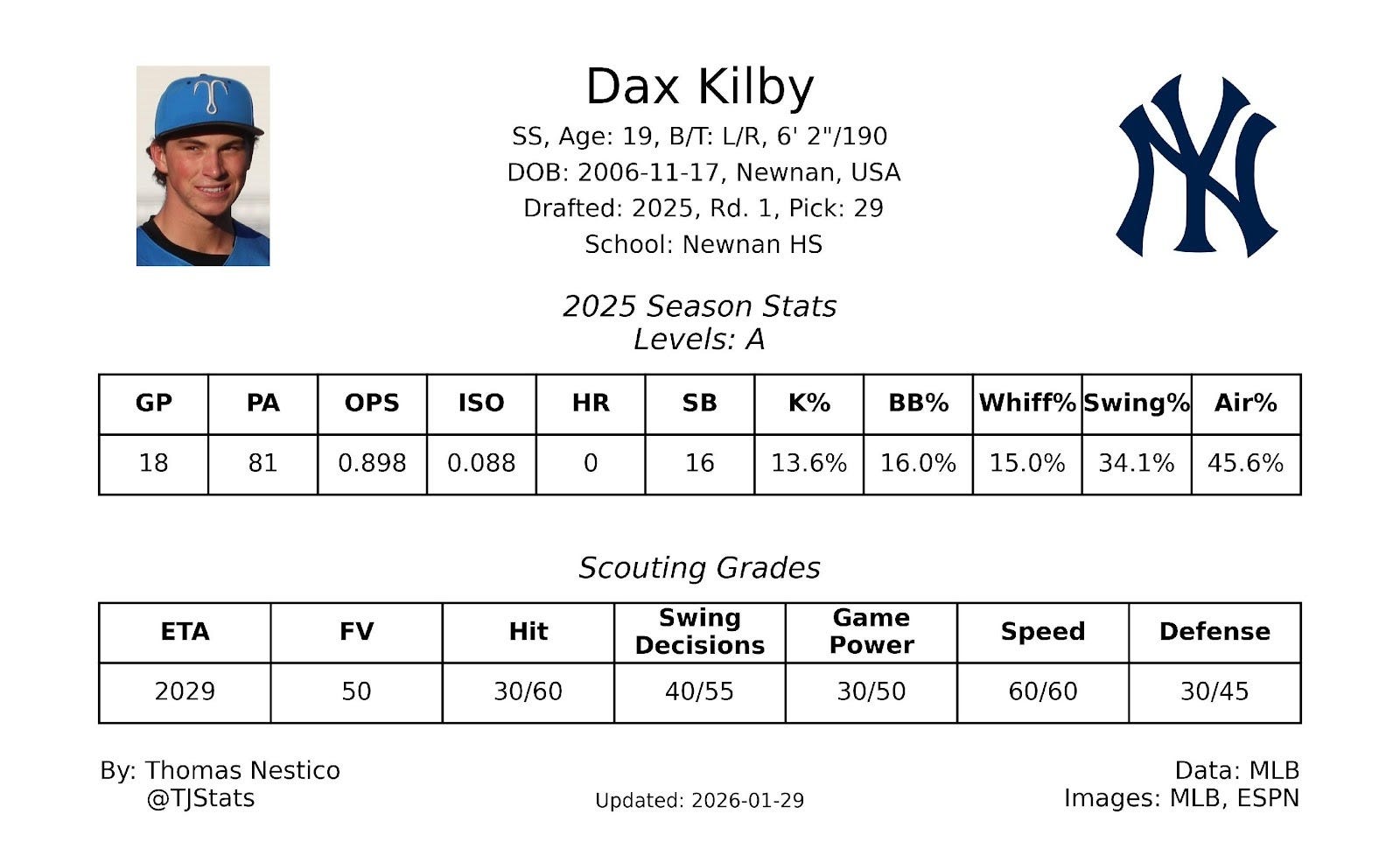
Dax Kilby was selected 39th overall in the 2025 MLB Draft after showcasing a polished blend of bat-to-ball skills and plate discipline on the amateur circuit. His pro debut offered a glimpse of additional offensive upside, as Kilby flashed above-average raw power with wood, posting a 108.9 MPH max exit velocity and a 49.1% HardHit rate. The combination of contact ability and damage potential gives him one of the higher offensive ceilings in the class, though his extremely flat swing plane raises questions about whether his game power will consistently trail his raw power. Further bolstering his profile are plus sprint speeds and projectable defense up the middle. Any meaningful swing adjustment that allows him to access more loft could significantly elevate his prospect stock.
75) Connor Prielipp - P - MIN
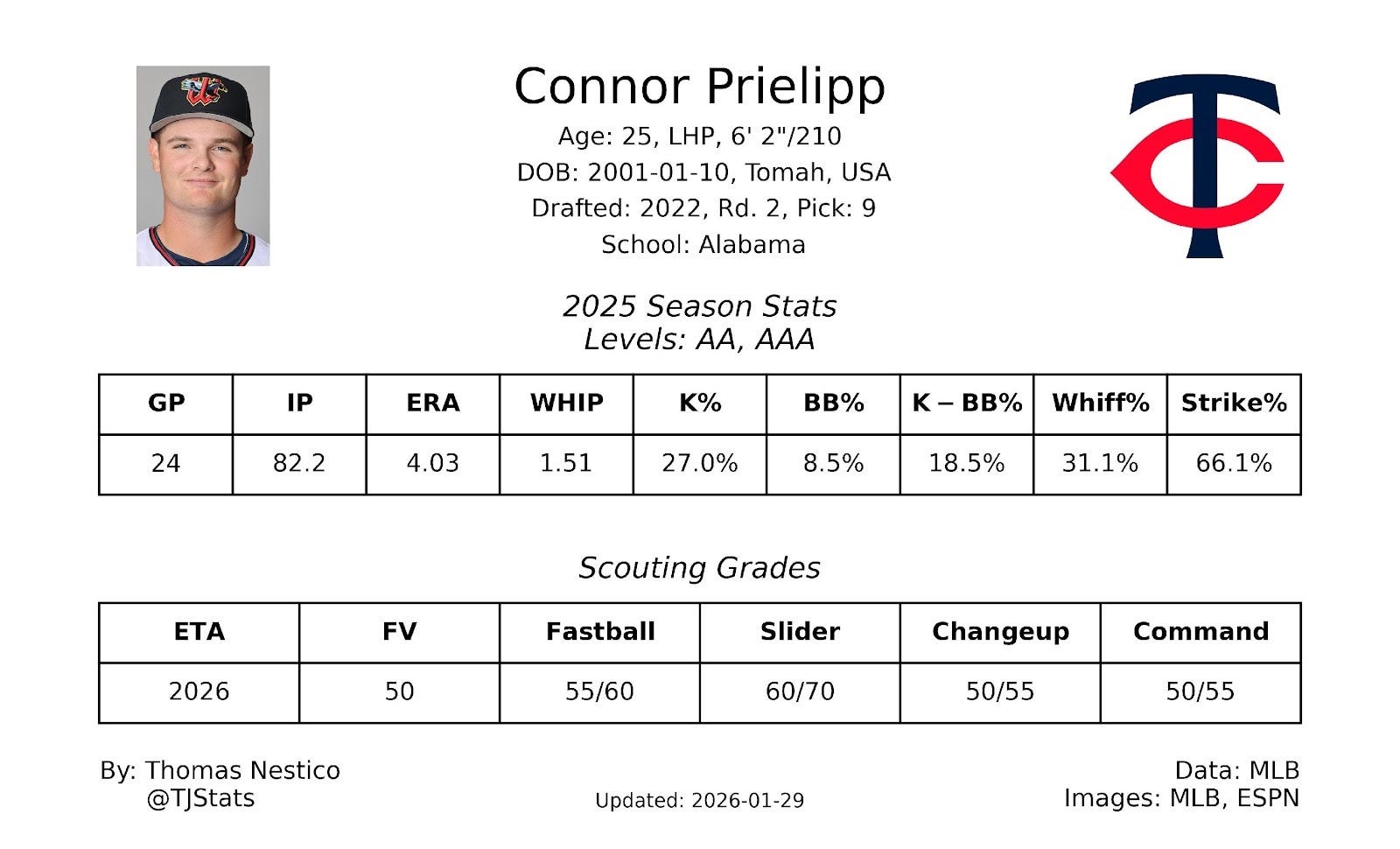
Injuries had stalled Prielipp’s development, but when he is on the field, he looks electric. His fastball sits 95-96 MPH and can reach 99 MPH with average ride for his 3/4 slot. He commands the offering exceptionally well, which allows it to rack up called strikes and run above average whiffs rates. He supplements his fastball with a pair of secondaries in his changeup and slider. His changeup sits 86-88 MPH with about a foot of vertical separation from his fastball. His slider sits in the same velocity band as his changeup and exhibits tight 2-plan action. He has a great feel for the pitch, and it has been his best option this season. He has started to introduce a sinker into his mix which should give him another option against LHH. Prielipp has an enticing 3-pitch mix that should lead to a solid MLB career as a starter, but his inability to stay on the field is his biggest hindrance. There is still more velocity in the tank, which gives me hope he can find the right balance of power and durability to help the Twins relatively soon.
76) Wei-En Lin - P - ATH
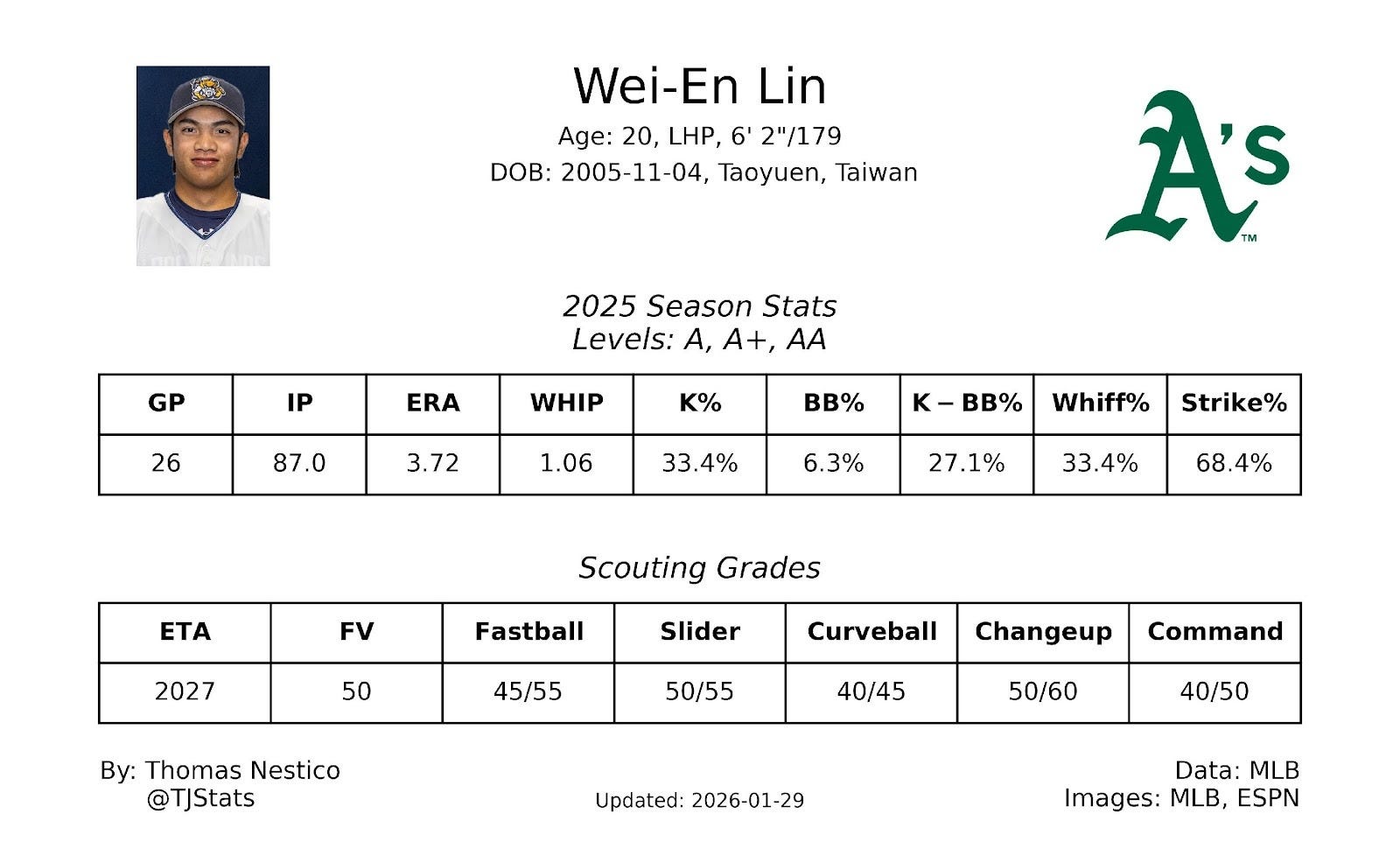
Wei-En Lin -- nicknamed “Taiwanese Snellzilla” by Athletics assistant GM Billy Owens -- burst onto the scene by reaching Double-A in his first professional season at just 19 years old. The left-handers rapid ascent was driven by advanced strike-throwing ability and elite swing-and-miss metrics. Lin operates with a prototypical starters mix, headlined by a low-90s fastball, a dominant changeup, and two breaking balls. While the fastball lacks high-end velocity, its above-average ride and Lins ability to consistently locate it in and around the zone allow it to generate strikes at a high rate while still inducing chases. The changeup is the separator and his most impactful offering, producing a 52.5% Whiff rate last season. It creates roughly 10 inches of vertical separation off the fastball, with a 14-mph velocity gap driving its tumbling action. Lin rounds out his arsenal with an 82-84 MPH two-plane slider with slight ride and a mid-70s curveball. At this stage, Lin profiles as more control than command, which is expected given his age. Still, the foundation is that of a future mid-rotation starter: a fastball he can reliably land for strikes, a polished four-pitch mix, and bat-missing secondaries. Refining command with his secondaries is the next step in his development.
77) Jamie Arnold - P - ATH
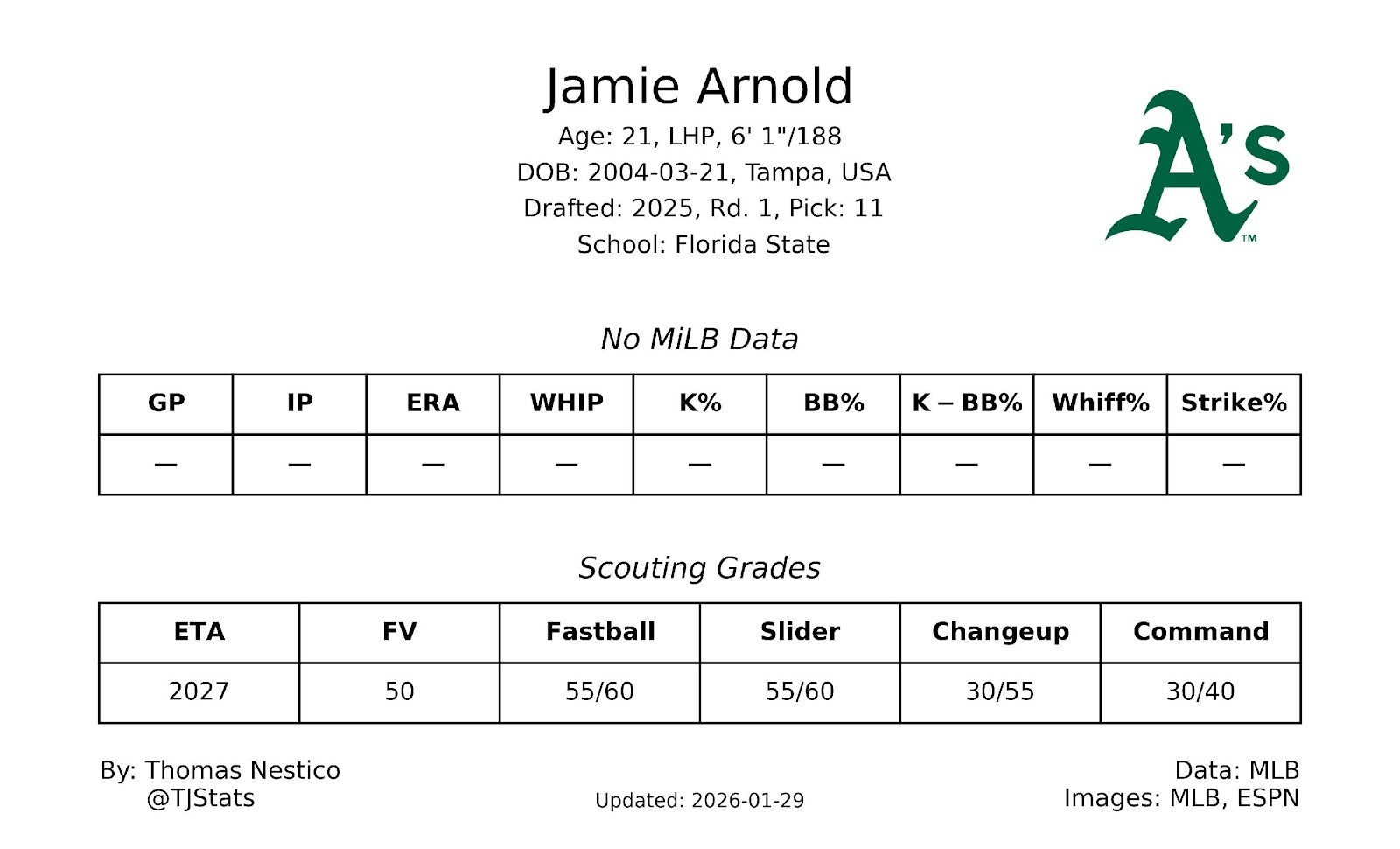
Jamie Arnold is a low-slot lefty who dominated the ACC over his final two seasons at Florida State and was selected 11th overall in the 2025 draft. He features a two-fastball look, mixing a sinker and four-seamer that sit in the low-to-mid 90s and are defined by exceptionally shallow vertical approach angles, a trait further amplified by elite extension. Both fastballs grade as above average, and Arnold has shown the ability to touch 97 mph. He leans heavily on a well-commanded mid-80s slider with moderate sweep that moves away from left-handed hitters and creates uncomfortable angles for right-handers when located on the inner third. The most intriguing secondary is a bowling-ball changeup with significant arm-side fade (-6 inches of iVB), a shape that plays well off his fastball, though feel for the pitch remains inconsistent. Given his fastball-slider foundation, deceptive arm action, and strong NCAA track record, Arnold profiles as one of the top arms in his draft class, with a tantalizing ceiling if he can stabilize the changeup.
78) Kyson Witherspoon - P - BOS
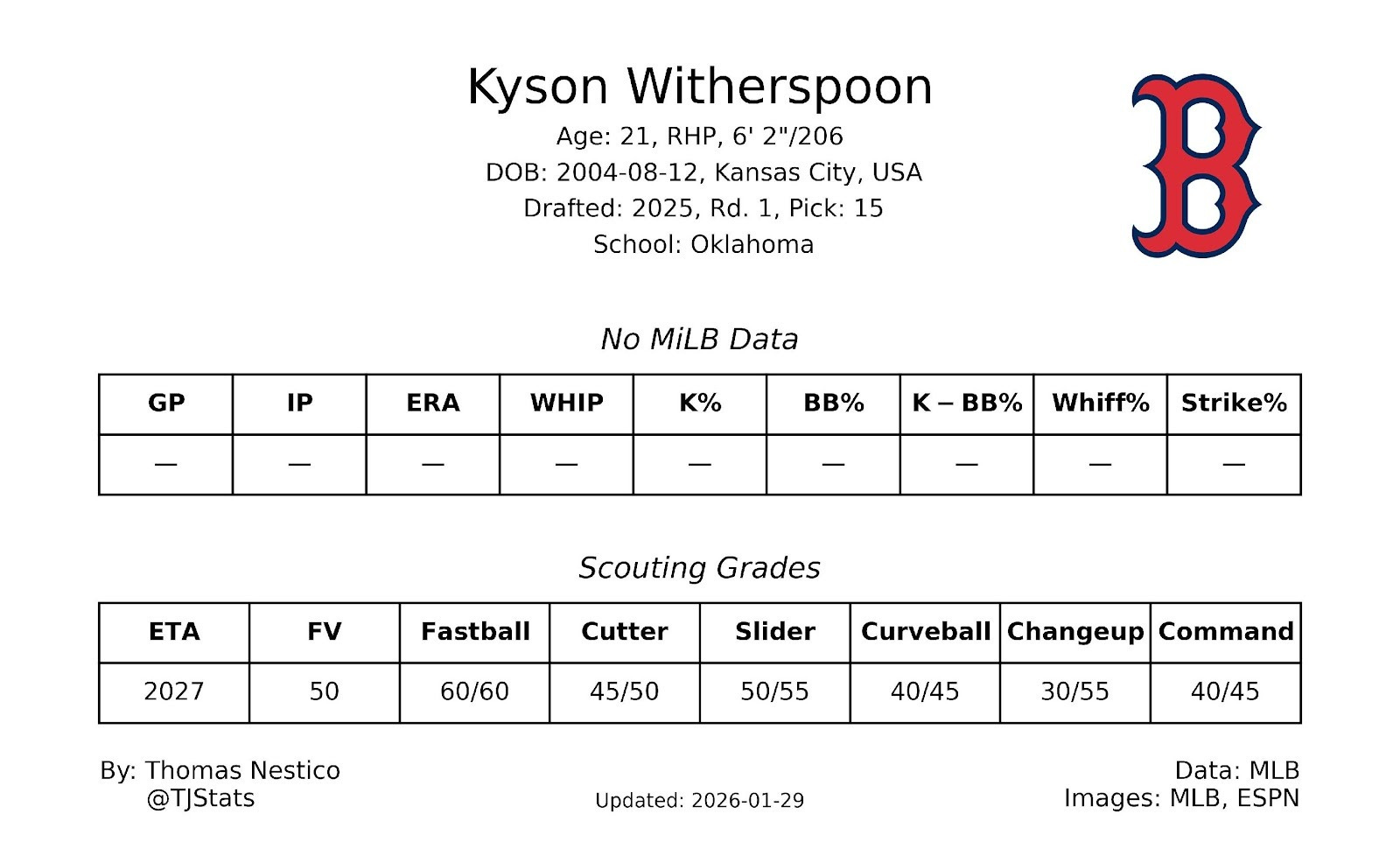
Kyson Witherspoon entered the 2025 draft as one of the most polished college arms available, and the Red Sox selected him 15th overall. His tenure at Oklahoma was defined by elite strikeout rates, driven by upper-90s velocity and a deep mix of secondaries. In line with recent Boston pitching acquisitions, Witherspoon uses a long stride to generate close to 7 ft of extension, allowing his stuff to play up. His fastball sits 9597 mph and features above-average ride from a 5.9-foot release height, paired with a shallow approach angle that pushes the pitch into plus territory. His primary secondary is a hard slider with slight cutting action, which he commands well to generate chase outside the zone. During offseason work at Driveline, Witherspoon introduced a sweeper variant, adjusting his grip to unlock up to 20 inches of glove-side movement. He has also mixed in a curveball and cutter at various points to round out the arsenal. An athletic mover, Witherspoon showed improved strike-throwing in 2025 and owns both the raw stuff and physicality to project as a mid-rotation starter.
79) Noah Schultz - P - CWS
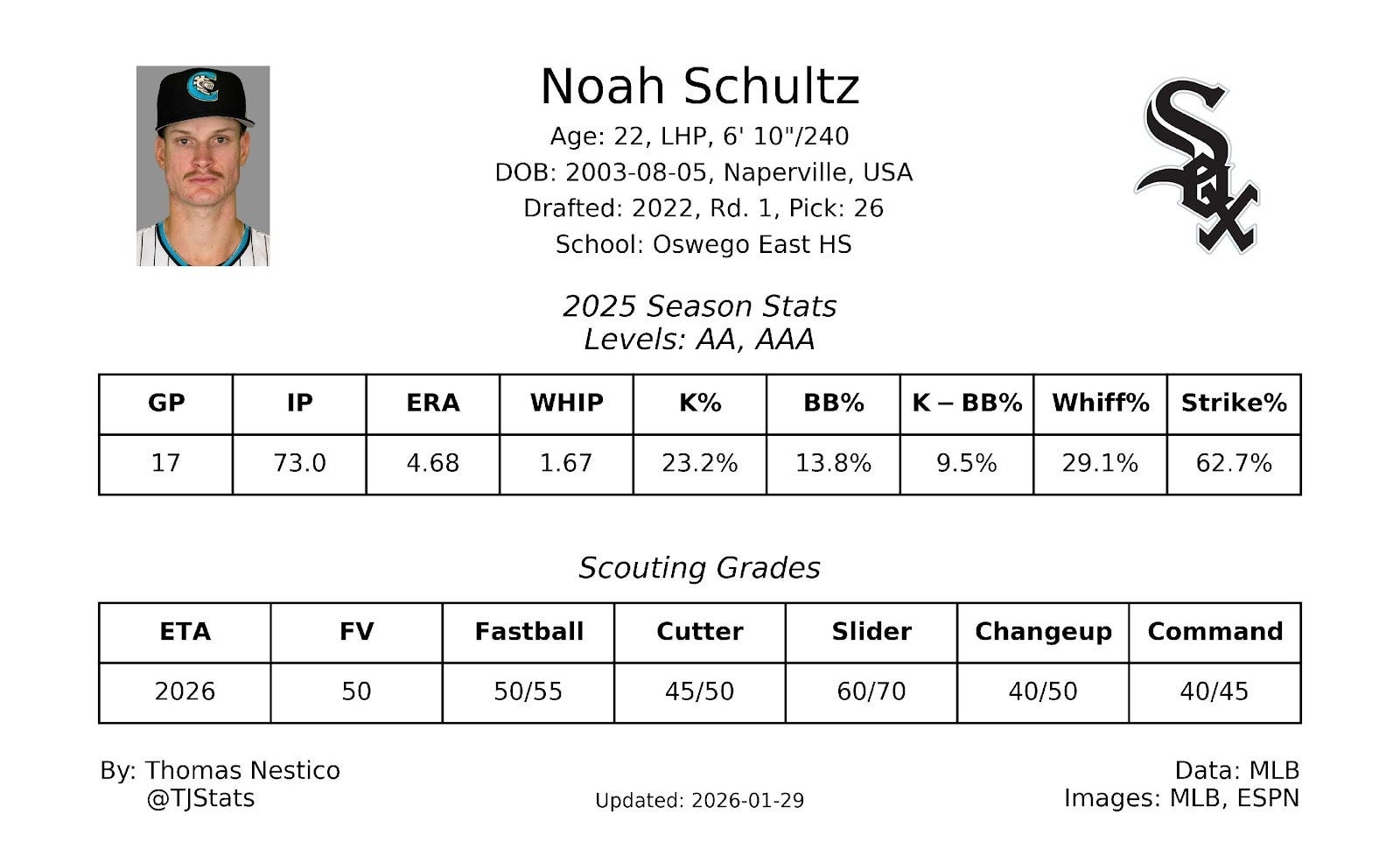
Schultz is a behemoth on the mound, standing at a towering 6’9”. Before 2025, Schultz consistently dominated batters. Unfortunately, his stock took a big tumble this season as all his pitches took a step back. This velocity dipped nearly a tick after he started to stretch out more and his command metrics plummeted. He utilizes his towering presence to his advantage as he is able to get a 5.5 ft vertical release point from a lefty sidearm delivery. His arm action has the added benefit of allowing him to get a ton of glove-side movement on his high-spin sweeper. His sweeper exhibited less depth , which has put a damper on its stuff grades. His sinker possesses some strong characteristics, including sitting 94-95 MPH with 16” HB, mirroring his huge sweeper. However, it has struggled with missing bats and allowing damage against. Schultz added in a cutter and changeup to round out his arsenal, but both offerings are not polished. His sinker may not become a dominant pitch in the Majors, but its physical characteristics portend well for further development. His prospects as a starter hinge on finding his command while limiting damage against his fastball and further improving his changeup and cutter, with his sweeper raising his ceiling to lofty heights.
80) Jacob Melton - LF - TB
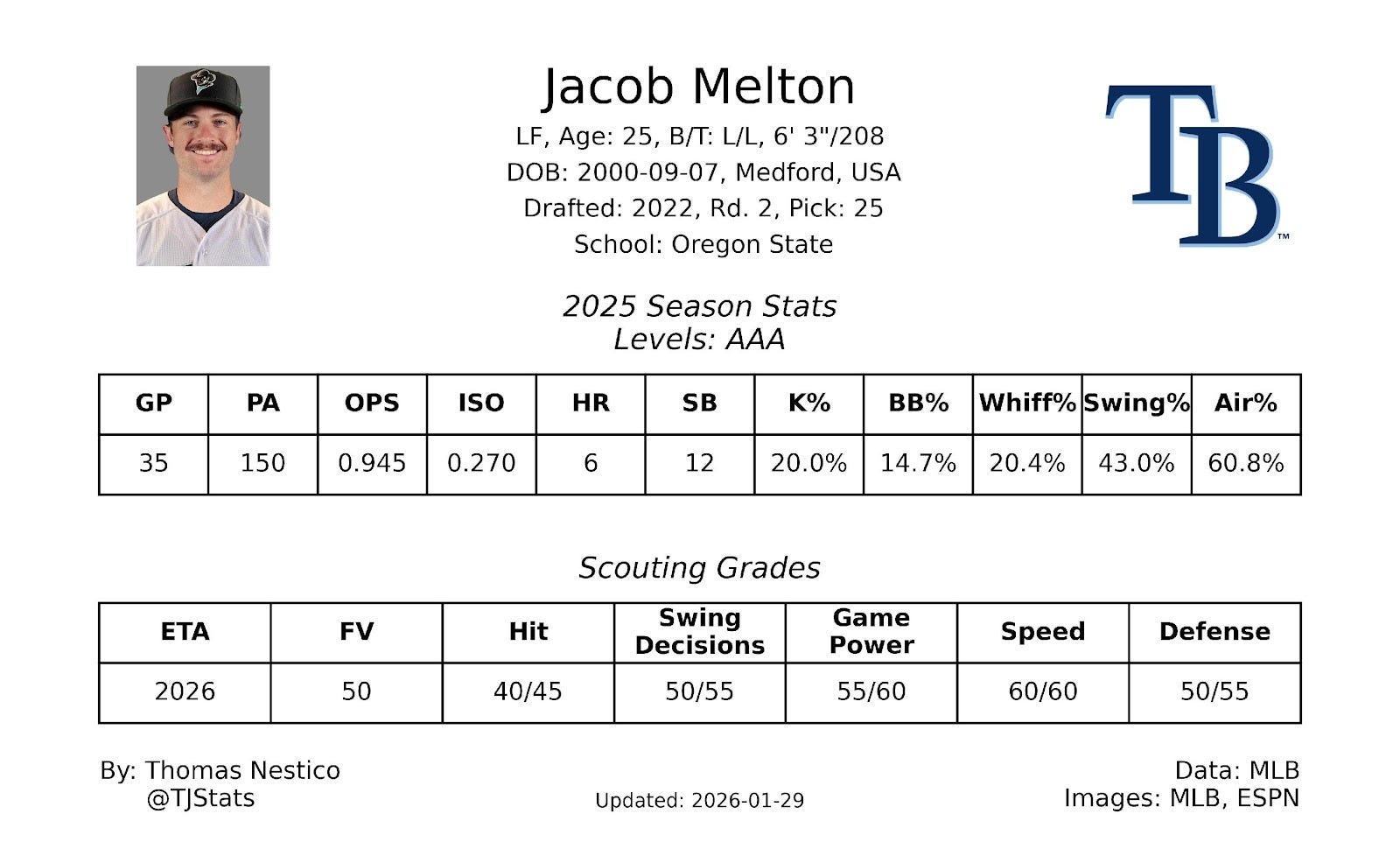
Jacob Melton put himself back on prospect radars last season following a torrid stretch in AAA, where he showcased plus exit velocities and barrel rates alongside a solid blend of plate discipline and contact skills. His 107.2 mph 90th% EV ranked among the best at the level and fueled a massive 60.6% HardHit rate, supporting an excellent 141 wRC+. He earned a deserved MLB call-up, though his production quickly stalled as he struggled against spin and later suffered an ankle injury. That setback did little to dampen interest, as Tampa Bay acquired him this past winter and he now enters camp competing for an Opening Day roster spot. Away from the dish, Melton is an plus runner who grades out as an above-average center fielder. His present floor looks like a strong-side platoon outfielder with enticing pop, but if he can rein in his contact rates, theres a realistic path to an everyday role up the middle.
81) Alex Freeland - SS - LAD
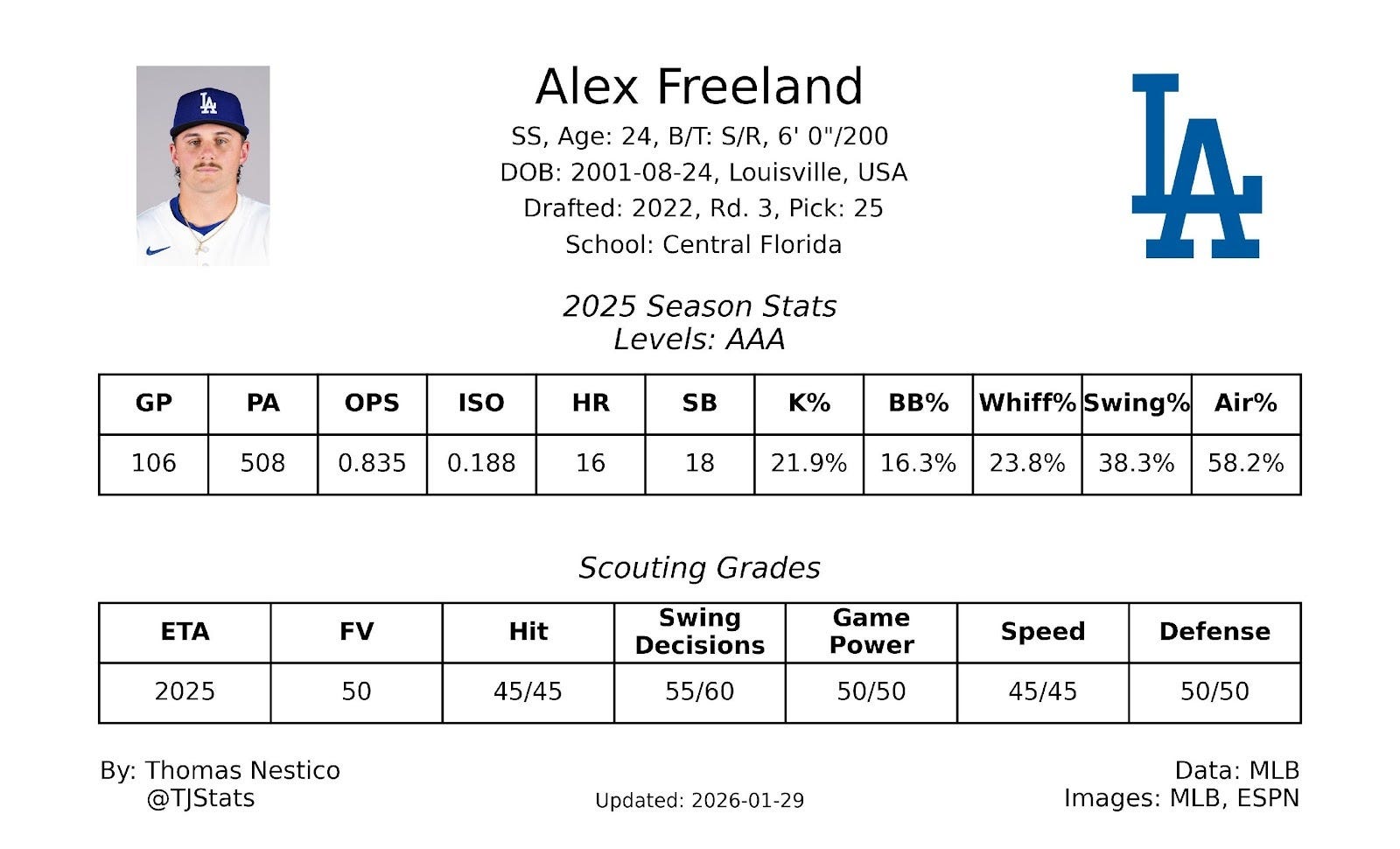
Alex Freeland broke out during the 2024 season, and it was more of the same in 2025, where he spent most of the year in AAA with occasional MLB appearances. Freeland blends a patient approach with average power and solid bat-to-ball skills from both sides of the plate. This foundation allowed him to produce above-average results at every minor league stop. While his footspeed is below average, he is an agile defender capable of delivering strong results at any infield position. Freeland is a well-rounded switch-hitting shortstop who should make an impact in MLB soon, although whether that will be with the Dodgers remains unclear.
82) Harry Ford - C - WSH
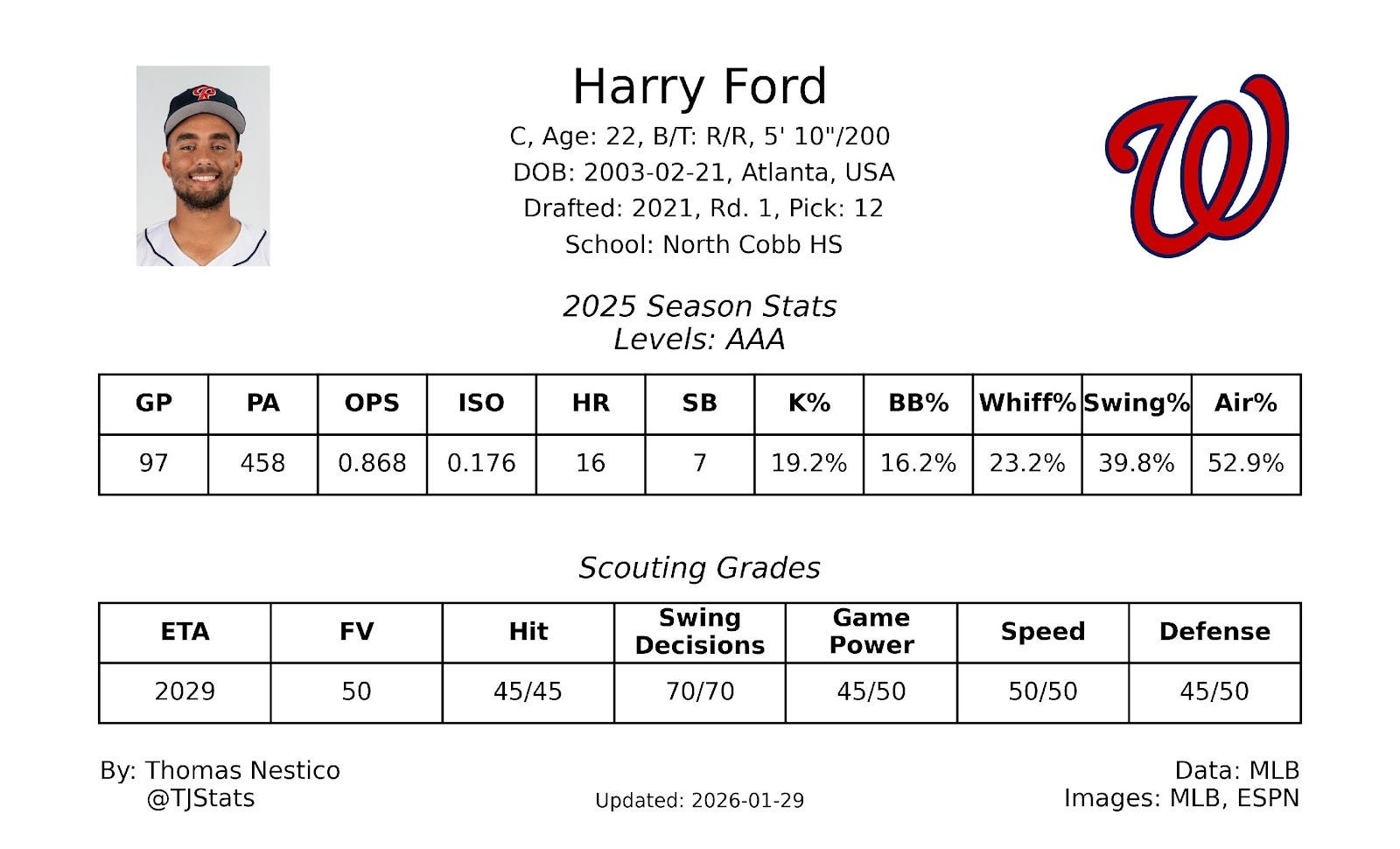
Harry Ford returned an effective 2025 season, spending most of the year in AAA and posting a strong 125 wRC+ across 97 games, which is consistent with his performance throughout his pro career. His success is built on an extremely selective approach paired with solid bat-to-ball skills and decent power output. A 14% O-Swing rate buoyed his impressive 16.2% walk rate, which drove much of his offensive value. His defense remains a major talking point, as scouts believe he has the tools to be an above-average catcher, yet his framing and blocking results have been well below average. Ford’s offensive skill set paints him as an average bat, but concerns over his defensive reliability and limited versatility cap his prospect stock.
83) Owen Caissie - RF - MIA
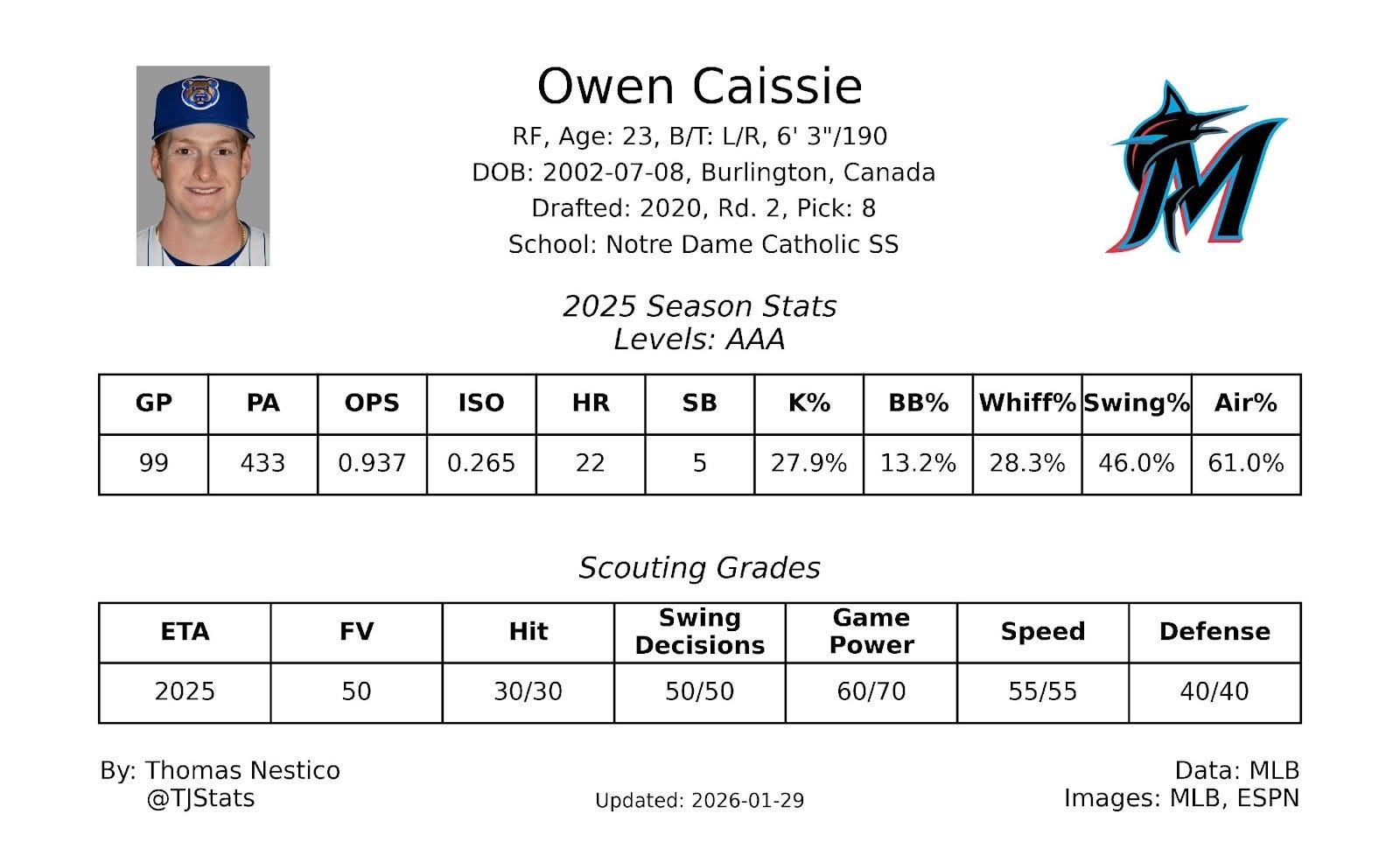
Owen Caissie was one of the most destructive prospects in 2025. He hit 22 home runs with a .265 ISO, fully supported by a 107.6 MPH 90th percentile exit velocity, plus bat speed, and elite barrel rates. These underlying metrics improved from 2024, complemented by better contact rates and plate discipline. In the field, he looked more comfortable in the outfield and should stick there long-term, alleviating concerns that he would be a first baseman. While it was an encouraging season, Caissie’s inability to hit spin remains an issue, as shown by a 42% whiff rate. He projects as a typical slugging corner outfielder reliant on the three-true-outcomes approach.
84) Lazaro Montes - OF - SEA
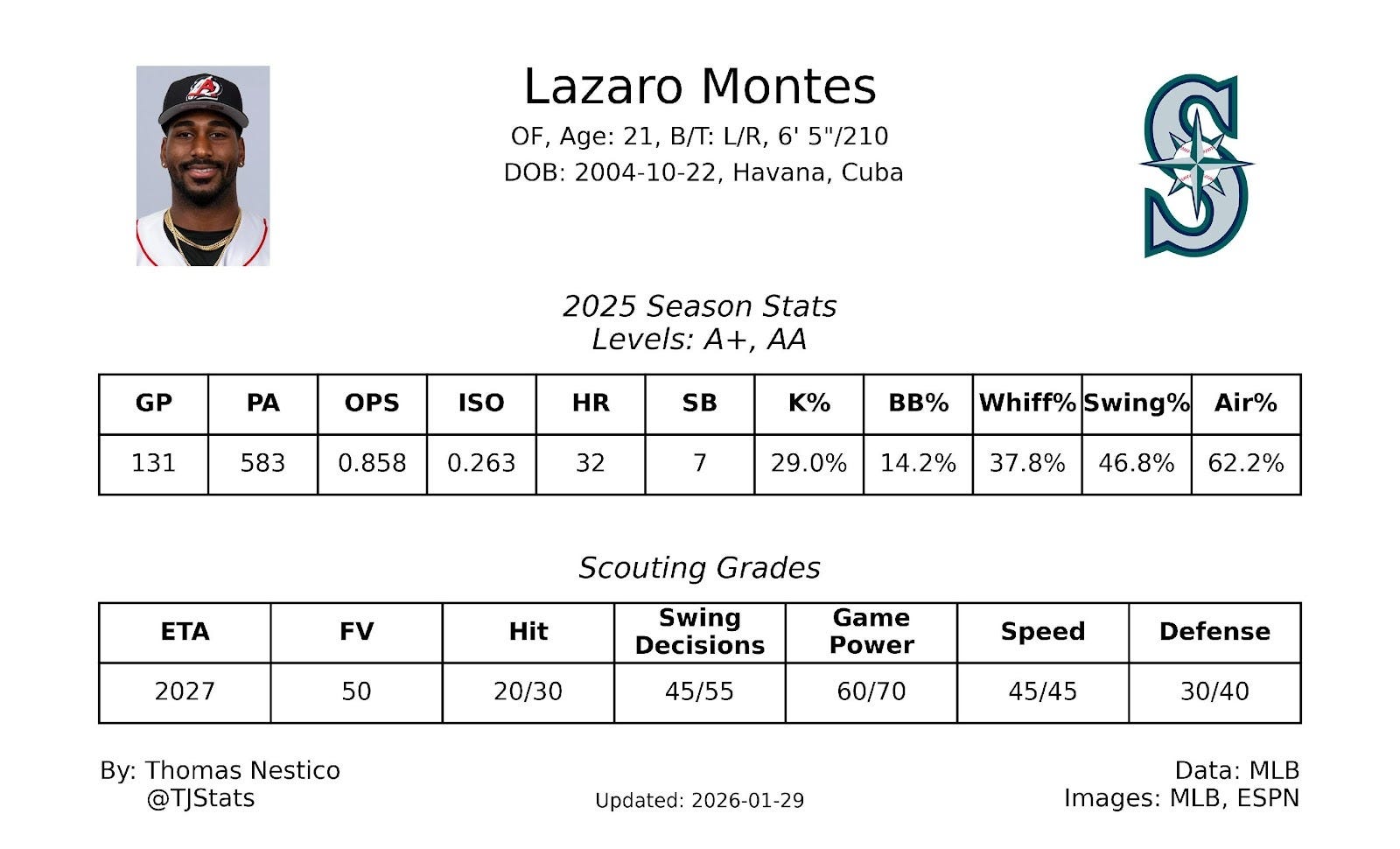
Lazaro Montes is a mountain of a man with one of the loudest bats in baseball. Standing at 6’5”, Montes is an imposing force at the dish who knocked 32 home runs in 2025 thanks to his lightning quick hands and upward swing plane. He took encouraging strides with his plate discipline this season as he cut down on his chase rate with two strikes. This improvement lined him up with more favourable counts and let his immense power do the talking. On the complete opposite end of the spectrum sits his bat-to-ball skills. Montes registered a pathetic 37.8% whiff rate on the year, and it was not much better against pitches in the zone. It is not a stretch to say he has one of the worst hit tools in MiLB. Adding more negativity to his profile is his defensive versatility. While his arm grades out well above average, his poor route running may force him to be a DH sooner rather that later. Power like this is something you dream on, but Montes simply has too many underlying risks to be confident in his outlook.
85) Ethan Holliday - SS - COL
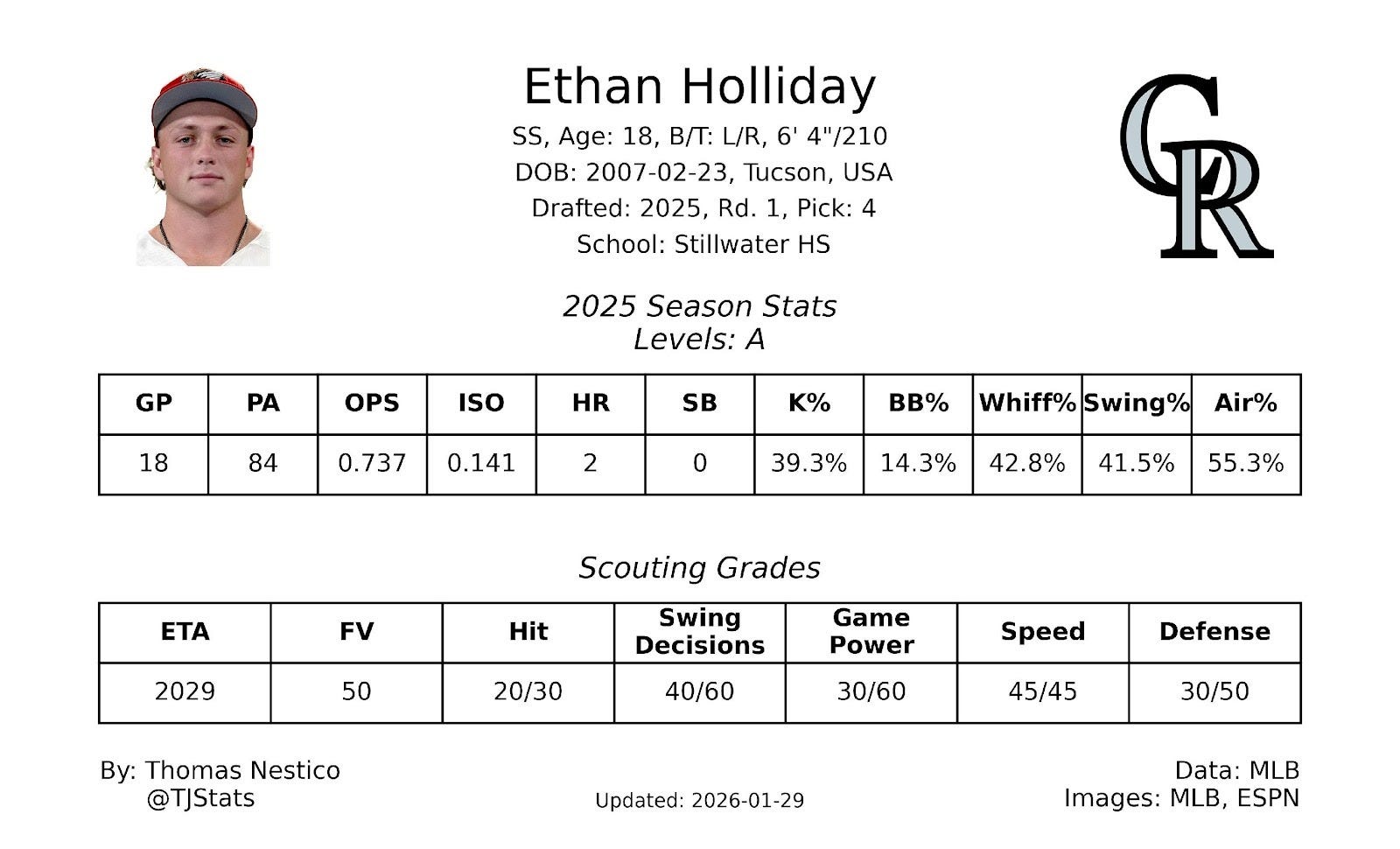
Ethan Holliday landed a comfy $9 Million signing bonus after being selected 4th overall in the 2025 draft this past summer. Despite concerns about his hit tool, the Rockies were enthralled by the power upside and pitch selection skills that they thrusted him into full season ball shortly after his selection. As expected, Holliday quickly made an impact with the bat, posting an impressive 105.8 MPH 90th% EV and 47.4% HardHit rate in his stint. On the other hand, he looked completely over matched after posting an awful 42.8% Whiff rate. These 66 plate appearances were a continuation of his high school career and makes Holliday one of the toughest prospects to rank. He will need to show a substantial improvement with his bat-to-ball skills before he makes waves in the prospect scene.
86) Arjun Nimmala - SS - TOR
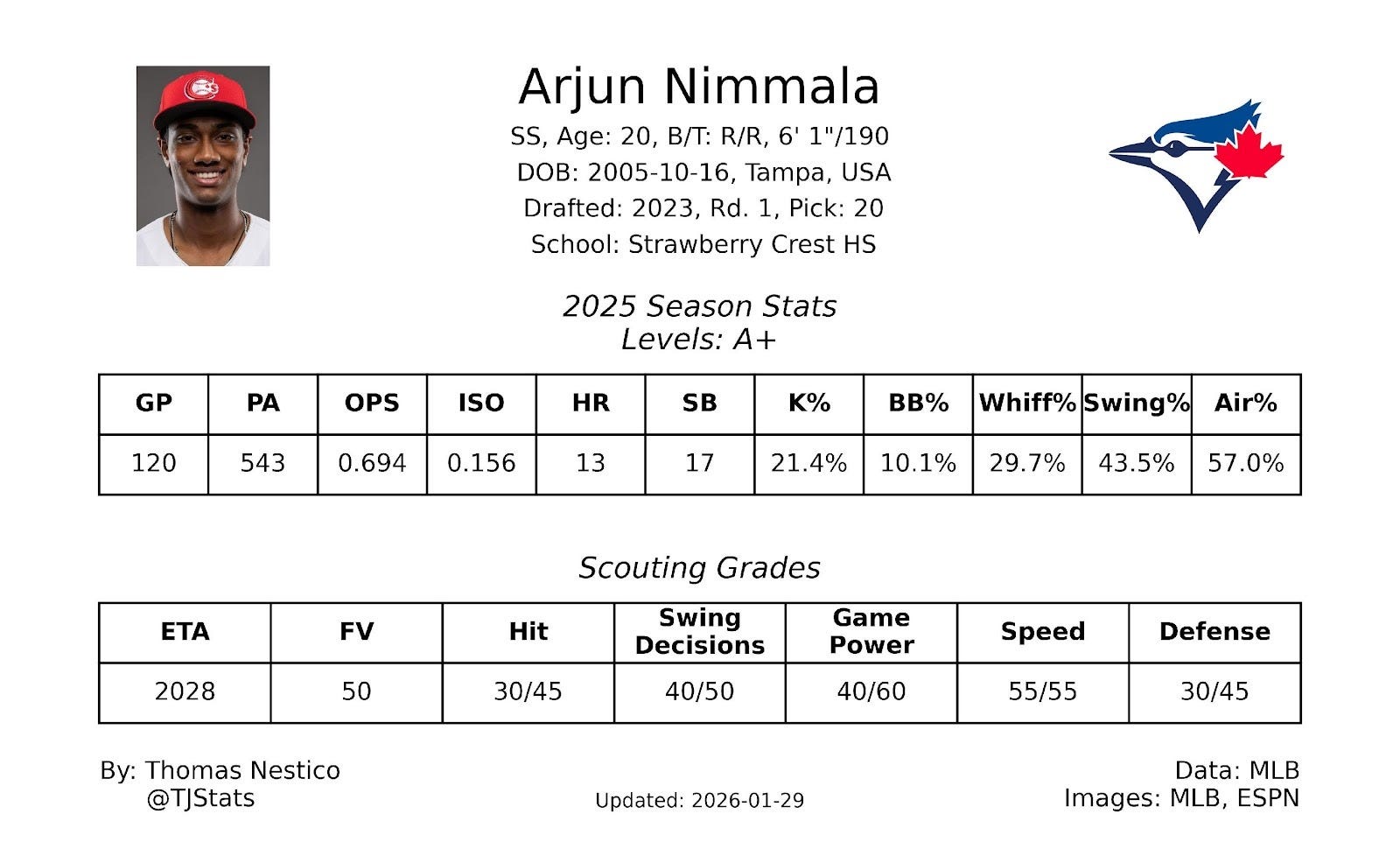
Arjun Nimmala hit the ground running in 2025 where it seemed like he was producing extra base hits every game and showcasing improved bat-to-ball skills to start the year. This, unfortunately, petered out and he was in free-fall for majority of the season. It was not all bad news for Nimmala though. He sustained his above average swing decisions from a year prior and slashed his strikeout rate by nearly 10%. These gains were also accompanied by a gradual progression in power, as much is the case for a teenage batter. Unfortunately, his contact improvements came with a large spike in ground ball rate which neutered his damage output. He also took a step back defensively. The upside is very apparent with Nimmala, but the growing pains are as present as ever.
87) Khal Stephen - P - CLE
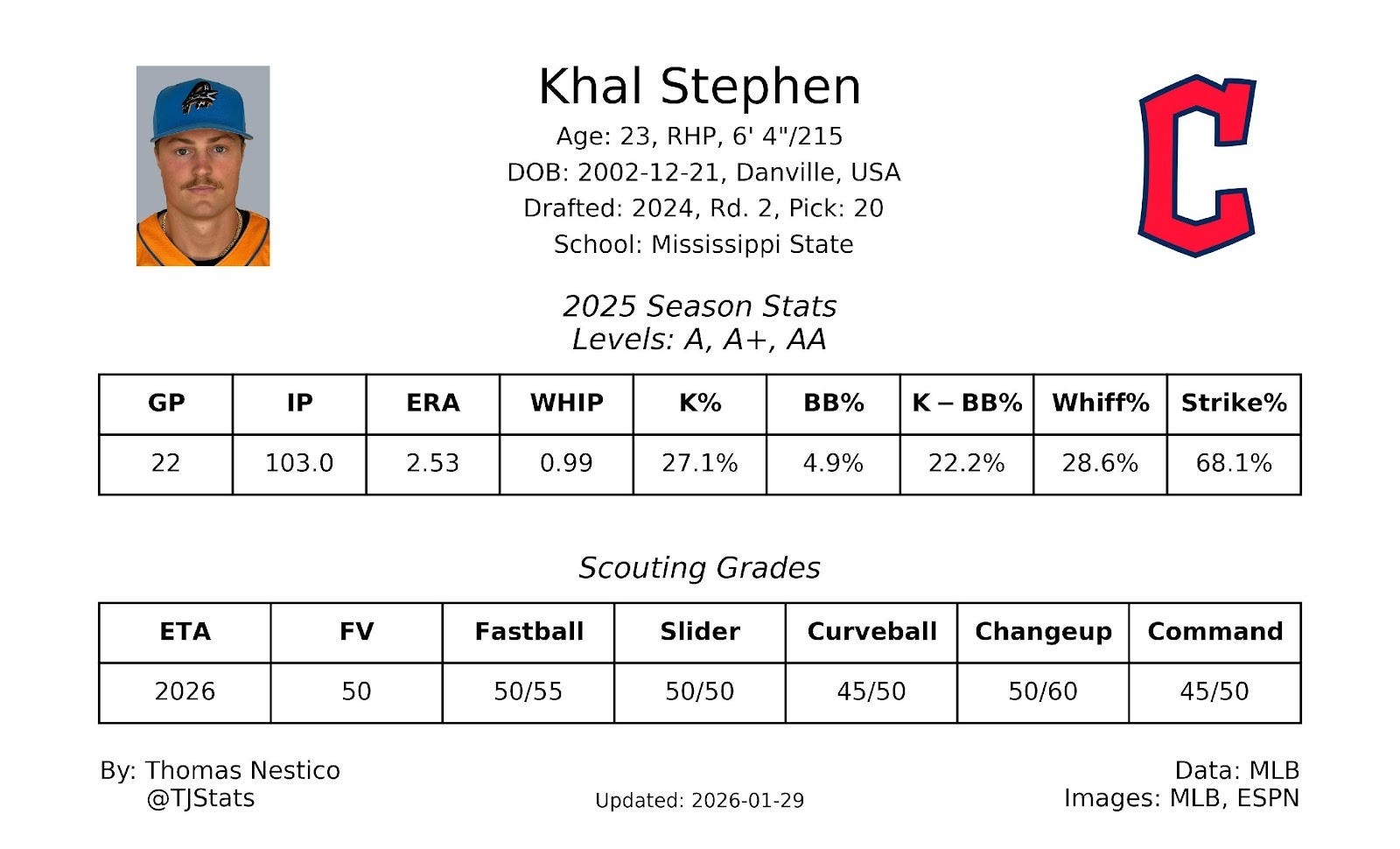
Khal Stephen was selected in the 2nd round by the Blue Jays in the 2024 draft and quickly climbed through their system with fellow draft-mate Trey Yesavage before being moved at the trade deadline. Stephen’s arsenal is highlighted by a mid 90s, high riding fastball and an extreme dropping changeup that simply falls under bats. He also leverages his size and athleticism to reach 7” of extension down the mound. He supplements his plus fastball and changeup combo with a pair of breaking balls in his high 70s two-plane curveball and mid 80s slider. He typically utilizes both these offerings to RHH, with his curveball being used early in the count to draw early strikes and his slider as a put away pitch. His curveball is a below average offering and his slider flashes plus. Stephan has always exhibited good command and feel for his arsenal, returning above average walk rates throughout his College career. His upside is a mid-rotation starter with the fallback option being an effective #5.
88) Charlee Soto - P - MIN
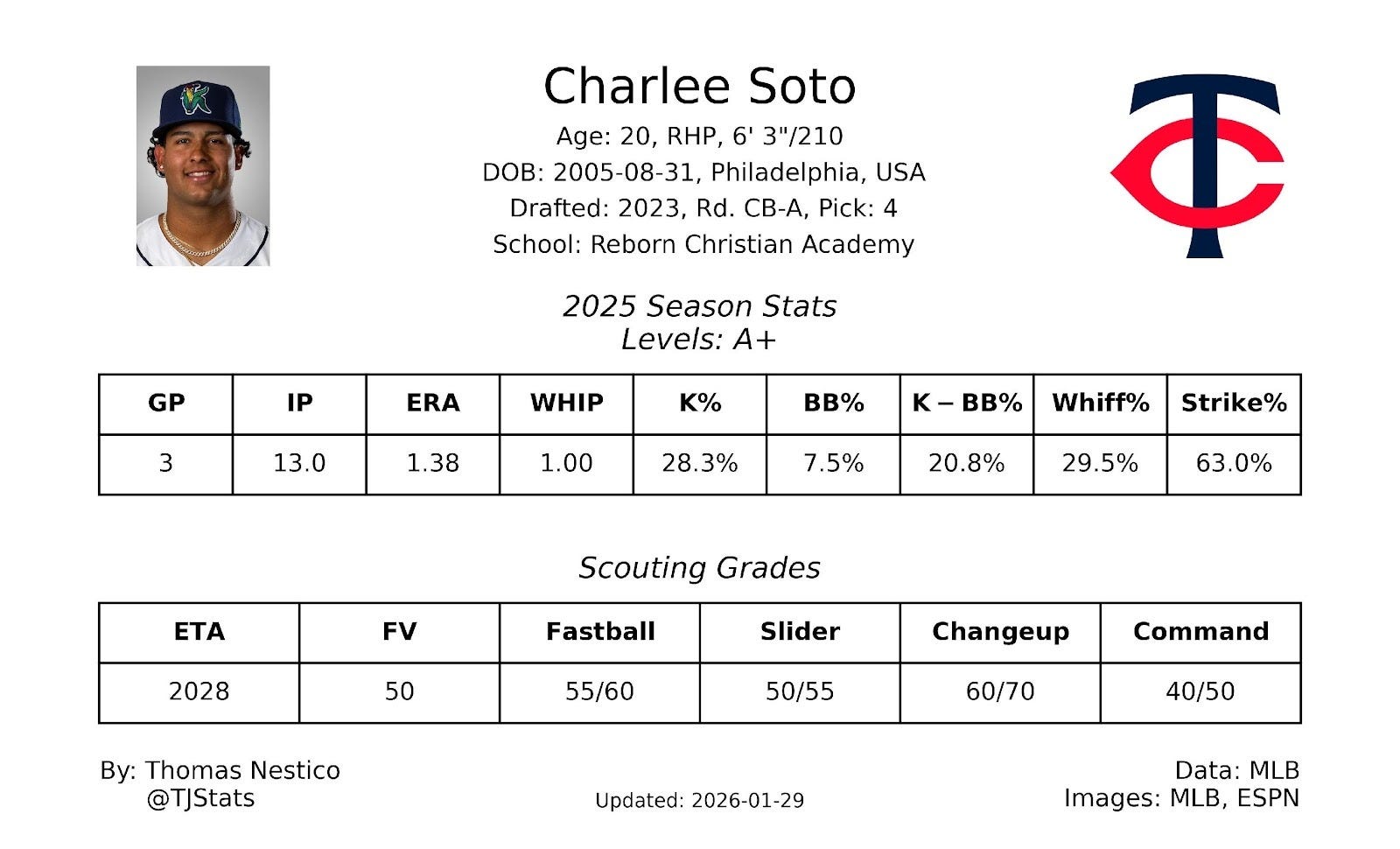
Charlee Soto is a young power arm with a projectable frame and 4-pitch mix headlined by a high-90s fastball and a bat-missing changeup. He is currently nursing a triceps injury, but his results prior were encouraging. His fastball averages 97-98 mph and exhibits average ride from his 3/4. He has shown advanced feel for the offering and looks much more refined this season. His best secondary is a high 80s changeup with about a foot of separation from the four-seam, where its late fading action gives batters fits. Soto also throws a sinker which sits in the same velocity band as his fastball and uses it primarily against RHH. His mid 80s mph slider features tight two-plane movement, which allows him to utilize it as a platoon neutral offering. The growth in the command department has been a pleasant sight to witness, especially given how young he is for the level. The high-end velocity paired with his solid strike throwing makes him a very intriguing arm, although he will need to build back up following surgery to remove a partially detached bone spur in his elbow.
89) Brandon Sproat - P - MIL
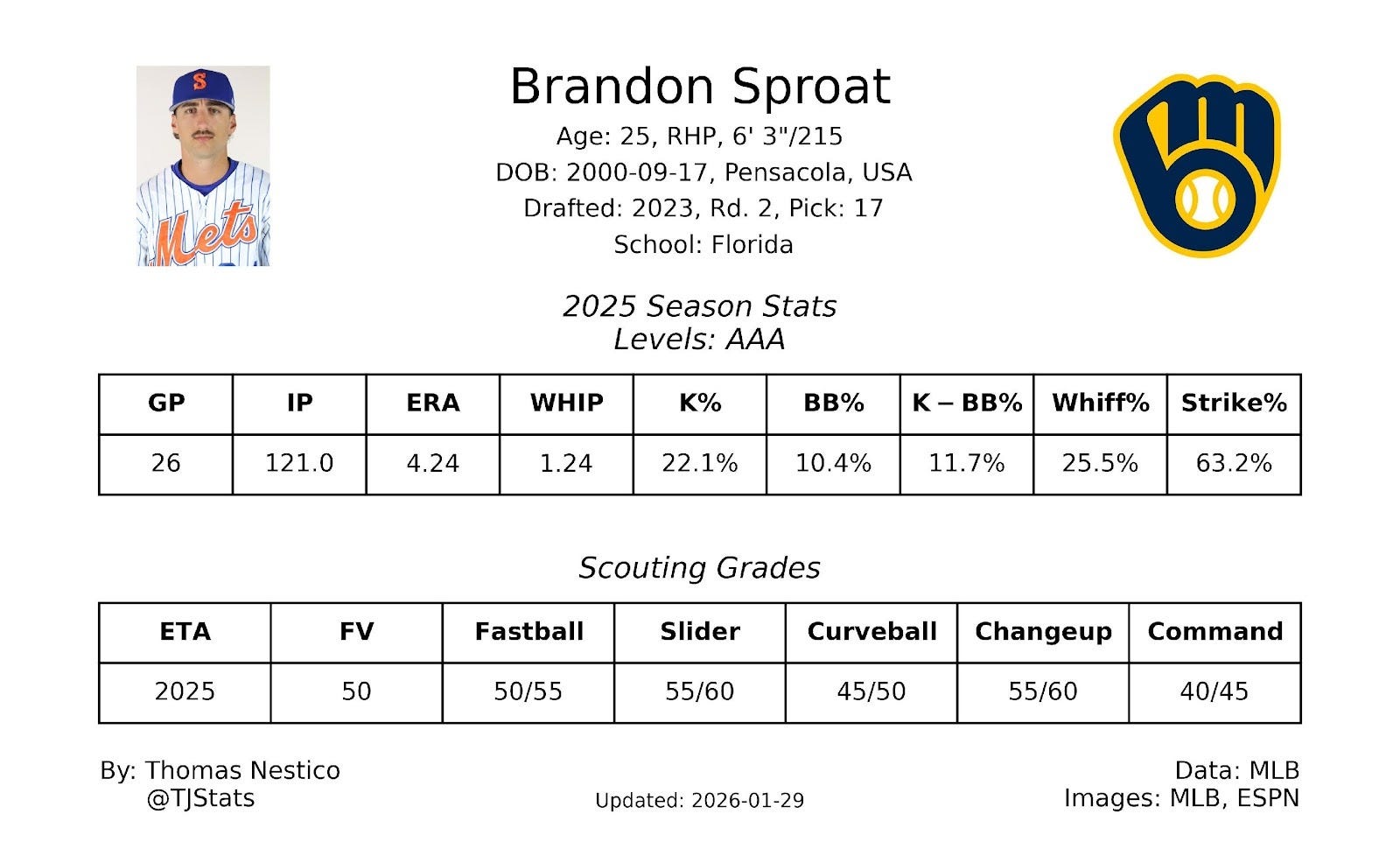
After an electric 2024 which saw his storm through Hi-A and AA on the heels of fastball that hit triple digits, Sproat took a step back in 2025. After a trip to the development list cut last season short, it felt like a full winter to recover and build up would allow his elite velocity to return. This was rather the opposite, as Sproat failed to consistently hit the same velocity heights. He cannot overcome his fastball’s poor shape in this lower velocity band, which leaves it as an average offering. Due to this inefficiency, Sproat will likely be more effective as a sinkerballer, but that would lead to a heavily depressed strikeout rate. From his low 3/4 slot, his sinker generates over 17” of arm-side run and helps jam RHH on the inner third. He doesn’t generate many whiffs on the offering, but it has effectively limited damage this season. His changeup always flashed plus potential thanks to his low 90s velocity and depth, but he is not seeing the same shape this season. The pitch closely resembles his sinker and has been hit much harder. It was not all bad news for Sproat though as he righted the ship in the 2nd half and returned positive results thanks to his ability to induce weak contact. Sproat’s trio of breaking balls prop his arsenal back up as it gave him plenty of options to mix and match his offerings. While he no longer looks like a frontline option, Sproat’s blend of power and versatility paint him as a potential mid-rotation starter who should excel by limiting damage.
90) Jack Wenninger - P - NYM
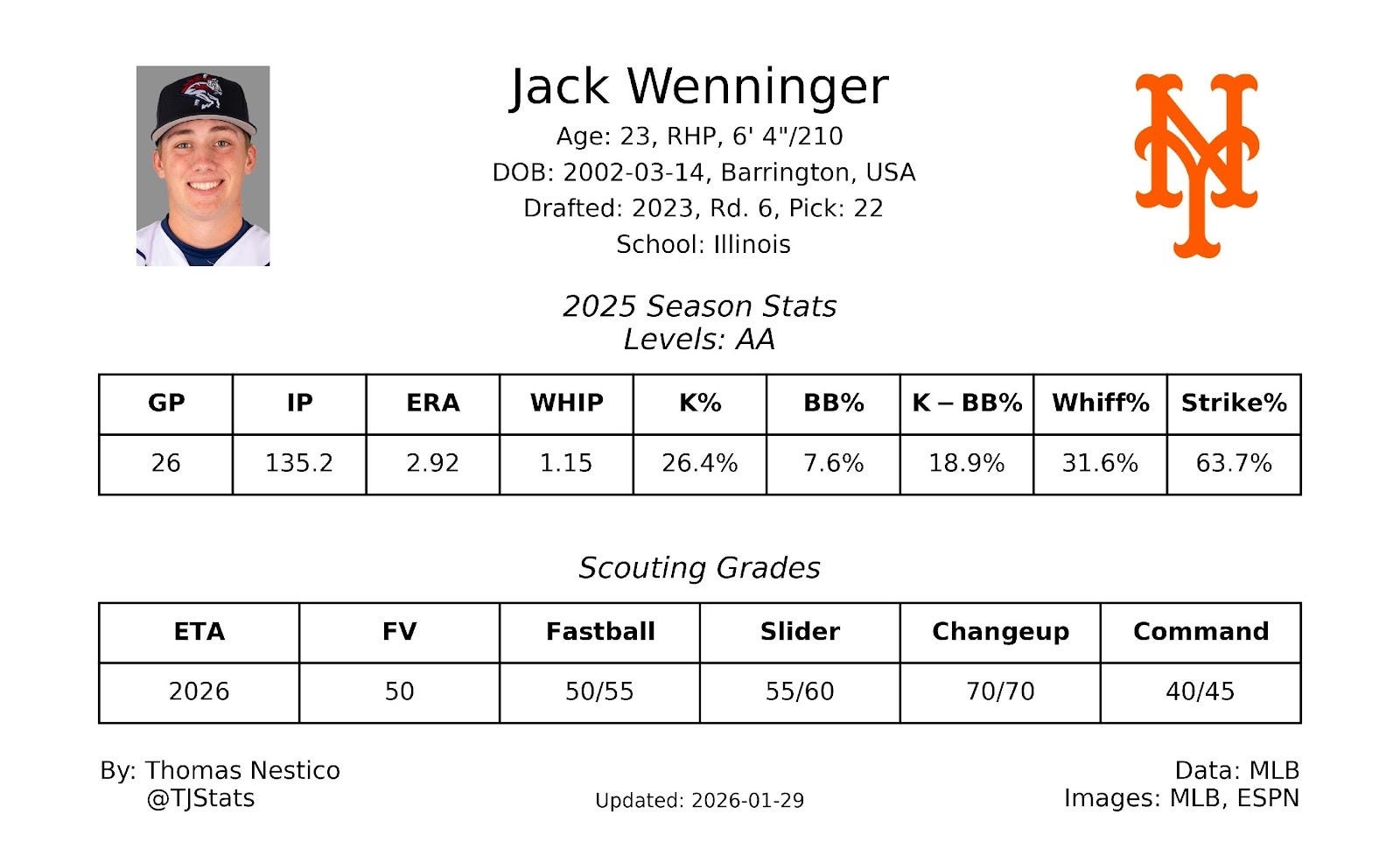
Wenninger has a prototypical starters frame at 6’4”, 210 lbs, and took a meaningful step forward in 2025 with a substantial jump in fastball velocity, sitting 9496 mph after adding roughly 1.5 mph from a year prior. That velocity bump has pushed the fastball to an average offering that flashes above-average traits. If the early reports from camp regarding another bump in velocity, his fastball could be one of the best in the Mets system. While he doesnt always show pristine feel for the pitch, its strong swing-and-miss ability allows him to battle back into counts. Wenninger also added a sinker last season that operates in the same velocity band and deviates slightly from his three-quarter slot. The crown jewel of his arsenal is a devastating changeup at 8385 mph, featuring roughly 15 inches of vertical separation off the fastball. Though its low-spin profile can lead to occasional wasted pitches, he generally repeats the shape well and locates it effectively at the bottom of the zone. He rounds out the mix with an 8385 mph slider featuring tight gyro movement and modest depth. He is doing a better job at attacking the zone and getting ahead in counts, which is reflected in his improved walk rate. Wenninger’s deeper arsenal and refined command has his prospect stock rising rapidly as he looks like another win for the Mets renowned pitching lab.
91) Logan Henderson - P - MIL
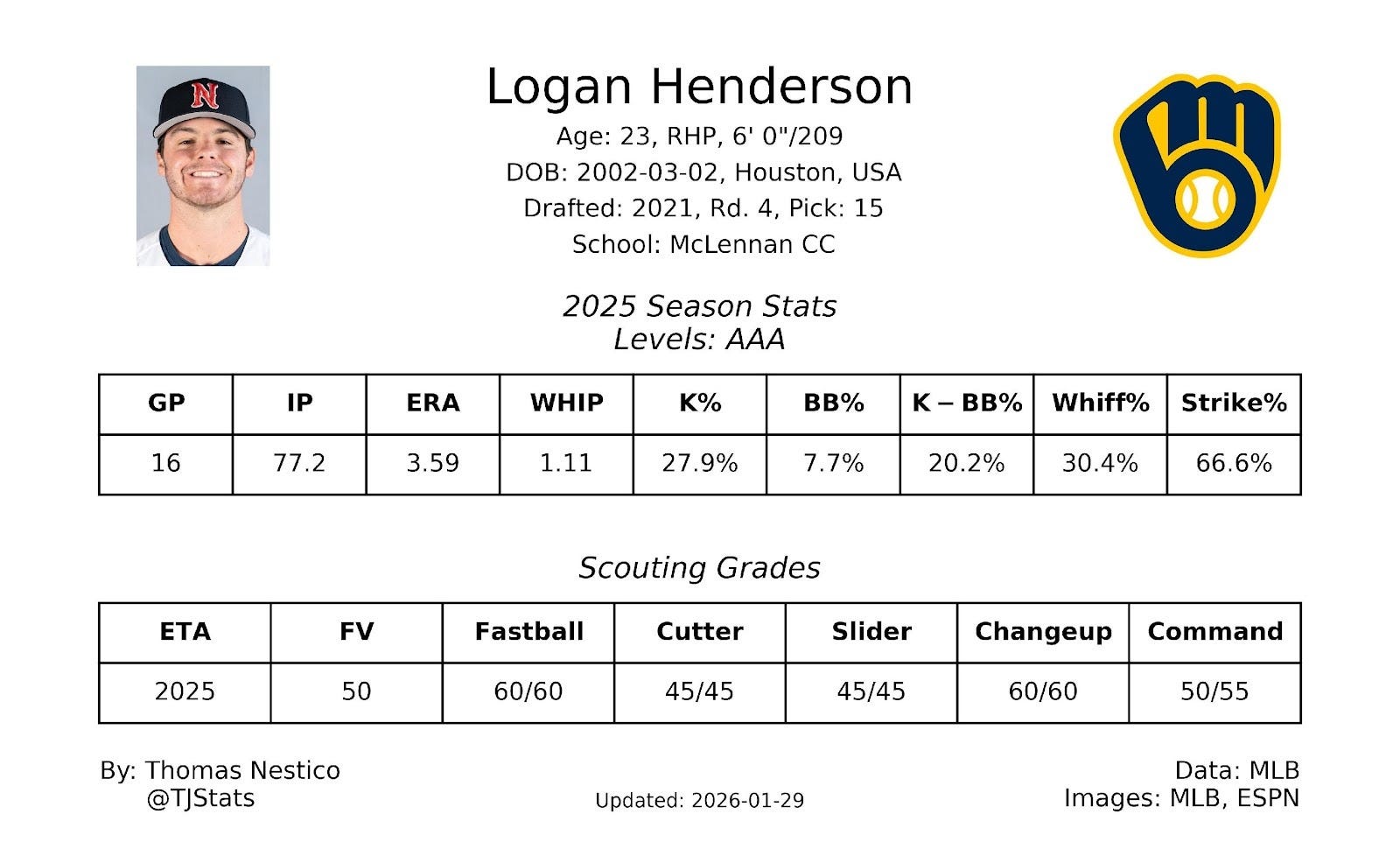
A series of injuries has limited Henderson’s development since being drafted in 2021, but he has been excellent while healthy. He is a small, framed righty with a very fluid and repeatable delivery, which led to an elite 25.3 K-BB% in his limited MLB stint this season. He is primarily a 2-pitch pitcher, with his main weapons being a low 90s fastball and low 80s changeup. He also weaves in a cutter early in the count to try to steal strikes. Henderson’s fastball is very deceptive thanks to the incredibly shallow approach angle he gets on the offering. His low 3/4 slot pairs well with the immense ride he generates on the pitch. He enhances its effectiveness by filling the top of the zone, which led to a ridiculous 40.0 O-Swing% and 30.3 Whiff% his 6 AAA starts. His changeup is his highest spin offering, averaging 2350 RPM with a great deal of run. The ~18” of arm side movement with nearly 1’ of iVB separation from his fastball creates an illusory movement differential. He is not afraid to attack batters in all counts and tosses it +40% against both LHH and RHH. Henderson most recent addition is a gyro slider which sits in the mid 80s. It likely won’t be a plus offering, but it gives him some well-needed depth to his arsenal. Henderson is as extreme fly ball pitcher which makes him extremely susceptible to home runs. His fastball-changeup duo should be an effective pair in MLB, but a more refined secondary in his cutter and slider would greatly increase Henderson’s odds as a starter. If all else fails (or the injuries continue to pile up) he should be a very effective long reliever for the Brewers.
92) Braylon Doughty - P - CLE
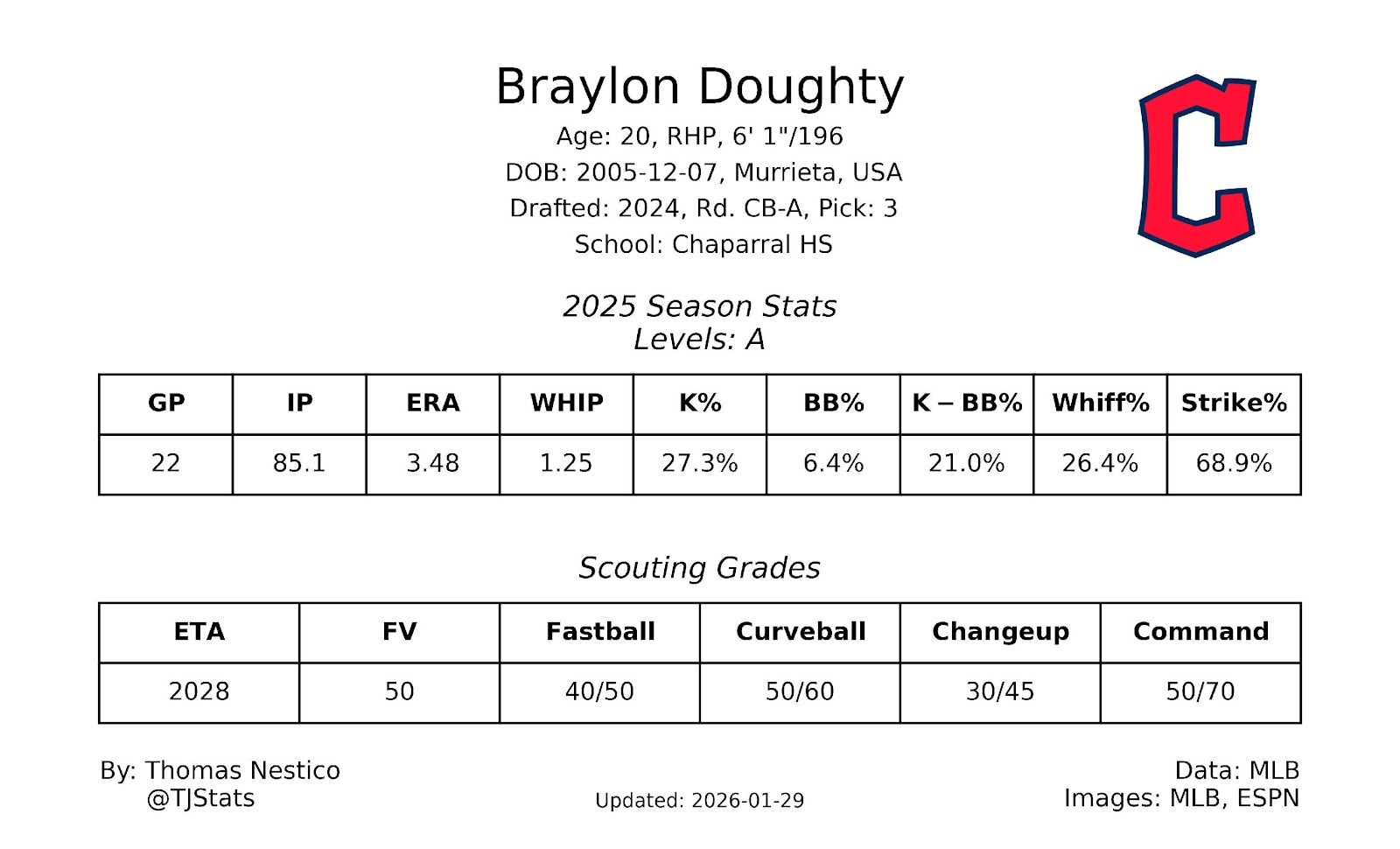
Braylon Doughty made an immediate impression in his pro debut last season after being selected 36th overall in the 2024 MLB Draft. True to his draft profile, Doughty showcased advanced command, consistently throwing strikes and keeping lower-level hitters off balance. His primary offering is a 9294 mph fastball with modest shape, which he works around the zone to generate above-average whiff and chase rates. He has a good feel for spin -- a key aspect of his profile that helps him generate steep two-plane action on his mid-80s curveball and provide him more pathways to introduce more breaking balls into his arsenal. Doughty also effectively locates his changeup at the bottom of the zone, generating swings and misses while complementing his fastball and curve. Projecting more as a command-artist than a pure stuff-driven arm, Doughty profiles as a high-floor, low-variance teenager with a mid-rotation starter ceiling.
93) Eduardo Tait - C - MIN
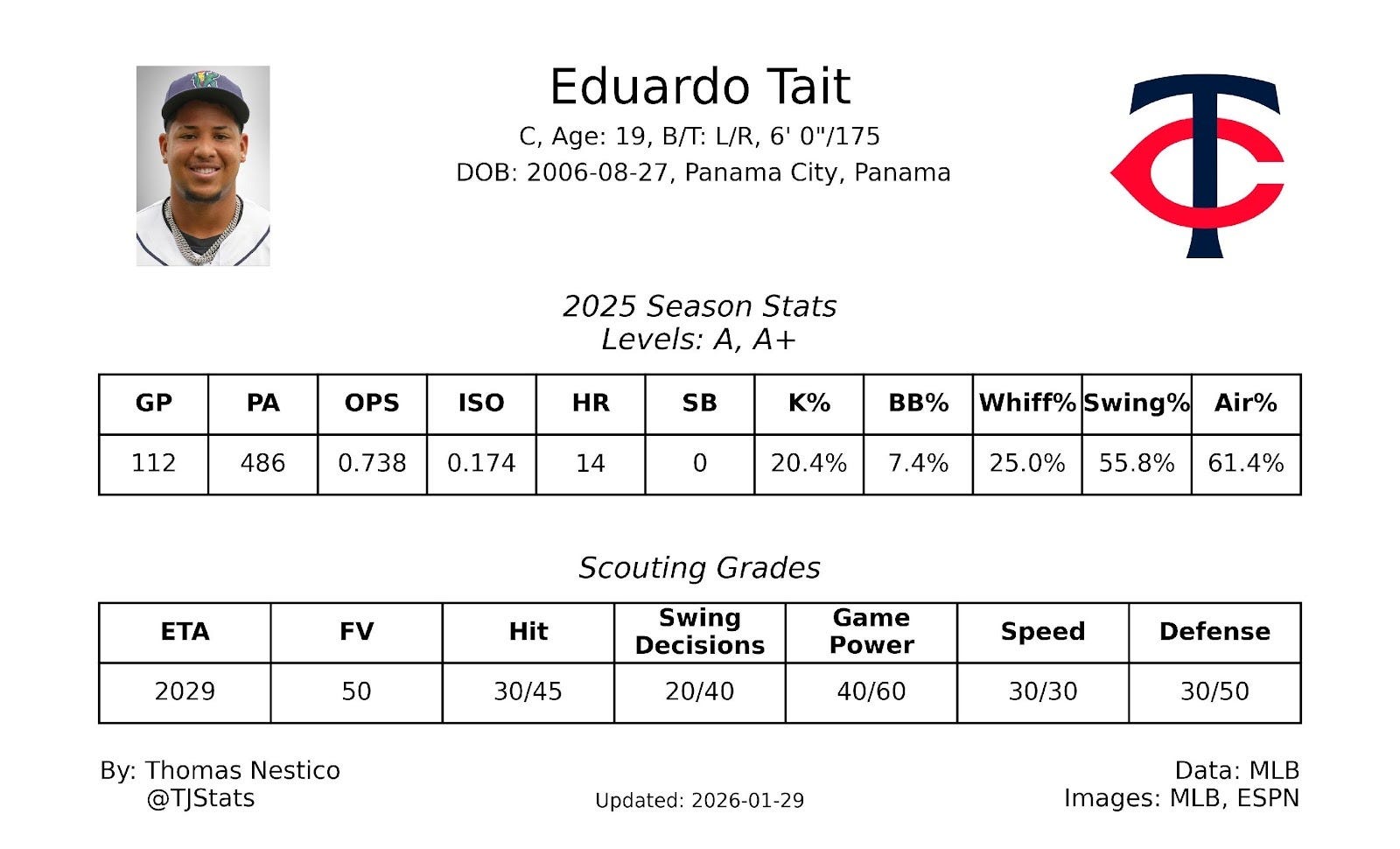
Eduardo Tait didn’t light up the score sheet in his first taste of full-season ball, posting a 103 wRC+ across 112 games, but he did impress scouts with his athleticism and appealing power. Most notably, the Twins decided that Tait would headline the package that sent Jhoan Duran to the Phillies at the deadline. His power metrics were eye-opening from an 18-year-old and were fully supported by remarkable bat speed and an impressive 105.1 MPH 90th% EV. He also has a swing geared to keeping the ball off the ground, however he is extremely susceptible to pop ups. The most glaring flaw in Tait’s profile are his putrid swing decisions. He doesn’t let many mistakes go by him, but he chases far too often (38% O-Swing Rate). This caused his walk rate to dip below 5% following his promotion to Hi-A with his strikeout rate seeing a substantial spike. Behind the dish he is an effective blocker and has exhibited plus pop times, with framing being his least polished aspect. Tait’s concerning plate discipline puts a damper on an otherwise intriguing blend of power and athleticism from the catcher position.
94) Ethan Salas - C - SD
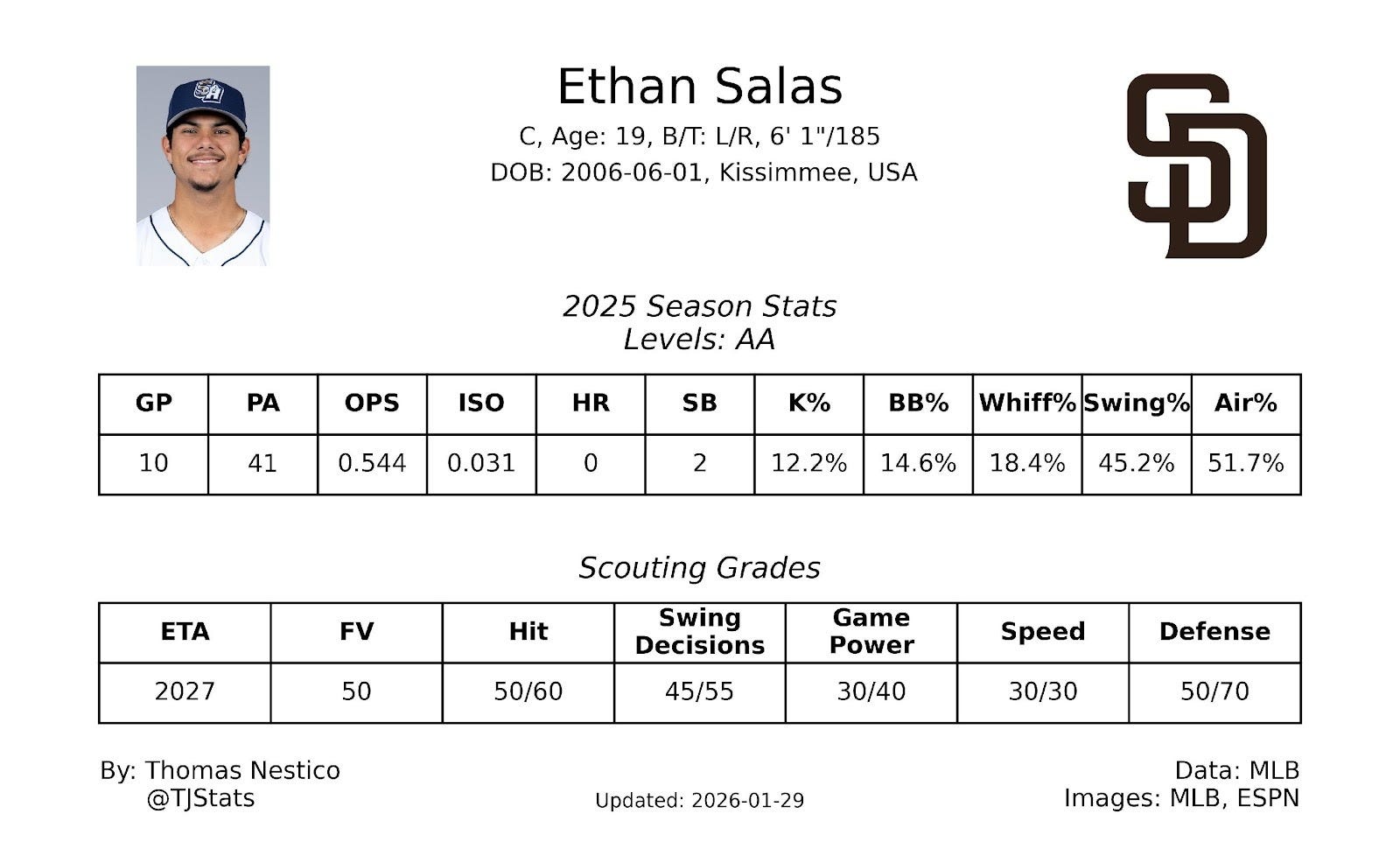
There may not be a current prospect who has experienced more prospect fatigue than Ethan Salas. After an exceptional professional debut that saw him reach Double-A at just 18 years old, the Venezuelan catcher drew widespread attention for a refined hit tool, projectable power, and elite defensive potential. Since then, his stock has cooled as the bat failed to take a significant step forward, while a back injury effectively wiped out his 2025 season. All indications suggest Salas will be ready for the start of the 2026 campaign, where hell look to reestablish momentum. His bat-to-ball skills remain the foundation of his offensive profile, having shown meaningful gains in contact rate at each stop in the minors, though translating average bat speed into consistent game power remains the primary offensive hurdle. Defensively, Salas continues to separate himself, standing out as an athletic mover behind the plate with elite pop times and above-average framing, giving him a chance to provide plus-plus value with the glove.While Salas might not have the same allure as before, Salas still possesses the tools to develop into a quality big league catcher.
95) Gage Stanifer - P - TOR
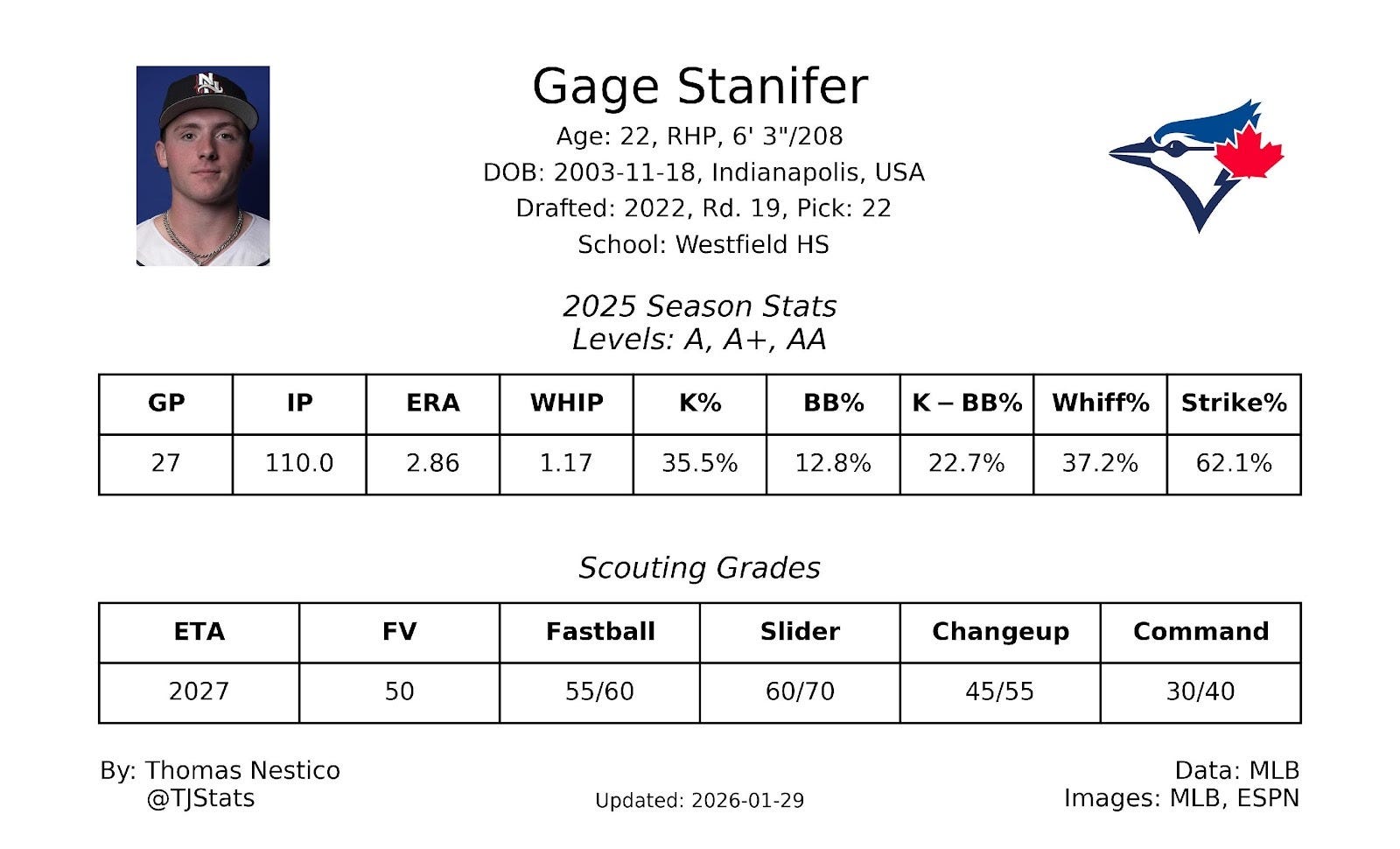
Gage Stanifer, a 19th round pick by Toronto in the 2022 draft, looks like he has found his footing in 2025. Stanifer’s results are backed up by a substantial increase in velocity and overpowering 3-pitch mix. He stands at a sturdy 6’3” and 201 lb and utilizes a short arm stroke to add a layer of deception into his delivery. He doesn’t get far down the mound with just 6 ft of extension, but he is able to release the ball from a 3/4 slot at a lower than average release point at 5.7 ft. This delivery works well with his ability to generate ride on his fastball that is up +3 MPH compared to last season. Now sitting at 94-95 MPH with over 17” of iVB, Stanifer throws his fastball over 60% of the against both LHH and RHH. It’s shallow vertical approach angle works incredibly well as a whiff generator because he consistently locates it high in the zone. His slider is one of the nastiest pitches at the level thanks to its “deathball” shape in the mid 80s. His short arm action makes it difficult for RHH to pick up out of hand and its steep drop generates some ugly swings. Stanifer’s final offering is an 86-87 MPH changeup which he exclusively uses against LHH and mainly as a put away offering. It’s large vertical deviation from his fastball gives it an ideal shape to stun batters. While it hasn’t generated many chases or whiffs, it has been his most effective weapon at inducing weak contact. It’s a dependable arsenal filled with 3 potential plus offerings, making Stanifer a safe bet to fall back into a long relief role for Toronto if his command falters. He has showcased improved strike throwing ability last season in tandem with a large velocity bump, although he hasn’t worked deep into game often. His strides in 2025 make him one of the most intriguing arms in the Blue Jays pipeline and a surefire riser in their system.
96) Cam Caminiti - P - ATL
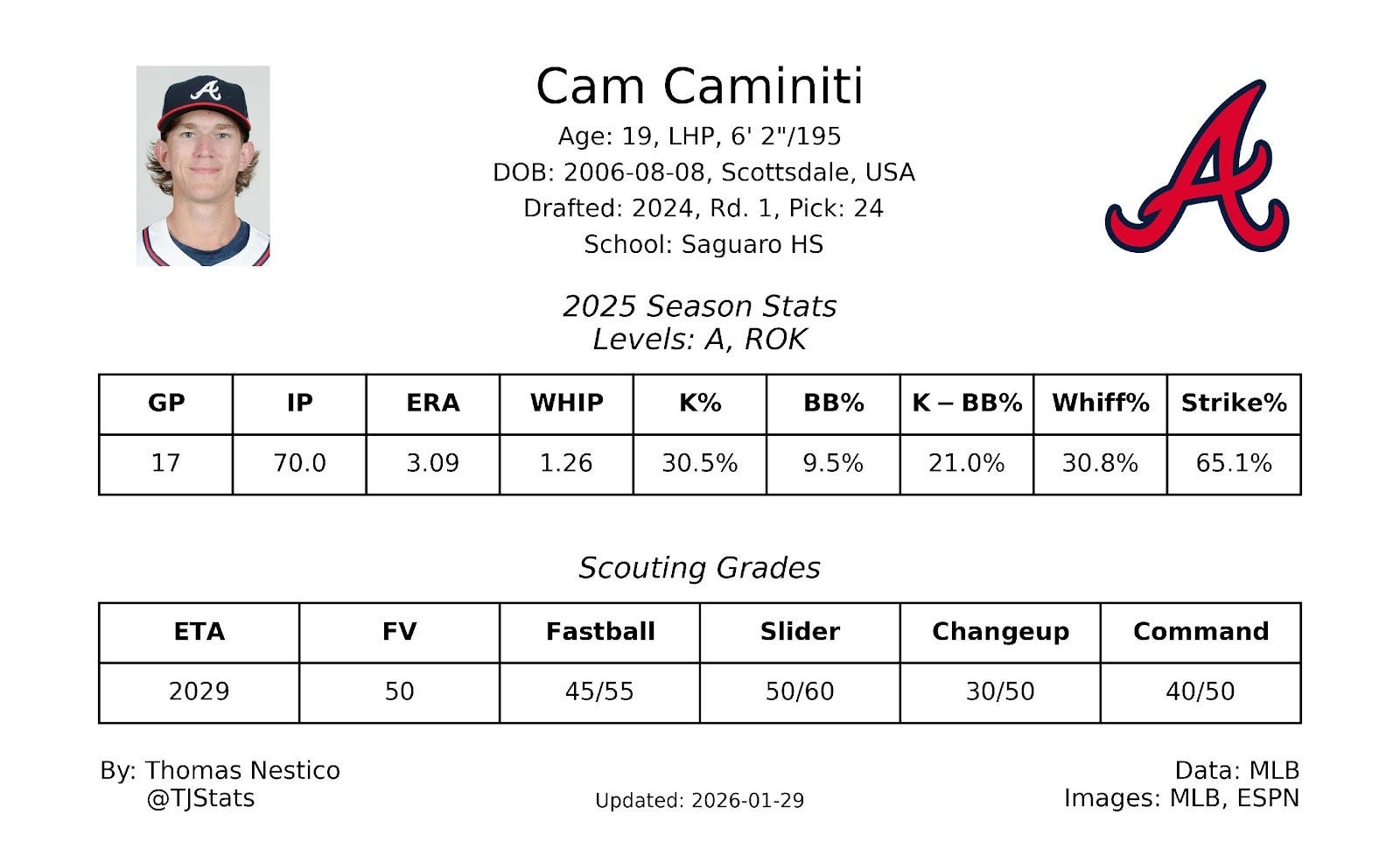
Cam Caminiti wrapped up his first pro season on a high note with a 3.09 ERA and 3.30 FIP in 70.0 innings across the complex and Lo-A. The young lefty utilizes a whippy side-arm release that create jarring angles for opposing batters. This is most prevalent with his fastball as its steep HAA allows its otherwise average shape play up. He has a good feel for the offering and is not afraid to attack the zone with the pitch. His slider also benefits from his distinct arm action as it allows him to generate plenty of sweep. He rounds out his arsenal with a developing changeup that flashed strong swing and miss numbers in 2025 but lacked the consistency to be an effective weapon. There is concern surrounding the inconsistencies in Caminiti’s delivery and how it will impact his future command. Nonetheless, Caminiti has the arsenal to be a mid-rotation starter and plenty of time to iron out any kinks.
97) Didier Fuentes - P - ATL
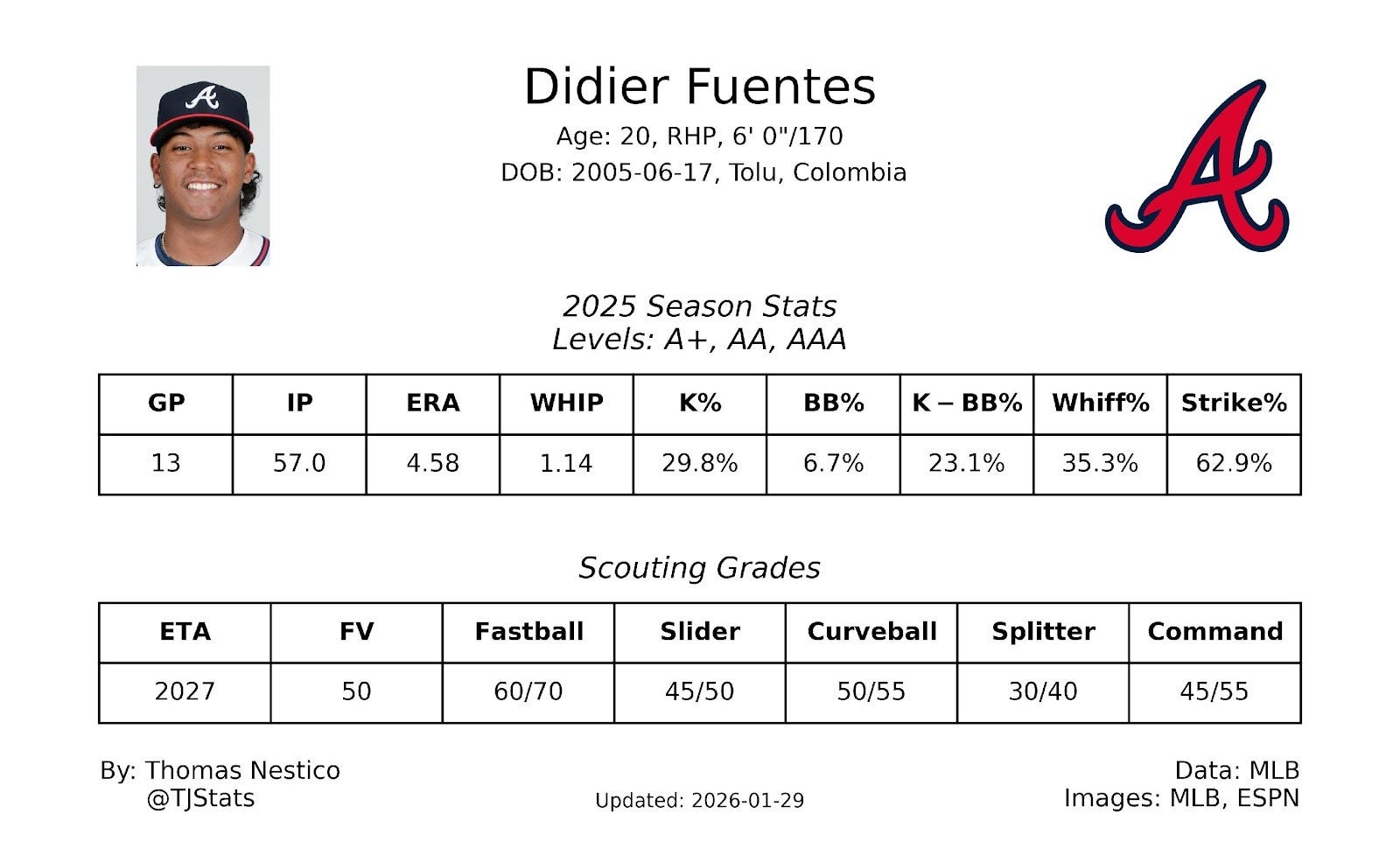
Didier Fuentes is a young undersized righty who has shredded upper minors hitters with his elite fastball. Sitting in the mid 90s, Fuentes generates well above average ride on the offering from his low 3/4 slot. His ability to pepper the top of the zone with the pitch is what makes it so effective. An extremely flat -3.7Á VAA paired with plus extension causes the pitch to jump at batters and leave them dumbfounded as they swing right through the zone. Fuentes’ fastball alone makes him an intriguing prospect, and fortunately it is not his only trick. His sweeper returned an excellent 40% Whiff rate in AAA thanks to its moderate glove-side action veering the pitch away from RHH. He also tosses a slower curveball with more distinct two-plane action to help tackle LHH. He rounds out his arsenal with an unrefined, yet intriguing, splitter. Fuentes results as a 20-year-old in the upper minors are impressive and the fluidity of his delivery indicates that he should continue to flash plus command. He will need another step with his secondaries before becoming a mainstay in the Braves rotation.
98) A.J. Ewing - SS - NYM
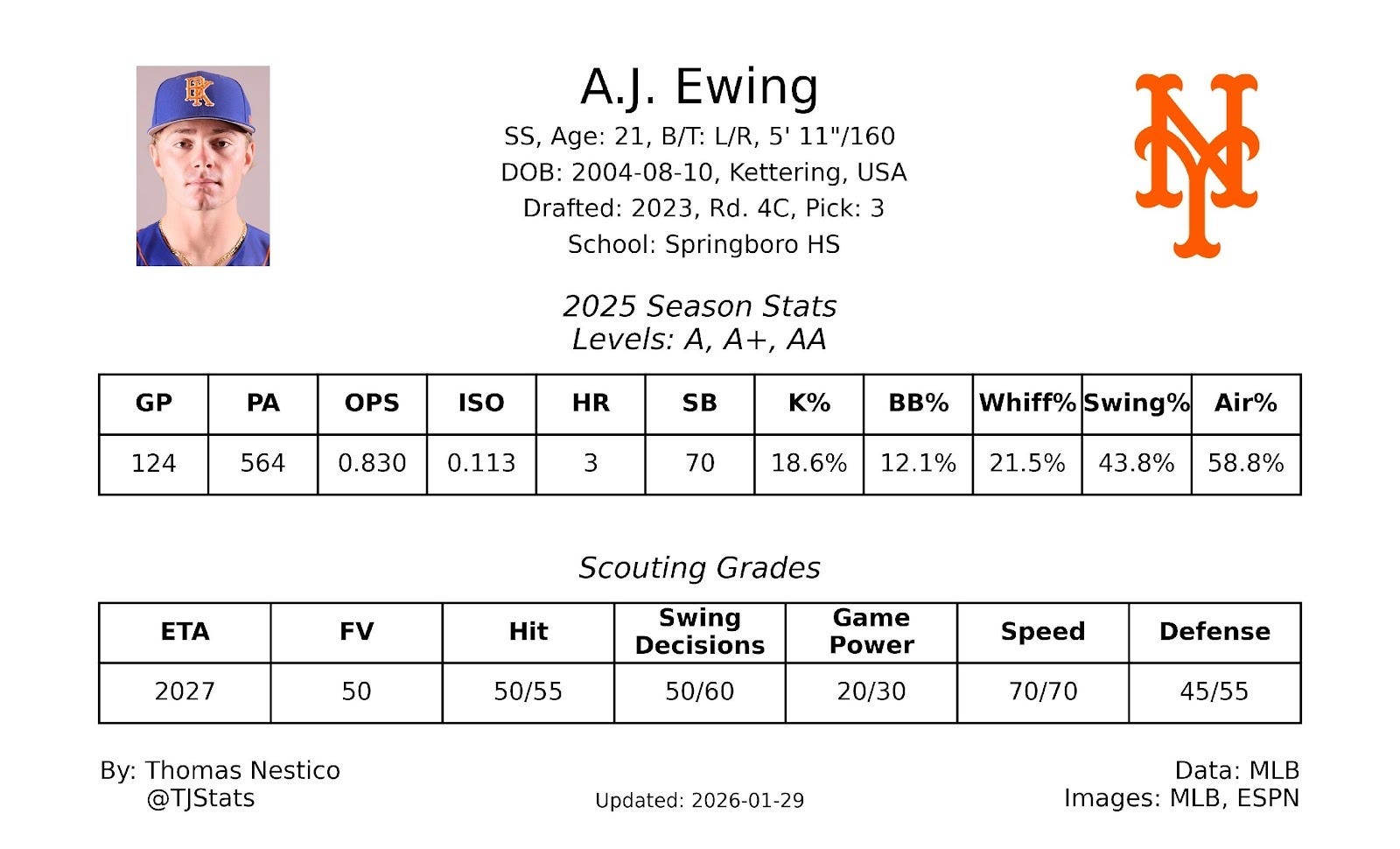
A.J. Ewing followed up an encouraging debut with a standout season, posting a 147 wRC+ across three levels while swiping 70 bases. The speedy center fielder showed plus swing decisions and above-average bat-to-ball skills, consistently putting himself in position to impact the game with his legs. He also made tangible strides in the raw power department, highlighted by a 103.0 mph 90th% EV and average bat speed, though a lack of loft prevented those gains from translating into game power. Ewing hit just three home runs on the year, doing most of his damage on line drives. Defensively, his speed plays up, and he projects as an above-average defender in center field. While limited power caps his offensive ceiling, Ewings speed, contact ability, and defensive value give him a high likelihood of carving out an impactful MLB career.
99) River Ryan - P - LAD
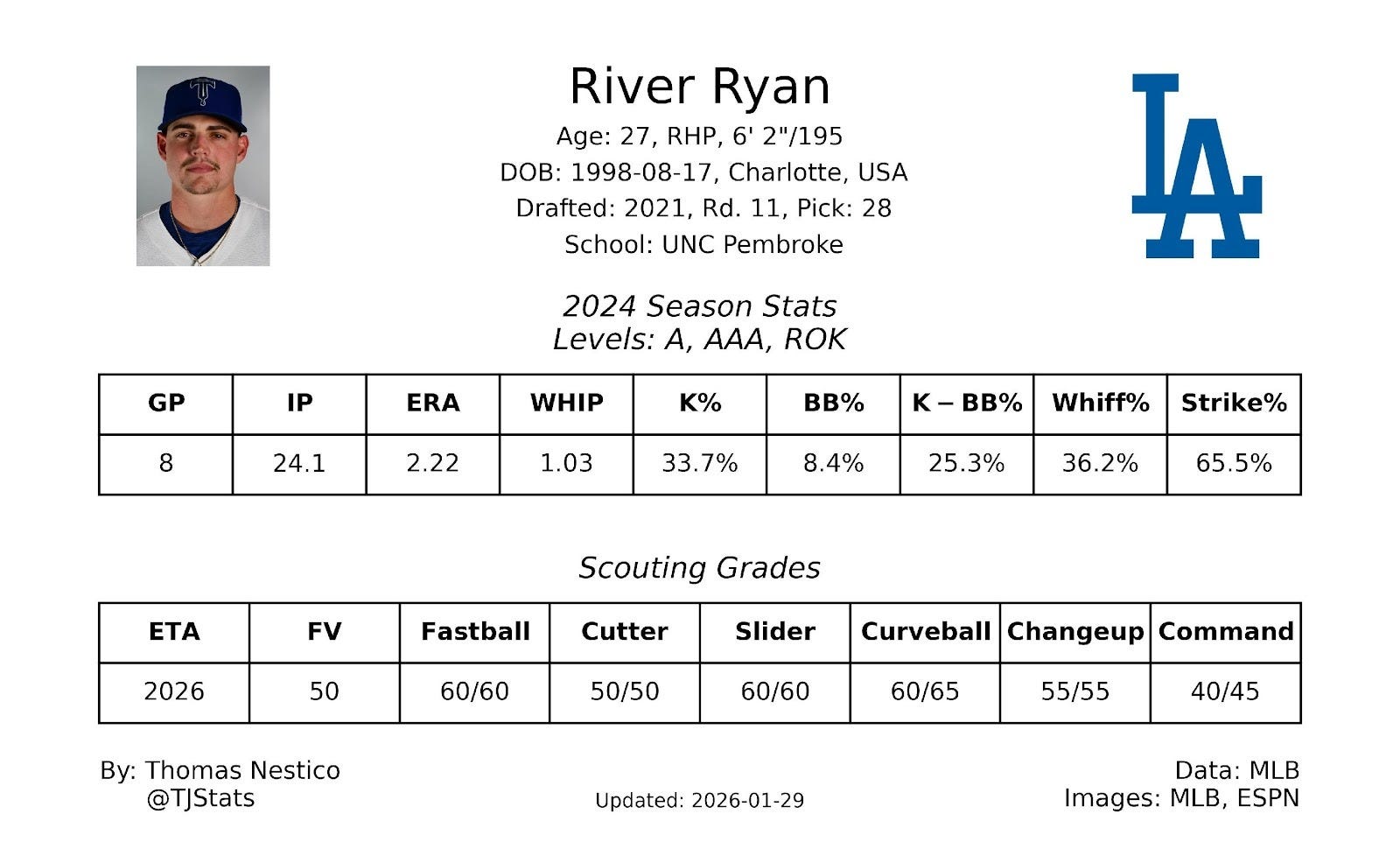
River Ryan has the tools to be a front-line starter, and it looks like he was on track to be an impact arm for the Dodgers this season. Unfortunately, he underwent Tommy John surgery in August 2024 and won’t pitch until 2026. It will be tough to project Ryan’s future as a starter as he will be almost 28 years old once he is ready to return, not to mention the likelihood that his command will suffer. His fastball sits 95-97 MPH with 15” iVB from a 5.5’ release. The shape is about average, but the velocity bumps it up into the plus territory. He wields a trio of breaking balls, which all grade out above average and have flashed plus potential. His slider averages 90 MPH with half a foot of sweep, his curveball sits 82-84 MPH with steep two-plane movement, and his cutter, which sits 93-95 MPH, creates a bridge to his fastball. He also tosses a sinker and changeup, which exhibit similar arm-side run. His changeup flashes plus upside, but his command of the offering has room for improvement. Ryan is one of my favourite pitching prospects thanks to his 6-pitch mix and high-end velocity. Without the injury concerns, he would rank in the upper tiers, but the risk of him being a reliever is too apparent at this moment.
100) Travis Sykora - P - WSH
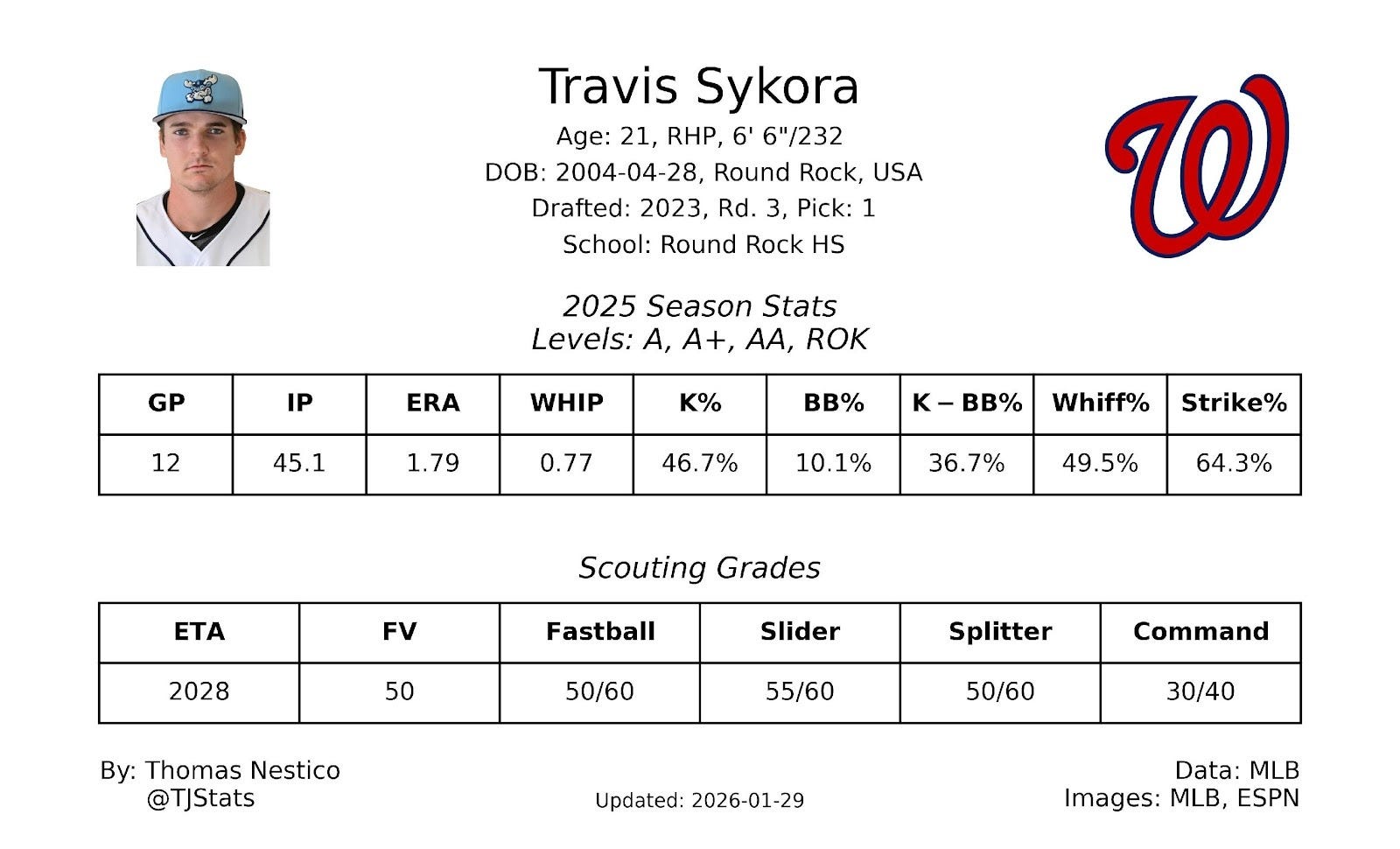
Sykora was a strikeout fiend in 2025 as he posted a nutty 46.7% strikeout rate across 45.1 IP before an elbow injury forced him to undergo Tommy John Surgary. He is unlikely to return to a starter role until 2027. Sykora stands at 6’6” and utilizes a lower 3/4 slot and large extension to get a 6’ release. His fastball fits 95-97 MPH with 15” iVB, which makes it grade out as an average pitch in stuff models. His slider was his prime swinging strike offering. It sits at 81-83 MPH and has tight movement, hovering near the bullet-slider characterization. He kills spin with his splitter, but it doesn’t consistently get the same diving action as most splitters. His best ones have a good amount of late downward movement, but most of the time it gets minimal deviation from his fastball. A better feel for the splitter could make it a plus offering. Sykora has been exceptional, but his putrid zone rates have been masked by overpowering stuff. I need to see a substantial improvement in his strike throwing before jumping on board, and his injury throws a wrench into that timeline. His stuff is intriguing me, which makes me confident he can excel, but the command caps that to a #3/4 starter projection.